
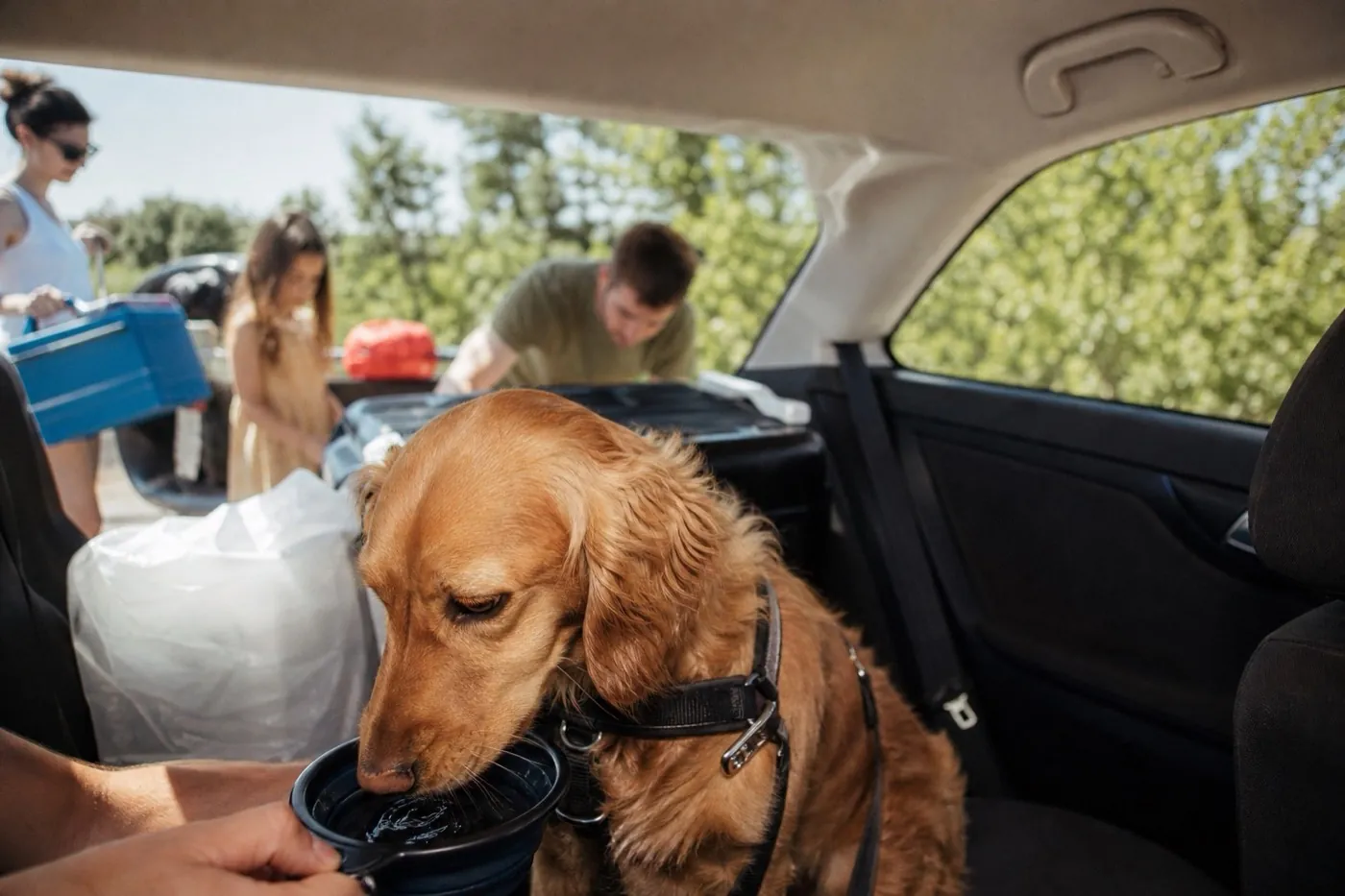
Travelling with a dog: where do you start?
Travelling with a dog or cat abroad starts with a vet appointment a few weeks before you go: checking the microchip, the rabies vaccination and the travel document your pet needs. Then you check the rules of your ferry, airline or train and your accommodation, and a few days before you leave you pack food, water, medicines, a carrier and the paperwork.
A trip within the UK needs far less paperwork, but the packing list is much the same. Below you'll find the timeline and documents first, then packing for dogs and cats, and finally what to check when you arrive.
Take your pet's vaccination record and your route to the vet, including any countries you're just driving through. The vet will check that the chip can be read and that the rabies vaccination will still be valid on the day you return.
When should you start preparing for a trip abroad?
The rabies vaccination takes longest if your pet hasn't had one or it has lapsed. GOV.UK says your pet must be microchipped before or at the same time as the jab and be at least 12 weeks old, and you must wait at least 21 full days after the first vaccination before travelling to the EU.
The timeline below is for one dog or cat travelling with its owner from Great Britain to an EU country. If your pet's rabies cover is already up to date, skip the first row.
| When | What to do | Why then |
|---|---|---|
| At least 21 days before | Microchip and rabies vaccination | Minimum wait after the first jab (GOV.UK) |
| 2–3 weeks before | Check ferry, airline and hotel pet rules, plus any breed bans | Set by each carrier and country |
| Within 10 days before entering the EU | Animal health certificate from an official vet | The certificate is valid for entry for 10 days (GOV.UK) |
| A week before | Get your pet used to the carrier, buy food with spare | Our editors' estimate |
| 24 hours to 5 days before arriving back | Tapeworm treatment for dogs returning to Great Britain, if needed | GOV.UK rules for entering Great Britain |
Book the certificate appointment early, as not every practice has an official vet. Tell the vet you need an animal health certificate when you book the rabies jab, so they have time to prepare it.
GOV.UK: Taking your pet dog, cat or ferret abroadGOV.UK: Getting an animal health certificateGOV.UK: Bringing your pet dog, cat or ferret to Great BritainWhich documents does your pet need for the EU?
If you live in England, Scotland or Wales, GOV.UK lists these for a dog, cat or ferret going to an EU country:
- Microchip, fitted before or on the same day as the rabies vaccination
- Rabies vaccination, with any booster given before the old one runs out
- Animal health certificate (AHC) signed by an official vet, one per trip
- Signed declaration that you won't sell or rehome your pet while abroad, which the vet gives you with the certificate
The AHC is valid for 10 days for entry into the EU, then for 6 months for onward travel within the EU and for coming back to Great Britain. You need a new one for each trip, and up to 5 pets can go on one certificate. A pet passport issued to someone living in Great Britain can't be used to enter the EU, even if it was issued in an EU country; residents of Northern Ireland can still use an EU pet passport.
If you live in an EU country, the rules are different: your pet travels on a European pet passport. For years these rules came from Regulation (EU) No 576/2013. Regulation 2026/131 says it applied until 21 April 2026, and from 22 April 2026 Commission Delegated Regulation (EU) 2026/131 applies, adopted under Regulation (EU) 2016/429. Your Europe has a plain-language summary.
Some countries ban certain dog breeds, so check the destination's own rules before you go. For your own passport, insurance and driving papers, see documents for travelling abroad.
When does a dog need tapeworm treatment?
Dogs entering Finland, Ireland, Malta, Northern Ireland or Norway need treatment against the Echinococcus multilocularis tapeworm before arrival. Coming back into Great Britain, GOV.UK says the treatment must be given no less than 24 hours and no more than 5 days before you arrive, and recorded by a vet. Cats and ferrets don't need it.
On a long drive home, count back from your planned arrival time and book a vet abroad with time to spare for traffic and ferry delays.
Can your pet travel with someone else?
Yes, if you sign a declaration naming the person and their journey is within 5 days of yours, before or after. Only the owner named on the travel document can give permission, and the other person must carry the signed declaration and proof of your travel dates. If the 5-day rule doesn't fit, GOV.UK suggests contacting the APHA Pet Travel helpline.
GOV.UK: Taking your pet dog, cat or ferret abroadGOV.UK: Getting an animal health certificateGOV.UK: Tapeworm treatment for dogs entering Great BritainEUR-Lex: Rozporządzenie (UE) nr 576/2013 w sprawie przemieszczania o charakterze niehandlowym zwierząt domowych (ELI)EUR-Lex: Commission Delegated Regulation (EU) 2026/131 on non-commercial movement of pet animals (ELI)Your Europe: Travelling with pets and other animals in the EUWhat should you pack for a holiday with your dog?
This list assumes one dog and a one- or two-week trip by car or train. Start with the documents, because without them the rest of the packing won't get you far.
- Animal health certificate or pet passport, the original, plus a photo on your phone
- Microchip number and the database it's registered on
- Recent photo of your dog in case it goes missing
- Seat belt harness, dog guard or crate for the car
- Lead, collar and ID tag with a number that works abroad
- Water for the journey and a collapsible bowl
- Food for the whole trip plus two days' spare, the same food as at home
- Treats and a favourite toy
- Poo bags, wipes and a towel
- Blanket or mat that smells of home
- Regular medicines with spare, in their original packs, with your vet's dosing
- Tick remover and a tick treatment your vet recommends
Don't switch food just before or during the trip; a new place and new food at once is a lot for a dog's stomach. Two days' spare is our editors' estimate for a delayed return; take more if you're coming back from far away.
Don't give calming medication without speaking to your vet first. If your dog doesn't travel well, ask about it at the pre-trip appointment, along with when to feed on the travel day. For your own medicines, see the travel first aid kit.
Travelling with a cat: what do you pack differently?
Cats rarely get out at rest stops, but they need their own loo and a quiet spot. Add these to the dog list, or swap them in:
- Carrier with a firm base and a secure door, big enough to lie down and turn round in
- Travel litter tray and a small bag of the litter your cat uses at home
- Absorbent pads for the floor of the carrier
- Blanket or towel to cover the carrier if your cat gets anxious
- Harness, used only when the carrier is opened inside a closed car
A week or two before you go, leave the carrier open in the living room with a blanket and a treat inside. A cat that only knows it from vet visits often refuses to go in; after a few days at home it becomes a hiding place.
When you arrive, set up one room first: litter tray, water, food bowl and the open carrier. Your cat will explore the rest when it's ready. Check windows and balconies before you let it out.
How do you travel safely by car, train or plane?
Rule 57 of the Highway Code says animals in a vehicle should be suitably restrained so they can't distract you or be hurt, or hurt you, if you stop quickly. It names a seat belt harness, pet carrier, dog cage or dog guard as ways to do it. Cats travel in a closed carrier, belted in or wedged behind a front seat.
Never leave a pet in a parked car, even briefly with a window open, because cars heat up fast. Stop every few hours so your dog can drink and stretch its legs, and use one of the approved routes when you come back into Great Britain; GOV.UK lists them.
On trains, ferries and planes the carrier sets the rules: carrier size and type, fees, how many animals are allowed and whether pets travel in the cabin or the hold. Check the carrier's website before you buy tickets and keep the booking confirmation for your pet. Do the same with your hotel or holiday let.
GOV.UK: The Highway Code, rules about animals (47 to 58)GOV.UK: Bringing your pet dog, cat or ferret to Great BritainWhat should you check when you arrive?
On day one, find the nearest vet and out-of-hours clinic and save them in your phone. Make sure the number on the ID tag works abroad and that you have the microchip number to hand.
Dogs are more likely to run off somewhere new because they don't know the area. Keep yours on the lead for the first few days, on the beach and in the woods too, and check local rules, as many beaches ban dogs in summer or ask for them to be kept on a lead.
If you're heading somewhere with ticks or mosquitoes, ask your vet before you go which protection to use. After every walk through long grass, check the coat and remove any ticks with a tick remover.
How do you get the pet travel checklist into BuyNest?
Open the ready checklist for travelling with a dog or cat in BuyNest with the button or scan the QR code. It has 29 items in five groups: weeks before, documents, for the journey, food and water, and at your destination.
Share it with everyone in the car. One person deals with the vet and paperwork, another with packing, and ticked items show up for everyone straight away.
Add the vet appointment, the tapeworm treatment window and the rabies booster date as reminders, using the dates from your pet's papers and your vet. When you're home, save the list as a template; next time you'll only change the destination and the amount of food. If your pet is staying behind this time, use the pet sitter checklist, and find more travel lists in travel lists.
Travelling with a pet
- Weeks before
- Check rules for the destination
- Vet appointment
- Check the microchip reads
- Check rabies vaccination date
- Pet passport or health certificate
- Ask about tapeworm treatment FI, IE, MT, NO, NI
- Check carrier and hotel pet rules
- Documents
- Pet passport, original
- Photo of your pet on your phone
- Microchip number and database
- Your vet's phone number
- Copies of papers on your phone
- For the journey
- Carrier or seat belt harness1 pcs
- Lead and collar with ID tag
- Poo bags1 pack
- Blanket or towel1 pcs
- Absorbent pads4 pcs
- Favourite toy1 pcs
- Travel litter tray and litter for a cat
- Wipes and bin bags1 pack
- Food and water
- Food for the trip plus spare +2 days
- Water for the journey1.5 l
- Collapsible bowl1 pcs
- Treats1 pack
- Regular medicines plus spare as prescribed
- At the destination
- Find the nearest vet
- Bed or mat1 pcs
- Tag with your mobile number1 pcs
- Brush and tick treatment as advised by vet
Frequently asked questions
Does my dog need a passport to travel within the UK?
No, travel documents are only needed when you cross a border. Within the UK, take your pet's vaccination record and microchip details anyway, as hotels, kennels or ferry operators may ask for them.
How early should I get a rabies jab before going to Europe?
At least 21 full days before travel if it's the first vaccination or the old one has lapsed. GOV.UK says the wait can be longer depending on the vaccine, so ask your vet. A booster given before the old cover runs out doesn't need a wait.
Can I use my dog's old EU pet passport from Great Britain?
Not if you live in England, Scotland or Wales: GOV.UK says you can't use a pet passport to enter the EU, even one issued in an EU country. You need an animal health certificate for each trip. Residents of Northern Ireland can still use an EU pet passport.
Does my cat need tapeworm treatment?
No, the tapeworm rule applies only to dogs. Cats still need a microchip, a valid rabies vaccination and the right travel document, just like dogs.
Can I give my dog something to calm it on the journey?
Only after talking to your vet. Ask at the pre-trip appointment and tell them how long the journey is and how your dog copes with travel. Never give human medicines.
Book the vet appointment well ahead, then open the list and split the jobs between everyone travelling. That way travelling with a dog or cat starts with a packed car, not a search for the certificate on the morning you leave.
Open the ready list in BuyNestSources
- GIW: Podróżowanie ze zwierzęciem domowym w UE
- GIW: Podróż ze zwierzętami domowymi poza UE
- EUR-Lex: Rozporządzenie (UE) nr 576/2013 w sprawie przemieszczania o charakterze niehandlowym zwierząt domowych (ELI)
- EUR-Lex: Commission Delegated Regulation (EU) 2026/131 on non-commercial movement of pet animals (ELI)
- Your Europe: Podróże po UE ze zwierzętami domowymi
- Your Europe: Travelling with pets and other animals in the EU
- European Commission: Movement of pets
- GOV.UK: Taking your pet dog, cat or ferret abroad
- GOV.UK: Getting an animal health certificate
- GOV.UK: Bringing your pet dog, cat or ferret to Great Britain
- GOV.UK: Tapeworm treatment for dogs entering Great Britain
- GOV.UK: The Highway Code, rules about animals (47 to 58)
Take the shopping into BuyNest
BuyNest is on iPhone and Android. The app has no ads, including on the free plan.