
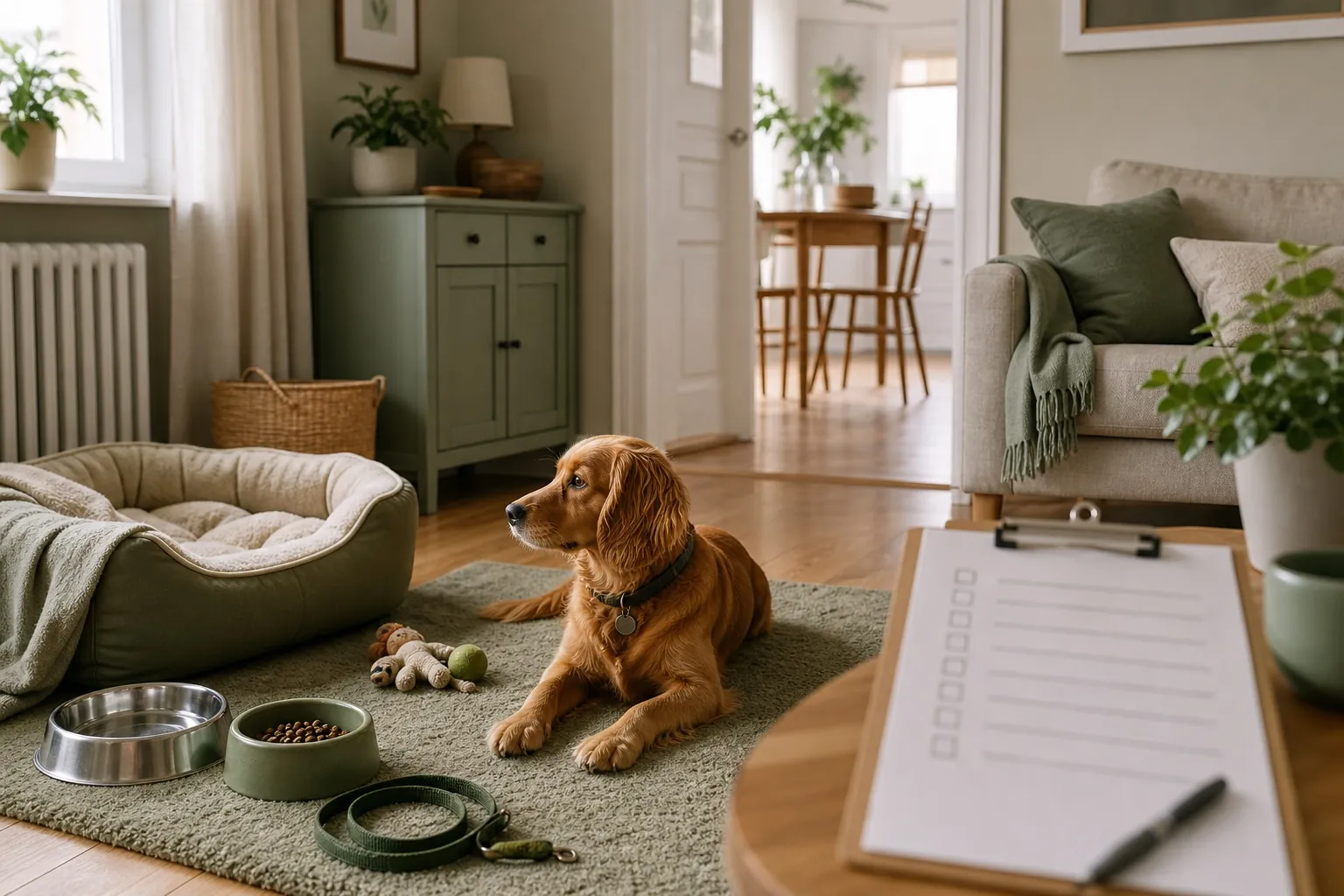
Preparing your home for a dog takes much more than setting up a bed and bowls. You need to secure things the dog could chew, swallow or knock over, set aside a quiet resting place, agree rules for everyone in the household and plan the first few days. How much you need to do depends on the animal's age, health and past experience. A puppy, an adult rescue dog and a senior will need different precautions, but each should arrive in a calm, predictable and safe space.
Ready-made checklist before your dog arrives
Ready-made checklist before your dog arrives (part 1 of 2)
- Dog information and who does what
- Find out what food the dog currently eats.
- Ask about feeding, walking and rest times.
- Check whether the dog takes any medication.
- Ask about allergies, illnesses and special needs.
- Find out how the dog reacts to children and other animals.
- Ask if the dog fears particular sounds, people or situations.
- Decide who will feed the dog.
- Decide who is responsible for walks.
- Plan care for work hours, trips away and emergencies.
- Choose a veterinary practice.
- Note the contact of the nearest 24-hour vet.
- Making the flat safe
- Put away medicines and supplements.
- Secure household chemicals and laundry products.
- Remove poisons, insecticides and other dangerous products.
- Secure electrical cables and chargers.
- Clear small objects from the floor.
- Put away batteries, hair ties, clips, coins and children's toys.
- Secure the bins.
- Put away any food within the dog's reach.
- Check houseplants for safety.
- Secure the windows and balcony.
- Block access to the washing machine, tumble dryer and dishwasher.
- Put away shoes, clothes and valuables.
- Check that shelves, lamps and decorations are stable.
- Close off rooms the dog should not enter.
- Resting and feeding place
- Choose a quiet place to sleep.
- Put the bed or mat away from the main thoroughfare.
- Give the dog free access to water.
- Pick a fixed feeding spot.
- Prepare a surface that is easy to clean.
- Set aside a place for the lead, harness and poo bags.
- Decide where food and treats will be stored.
- Prepare a separate space for the dog if there are other animals at home.
- Explain to the household that the dog must not be disturbed while resting.
Ready-made checklist before your dog arrives (part 2 of 2)
- Garden, patio and front door
- Check the fence and all gates.
- Remove or block gaps the dog could escape through.
- Secure tools, fertilisers and garden products.
- Check the plants growing in the garden.
- Secure any pond, pool or other water container.
- Agree rules for opening doors and the gate.
- Tell everyone not to leave the entrance open.
- Plan the first supervised trip into the garden.
- Children and the rest of the household
- Explain to children how to behave around the dog.
- Agree that the dog must not be woken or pulled out of its bed.
- Agree that the dog must not be touched while eating.
- Explain that the dog may walk away and should not be followed.
- Plan a short, calm first meeting.
- Decide which adult supervises contact.
- Limit the number of guests in the first few days.
- Other animals at home
- Prepare separate bowls and resting places.
- Set up separate rooms for the first meetings.
- At first, remove objects the animals might compete for.
- Decide how the animals will be introduced.
- Give the cat places the dog cannot reach.
- Plan how to separate the animals if needed.
- Do not leave them together unsupervised.
- Arrival day
- Keep noise down and limit the number of people at home.
- Close doors, gates and windows before the dog arrives.
- Get the water ready.
- Get out the food the dog is used to.
- Choose the first toilet spot.
- Let the dog explore at its own pace.
- Do not force contact.
- Do not arrange a bath, visits or long walks straight away.
- Watch the dog without constantly correcting it.
- Check that the dog rests safely on the first night.
Create the checklist in BuyNest and tick off each preparation as you finish it.
How to prepare for a dog: start by gathering information
Do not prepare your home based only on the dog's age, breed or a photo. Two animals of similar size can react completely differently to noise, being alone, children, stairs or other animals.
Before the dog arrives, ask the shelter, rescue, foster home, breeder or previous owner about:
- their daily rhythm,
- how they are fed,
- how they react to being left alone,
- how they behave in the car,
- how they get on with children and other animals,
- fears and situations that make them very excited,
- their resting and toilet habits,
- any medication and their general health,
- whether they can use stairs,
- previous experience of flats, gardens or city life.
With this information you can set up the right space and plan the first days realistically. A dog that has lived in a quiet home may need different support from one moved from a shelter, or a puppy separated from its mother and littermates for the first time.
Before you collect the dog, also put together the basic equipment. You will find the full list in our article on a new dog checklist: what to buy before they arrive. That article covers shopping, while the checklist above is about preparing the space and organising life for everyone at home.
Dog-proofing your home: cables, chemicals, plants and stairs
Check your home from the animal's point of view. Sit or crouch down and see what is at mouth height. Look not only at things on the floor but also at low shelves, small tables and windowsills.
Electrical cables and appliances
Secure loose cables, chargers, extension leads and power strips. A puppy may chew them while exploring, and an adult dog may take an interest in them out of stress or boredom.
Moving cables behind a piece of furniture is not enough if the dog can still reach them. Use cable covers or route them out of reach. Unplug anything you are not using.
Medicines, household chemicals and cosmetics
Move medicines, supplements, cleaning products, laundry capsules, detergents, car fluids and garden products into cupboards that close. Do not leave them on the floor, next to the toilet, under the sink without protection or in an open bag.
The ASPCA points out that household products and their packaging can cause poisoning, irritation or blockages if swallowed. If you suspect your dog has come into contact with a dangerous substance, do not try to make it vomit yourself. Contact a vet.
Food and waste
Do not leave food on a low table, on a worktop the dog can climb to or in an open bag. Secure the bin, kitchen waste and bags waiting to go out.
Do not make a short list of a few "forbidden foods" and assume everything else is safe. The simplest rule at the start is that the dog should have no unsupervised access to human food.
Small objects
Remove from the floor and low surfaces:
- batteries,
- medicines,
- coins,
- hair ties,
- hair clips,
- thread,
- socks,
- children's toys,
- decorations,
- bits of packaging,
- small office supplies.
An object does not need to look like a toy to interest a dog. Puppies, and dogs whose past behaviour you know little about, need particular care.
Poisonous plants: what to remove from your home
Check every houseplant, balcony plant and garden plant in a reliable source. If you cannot clearly identify a species, keep the plant out of the dog's reach until you can.
Remember too standing water in plant saucers, fertilisers, sprays, soil with additives and plant debris that falls on the floor.
Windows, balcony and stairs
A closed window does not always mean full safety. Check insect screens, railings, gaps and whether the dog can get onto the windowsill. A balcony should be secured so that the dog cannot squeeze between the bars or climb on furniture placed by the railing.
If the dog has limited mobility, is a senior or does not know stairs, consider blocking access for a while. Slippery steps and floors may need stable non-slip mats.
Preparing your flat for a dog: a place to sleep and rest
A dog should have a place it can go to by itself, rest in and retreat from people. It does not have to be a separate room or a crate. It can be a bed in a quiet corner, a mat under the table or a screened-off part of a room.
A good resting place should be:
- away from the front door and heavy foot traffic,
- free from draughts and excessive heat,
- easy for the dog to reach,
- big enough for the dog to lie down comfortably,
- far from cables and dangerous objects,
- accessible without having to ask a person for help.
Do not put the bed where everyone in the household has to walk past the dog. Do not put it next to a loud television, household appliances or a door guests regularly open.
Everyone at home should know one rule: when the dog is resting in its place, we do not approach, stroke or call it, and we never pull it out by force. Dogs Trust recommends that a safe space is used only for rest and never as a punishment.
A crate can be one way to create such a space, but it is not compulsory. If you use one, leave it open at first and let the dog explore it at its own pace. Do not shut the dog in a crate just because you do not know how else to deal with its behaviour.
Where to put the bowls and store the food
The water bowl should be in a quiet, easy-to-reach spot. The dog should not have to walk past an object, person or animal it is afraid of.
Choose a feeding spot so that:
Where to put the bowls and store the food
- the dog can eat in peace
- children do not walk past the bowl
- other animals cannot take the food
- the floor is easy to clean
- food is stored out of animals' reach
- everyone knows who feeds the dog and when
If other animals live in your home, set up separate feeding places. Do not assume that shared bowls will help them become friends. Separating resources reduces tension and lets you keep track of how much each animal has eaten.
How to make your garden safe for a dog
Do not treat a garden as automatically safe. Before the dog arrives, walk the whole length of the fence and check:
How to make your garden safe for a dog
- height and stability of the fence
- gaps at ground level
- places where the dog could dig under
- spaces between the gate and the post
- whether locks and bolts work
- objects standing near the fence
- access to the compost heap and rubbish
- tools and garden hoses
- fertilisers, sprays and pest control products
- plants and fungi growing in the garden
- water containers
- sharp edges and unstable structures
For the first few days, do not let the dog out alone even into a fenced garden. You do not yet know whether it will try to jump, climb, dig or squeeze through small gaps.
Before opening the front door or gate, check where the dog is. Agree a clear rule for opening the entrance with everyone at home. This matters most in a home where children, couriers or guests come and go regularly.
How to prepare your family for the dog's arrival
Before the dog arrives, agree rules that everyone will apply in a similar way. Inconsistency makes it harder for the dog to understand its new surroundings.
Agree:
How to prepare your family for the dog's arrival
- where the dog may sleep
- which rooms it can use
- who is responsible for feeding
- who goes on walks
- what words you will use in training
- where the dog rests undisturbed
- how you behave at the front door
- whether and when the dog may go on furniture
- who organises care during absences
- who contacts the vet if there is a problem
Children can help with simple tasks, but responsibility for care always rests with adults. Do not plan for a child to walk the dog alone, give medication or deal with difficult situations.
How to prepare a child for a dog
The first meeting should be short, calm and supervised by an adult. Do not ask the child to hug the dog straight away, put their face close for a sniff or sit next to the bed.
Before the dog arrives, explain to your child:
How to prepare a child for a dog
- we do not approach the dog when it is asleep
- we do not touch the dog while it eats
- we do not take its toys and chews
- we do not pull its tail, ears or fur
- we do not hug the dog round the neck
- we do not sit on the dog or go into its bed
- we do not run after a dog that walks away
- we do not shout around the dog
- we call an adult if the dog's behaviour worries us
An adult should actively supervise contact, not just be in the same room. Dogs Trust recommends stopping the interaction when the child or the dog starts to feel uncomfortable. The dog should always be able to go to a place where nobody will follow it.
How to prepare your home if other animals live there
Do not assume the animals will "sort it out themselves". Plan the first meetings and set up the home so that every animal has its own resources and can walk away.
New dog and a resident dog
If it is safe and in line with the previous carer's advice, the dogs' first meeting can take place outside the home, on calm and, where possible, neutral ground. Each dog should stay with a separate person.
Before going into the house:
How to prepare your home if other animals live there
- set up separate beds
- set up separate bowls
- at first, put away especially prized toys and chews
- make it possible to separate the dogs
- plan separate rest time
- do not leave the dogs together unsupervised
Do not tell a dog off for growling. Growling can be a sign that it needs more distance. Separate the animals and ask a competent specialist for help if you see rising tension, lunging, attempts to bite or strong fear.
New dog and a cat
The cat should have access to a safe room, a litter tray, food, water and high places the dog cannot reach. At first the animals should stay apart.
It can help to swap blankets or other items carrying each animal's scent before they meet face to face. Introduce them gradually and do not let the dog chase the cat. A baby gate can make it easier for the animals to watch each other in a controlled way, from a safe distance.
What to do the day before the dog arrives
The day before, finish anything that makes a lot of noise or needs the doors opened often. Do not leave assembling furniture, drilling, big cleaning jobs or putting up fencing for the day you collect the dog.
Do a final check:
What to do the day before the dog arrives
- Lock away medicines and household chemicals.
- Secure the bins.
- Clear small objects from the floor.
- Check the electrical cables.
- Close the windows and secure the balcony.
- Check the gate and fence.
- Put out the water.
- Prepare a quiet resting place.
- Get out the food the dog is used to.
- Put the lead and walking gear by the door.
- Get a towel and a cleaning product for accidents.
- Write down the vet's numbers.
- Limit visits from guests.
- Agree the first day's plan with everyone at home.
Do not fill the whole space with toys, treats and new objects. What matters more to a dog is being able to watch quietly, people behaving predictably and having access to rest.
A dog's first day at home: what it should look like
When you arrive, let the dog relieve itself in the chosen spot. Then take it into a quiet part of the home. Do not show it round every room straight away if it is clearly stressed.
The dog may:
- sniff intensely,
- pace round the room,
- stand still,
- hide,
- refuse to eat,
- seek contact or avoid it,
- find it hard to rest,
- have an accident indoors even though it was previously house-trained.
Do not judge its lasting character by the first few hours. The behaviour may come from stress, tiredness and too many new stimuli.
On the first day:
A dog's first day at home: what it should look like
- Let the dog explore the space at its own pace.
- Give constant access to water.
- Offer the food it knows.
- Limit how many people are around the dog.
- Do not invite guests.
- Do not force the dog to be stroked.
- Do not pull it out of its hiding place.
- Do not take a long walk in a crowded place.
- Do not bath the dog unless it is urgent.
- Secure the door every time anyone goes in or out.
- Make sure it can sleep in peace.
A rescue dog may need a few days or longer before it moves around the whole flat freely. A puppy, on the other hand, may need more frequent trips outside, close supervision and more breaks for sleep.
How to plan the first night
There is no single solution that suits every dog. Find out from the previous carer where the dog usually slept and how it coped with being alone.
For the first night:
How to plan the first night
- Put the bed in a quiet place.
- Give the dog access to water.
- Remove cables and things it could chew.
- Limit access to rooms you have not prepared.
- Plan for a toilet break outside.
- Do not suddenly shut the dog in an unfamiliar crate.
- Watch whether the dog can settle itself.
- Be ready for interrupted sleep, especially with a puppy.
Do not follow the rule that every dog must sleep alone from the first night. At the same time, do not make a decision when tired that you do not want to keep up. What matters most is safety, building confidence step by step and adapting the plan to the individual animal.
The first days with a dog: how to build a predictable routine
Do not try to show the dog every place, person and attraction in the first week. Too many stimuli can make it harder for the dog to rest and get to know its new surroundings.
Introduce a simple rhythm:
The first days with a dog: how to build a predictable routine
- Serve meals at similar times.
- Offer regular toilet breaks.
- Alternate activity with calm rest.
- Limit the number of new people.
- Open up further rooms gradually.
- Watch how the dog reacts to sounds and the family's movements.
- Introduce short, calm exercises.
- Write down questions before a vet visit.
- Do not leave the dog alone for longer than it can calmly manage.
- Increase the difficulty step by step.
A routine does not mean a rigid plan to the minute. The point is that the dog can predict when meals, outings, rest and time with people will happen.
If the dog cannot stay alone, barks, howls, destroys things or tries to escape, do not assume it is doing so out of spite. Reduce situations that are beyond its abilities and ask a vet or a suitably qualified behaviourist for help.
How to adapt your home for a puppy, a rescue dog or a senior
Preparing your home for a puppy
A puppy explores with its mouth, tires quickly and has no settled rules yet. Particularly important are:
How to adapt your home for a puppy, a rescue dog or a senior
- thorough removal of small objects
- secured cables and furniture
- gates to limit access
- an easy-to-clean space
- frequent toilet breaks
- a place for uninterrupted sleep
- safe things to chew
- constant supervision while exploring new rooms
- a limited, calm space to start with
- a choice of resting places
- solid security on doors and in the garden
- as few guests as possible
- a plan for getting to know the family gradually
- a routine close to the one it knew
- the option of separation from other animals
- stable mats on slippery floors
- an easily accessible bed
- limited access to stairs
- water in an easy-to-reach spot
- no high thresholds to climb over
- a calm space without furniture moved around often
- a shorter route to the door
- night lighting along the main route
A rescue dog: the first days in a new home
An adult dog may have set habits but behave differently at first in a new home. Prepare:
Do not assume that calm behaviour on the first day means there are no fears or difficulties. A dog may start to communicate its needs more clearly only when it feels more confident.
Preparing your home for a senior dog
A senior may have problems with sight, hearing, balance, pain or toilet control. Depending on its health, the following will be useful:
Discuss any changes to exercise, feeding and medical equipment with the vet who looks after the dog.
Shared preparation checklist in BuyNest
Create a separate checklist in BuyNest for preparing your home for a dog and share it with someone you live with. Tick off finished tasks on the same list so you do not do the same job twice.
FAQ: preparing your home for a dog
How far ahead should I prepare my home for a dog?
It is best to finish the basic safety measures and agree who does what a few days before the dog arrives. The day before, check the doors, fence, cables, household chemicals, medicines and the resting place. Do not leave bigger jobs for the day you collect the dog.
Should the dog have access to the whole home straight away?
No. Many dogs find it easier to get to know one room at a time. A limited, well-secured space makes the dog easier to observe and reduces the number of new things to take in. It should not mean long-term isolation from the family.
Where is the best place for the dog bed?
Somewhere quiet, away from the main thoroughfare, the front door, draughts and noisy appliances. The dog should be able to get onto the bed and off it alone, and nobody in the household should disturb it there.
Can I invite guests in the first few days?
It is better to limit visits until the dog knows the home and its closest carers. A nervous dog, a rescue dog or a puppy can easily be overwhelmed by lots of new people.
How do I prepare my home for a dog when there are children?
Agree the rules before the dog arrives and always supervise contact actively. A child should not disturb the dog while it eats, sleeps or rests, take things away from it, or follow it to its safe place.
How do I prepare a dog to be left alone?
Do not assume a new dog can stay alone calmly from the start. First let it get to know the home and the routine, then gradually introduce very short absences and watch how it reacts. If it is clearly distressed, ask a specialist for help.
What if the dog is afraid to come into the house?
Do not drag it in or crowd round it with several people. Keep the noise down, give it a safe distance and get in touch with the previous carer, who knows the dog. If the fear is strong or does not pass, ask a vet or a qualified behaviourist for help.
How do I get a garden ready for a dog?
Check the whole fence, gates, gaps, plants, garden products, tools and water containers. At first, take the dog into the garden under supervision, even if the space is fenced.
A calm start matters more than a perfectly prepared home
Your home does not have to be refurnished before a dog arrives. It should, however, be safe, predictable and suited to the individual animal. What matters most is removing hazards, a quiet resting place, clear rules for everyone at home and a plan for the first days.
Write the tasks down in BuyNest, spread them over stages and do a final check the day before the dog arrives. That way, in the first hours you can concentrate on watching what the dog needs, instead of hunting for an unsecured cable, an open gate or hidden documents.
Sources
Take the shopping into BuyNest
BuyNest is on iPhone and Android. The app has no ads, including on the free plan.