Puppy first weeks: what matters most?
A puppy's first weeks at home are mostly about routine: regular meals, frequent trips outside, plenty of sleep and one calm place of its own. Shopping is the smaller job, so this plan sets out four weeks as tasks for everyone in the household.
The topics are split on purpose. What to buy is in the new dog checklist, and how to make the house safe before the puppy arrives is in preparing your home for a dog. Here you get the order of things once the puppy is through the door.
The plan is our suggestion for one healthy puppy. The pace depends on breed, age and character, and your vet decides on vaccinations, worming and when the puppy can go out. The table gives a quick view of the four weeks:
| Week | Main goal | Tasks on the list |
|---|---|---|
| 1 | settling into the home and routine | vet, sleeping spot, fixed times, first trips outside |
| 2 | toilet training and being left | outings after sleep and meals, short separations, chews |
| 3 | first socialising | handling paws and ears, visitors, household noises |
| 4 | stepping out into the world | short outings once the vet agrees, classes, plan for later weeks |
What should you do in a puppy's first days at home?
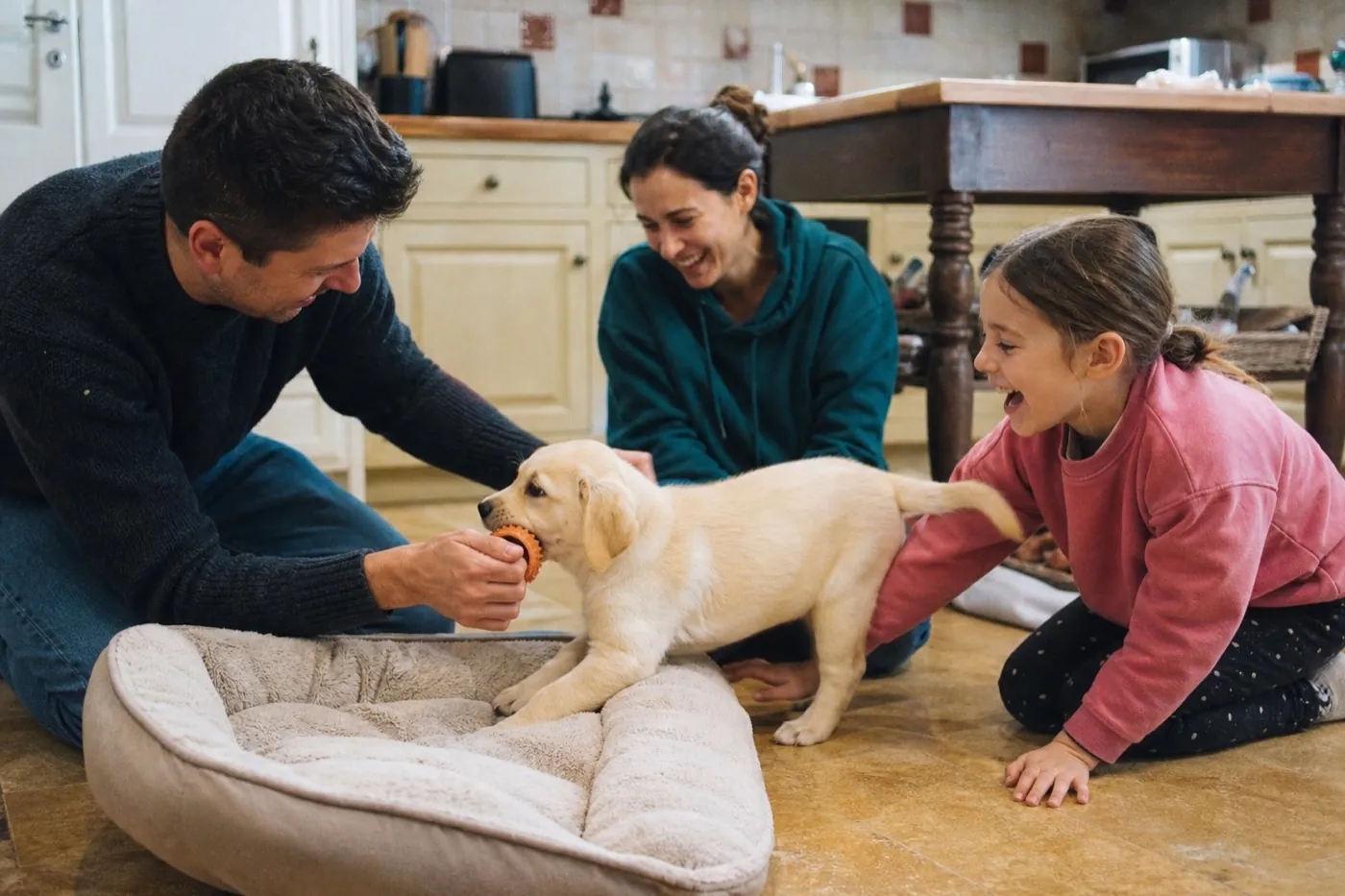
In its first days at home, a puppy mostly sleeps, eats and sniffs. Do not throw a welcome party or invite visitors: the puppy is in a new place without its mother and littermates. Give it time and stay close.
In week one, focus on these:
- The same food as before: feed what the puppy ate at the breeder's or shelter, in the portions and at the times you were given.
- One sleeping spot with a blanket that smells of its old home, in a quiet corner.
- A short tour of the house on the lead, or in one room, before you open up more space.
- Fixed times for getting up, meals and trips outside, written down so everyone follows the same plan.
- A vet visit booked for the first week, with the health record and the breeder's papers.
- The vet's number in every adult's phone.
The first nights can be noisy, because the puppy may whine for its littermates. Agree in advance who gets up at night, so that nobody has to decide at 3 a.m. If something worries you, such as a puppy that will not eat or is very lethargic, ring your vet.
What do you need to sort out with the vet and on paper?
Take the health record or passport, the breeder's papers and the microchip number to the first visit. The vet will examine the puppy and set out a plan for vaccinations, worming and flea and tick control. That plan depends on age and what the puppy has already had, so do not build it yourself from internet advice.
In the UK, GOV.UK says all dogs must be microchipped and registered on an approved database by the time they are 8 weeks old, and you can be fined up to £500 if not. When a puppy changes hands, make sure the owner details on the database are updated.
If you live in Poland, rabies vaccination is compulsory: the Chief Veterinary Inspectorate says the first dose is due within 30 days of the dog turning three months, then at least every 12 months. A law on a national register of marked dogs and cats (KROPiK), signed by the president on 3 June 2026, adds compulsory microchipping and registration and takes effect two years after its publication in the Journal of Laws. Ask your vet, check gov.pl and put the dates in your phone reminders.
GOV.UK: Get your dog or cat microchippedGIW: Szczepienie na wściekliznęMinisterstwo Rolnictwa i Rozwoju Wsi: Czipowanie psów obowiązkowe w całej Polsce, Sejm przyjął ustawę o KROPiKMinisterstwo Rolnictwa: Prezydent podpisał ustawę o Krajowym Rejestrze Oznakowanych Psów i KotówHow do you toilet train a puppy in week two?
Toilet training is about predicting. Take the puppy out as soon as it wakes, after it eats and after play, and also at regular intervals during the day. When it goes outside, praise it straight away and give a tiny treat.
In week two, stick to these rules:
- The same spot and the same cue word, so the puppy links the place with the purpose of the trip.
- Praise and a treat immediately, not once you are back indoors.
- Clean accidents without shouting, with an enzyme cleaner, because the smell left by ordinary sprays invites a repeat.
- Absorbent pads only where they are truly needed, for example in a flat when you cannot get downstairs in time.
- Night trips following the rota the household agreed.
Accidents happen to every puppy and do not mean bad behaviour. Telling a puppy off afterwards does not work, because it does not know why. If the problem does not improve, or the puppy goes very often and drinks a great deal, ask your vet.
What should a puppy's daily routine look like?
A puppy sleeps a lot and wakes for short bursts of play. Build the day around a simple pattern: sleep, outside, meal, short play, outside, sleep. Exact times and the number of meals depend on breed and weight, so agree them with your vet or follow the breeder's advice and the food packaging.
A sample rhythm for the first weeks, as our suggestion:
| Time | What happens | What to watch |
|---|---|---|
| Morning | straight outside on waking, then breakfast | praise for going outdoors |
| After a meal | outside, a short play, then sleep | no wild games straight after eating |
| During the day | naps in the bed, trips out every few hours | never wake a sleeping puppy |
| Evening | calm play, a last trip out, bed | a fixed time and ritual, such as a chew on the blanket |
| Night | a trip out if your rota says so | no play and no chat, calm and brief |
Measure portions with a scoop and write the daily amount down. Keep food in its original bag or a sealed container, and wash bowls and scoops after every use. The US Food and Drug Administration recommends these hygiene habits for pet food.
FDA: Tips for Safe Handling of Pet Food and TreatsHow do you practise being left alone and stop biting?
A puppy does not know that being left in a room is not forever. In week two, start with very short separations: step into another room for a moment, return calmly and without a fuss. Lengthen the breaks gradually, watching how the puppy reacts.
Chewing everything is normal for puppies. Steer it onto the right things:
- A chew within reach: when the puppy bites your hand, offer a chew and praise it when it takes it.
- A rest break: when the puppy is wound up and nipping everything, take it to its bed or playpen for a nap.
- A treat-dispensing toy before you step out of the room.
- No hand games, so the puppy does not learn that hands are toys.
If the puppy howls, wrecks the room or panics when left, do not push the training. Ask your vet for a recommended behaviourist.
How do you start socialising a puppy safely in week three?
Socialising means gently introducing new things so that they go with good experiences: people, sounds, surfaces, objects. In week three, start at home, the safest place, and widen the plan for socialising your puppy step by step.
In week three, practise:
- Handling paws, ears and mouth: briefly, with a treat, when the puppy is relaxed.
- Calm visitors: one person at a time, without crowding the puppy.
- Everyday noises: vacuum cleaner, washing machine, doorbell, first from a distance and quietly.
- Different surfaces at home: carpet, tiles, a blanket, a mat.
- Brushing: a few minutes, so the brush means something pleasant.
Keep every new experience short and end it with a reward. If the puppy hides, trembles or refuses treats, increase the distance or stop for the day.
When can a puppy go out into the world?
The first outings beyond the house and garden depend on the vaccination plan, so ask your vet before taking the puppy where other dogs go. Until then, you can carry the puppy along quiet streets or sit with it on a bench outside.
In week four, once your vet agrees, plan:
- Short outings to a few quiet places, one new place a day.
- The first car journey in a carrier or a harness clipped to the seat belt.
- Puppy classes: book one when the vet gives the go-ahead, and choose a class that teaches with rewards.
- Meeting a calm, vaccinated dog you know, in a quiet spot.
- A check-up with the vet, with notes on appetite and growth.
On walks, carry treats and poo bags. Stop the puppy eating things from the ground: the FDA lists chocolate, grapes, xylitol, human medicines, rodent bait and cleaning products among things that can harm pets.
FDA: Potentially Dangerous Items for Your PetHow do you get the 4-week plan into BuyNest?
You can open every task from this plan in the app from the ready-made puppy first weeks checklist: scan the QR code or use the button. The list mixes tasks and shopping in groups: vet, toilet training, a safe home, food, sleep and socialising.
Share the list with your household. Whatever one person ticks off disappears for everyone, so it is clear the puppy has already been out or that someone added a shopping item. Set a reminder for the vet appointment date your vet gives you.
The shopping from the new dog checklist and the tasks from the home preparation guide live on their own lists, so nothing is repeated here. More ready-made lists for pet owners are in pet lists.
Puppy: first weeks
- Vet and paperwork
- First vet visit in week one
- Note the vaccination plan from the vet
- Rabies vaccination date from your vet
- Agree worming and flea treatment
- Check microchip registration
- Folder for papers1 pcs
- Toilet training
- Take out after sleep, meals, play
- Puppy pads1 pack
- Enzyme stain cleaner1 pcs
- Kitchen roll2 pcs
- Poo bags2 pack
- Puppy-proofing
- Cable covers1 pack
- Gate or playpen1 pcs
- Put away shoes, medicines, cleaners
- Bin with a lid1 pcs
- Teething chews puppy size3 pcs
- Food and training
- Puppy food it already eats1 pack
- Small training treats2 pack
- Treat pouch1 pcs
- Water and food bowls2 pcs
- Write out daily portions
- Light lead, adjustable harness1 pcs
- Sleep and rest
- Bed or crate mat1 pcs
- Blanket that smells of the old home from the breeder1 pcs
- Day plan: sleep, meals, outings
- Chew toys3 pcs
- Socialising
- Short trips to new places once your vet agrees
- Calm meetings with visitors
- Get used to paws and ears handled
- Book puppy classes
- Brush and comb1 pcs
- Agree who does night trips out
Frequently asked questions
How much should a puppy sleep in the first weeks?
A lot, with naps between short bursts of activity. Do not wake a sleeping puppy, and always give it a place to rest. If the puppy sleeps for very long stretches, seems lethargic or will not eat, ring your vet.
When can I take my puppy for its first walk?
That depends on the vaccination plan, which your vet sets, so ask at the first visit. Until you have the go-ahead, play at home and in the garden and carry the puppy in quiet places.
How long does toilet training take?
It varies with age and temperament. Usually it takes several weeks of consistent trips outside and praise, and accidents can continue for longer. If the problem does not improve, talk to your vet.
Can a puppy sleep on my bed?
You can decide that, but agree it with the household before the puppy arrives. Introduce the rules from the first night, because they are harder to change later. Many people start with a bed or playpen in the bedroom.
What should I do if my puppy eats something dangerous?
Ring your vet straight away, even if the puppy looks well, and say what and how much it ate. Do not try to make it sick yourself. In this situation the vet decides.
Puppy first weeks come down to this: routine and calm first, then toilet training, and new places last. Open the ready-made list, share the tasks with your household and tick them off together, so no appointment or exercise slips your mind.
Open the ready list in BuyNestSources
- GIW: Szczepienie na wściekliznę
- Ministerstwo Rolnictwa i Rozwoju Wsi: Czipowanie psów obowiązkowe w całej Polsce, Sejm przyjął ustawę o KROPiK
- GOV.UK: Get your dog or cat microchipped
- FDA: Potentially Dangerous Items for Your Pet
- FDA: Tips for Safe Handling of Pet Food and Treats
- Ministerstwo Rolnictwa: Prezydent podpisał ustawę o Krajowym Rejestrze Oznakowanych Psów i Kotów
Take the shopping into BuyNest
BuyNest is on iPhone and Android. The app has no ads, including on the free plan.