
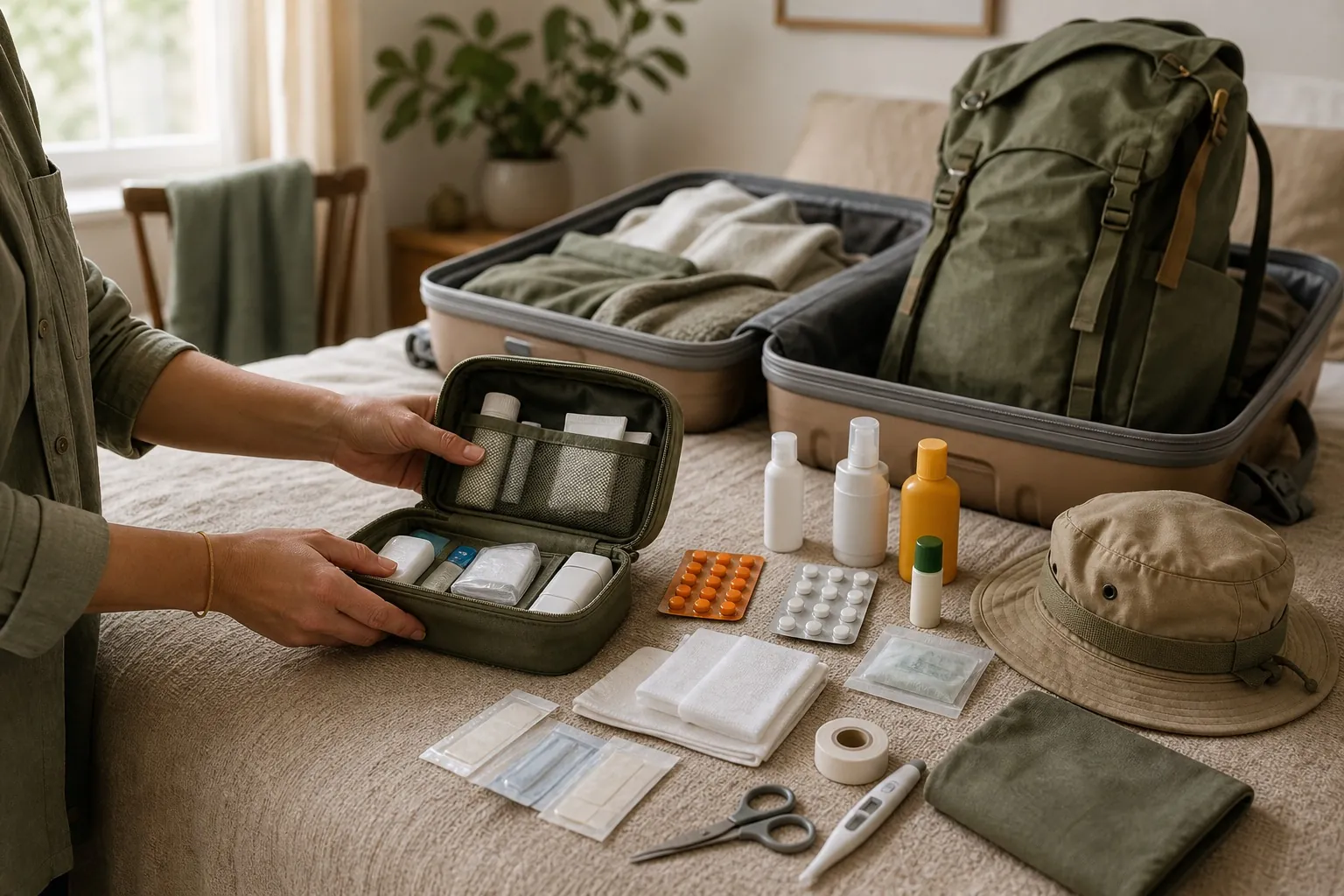
Tailor your travel first aid kit to the length and destination of your trip, travellers' health, planned activities and access to medical help. The basics are regular medicines, materials to clean and cover a small wound, and products for ailments that may arise on that particular trip. The list below will help you check your supplies, fill the gaps and get the kit ready before you leave.
The names of medicine groups point to a problem worth preparing for, but they do not replace choosing a specific product for the individual. A medicine for a child, a pregnant woman, someone with a chronic condition or someone taking other medicines should be chosen with a doctor or pharmacist.
Travel first aid kit: a ready-made list to copy
Tick the items your trip needs for the people travelling. Then check your supplies, expiry dates and the state of the packaging.
Travel first aid kit: a ready-made list to copy
- Regular medicines and medical documents
- Regular medicines, with a spare for a delayed return
- List of medicine names, doses and times
- Copies of prescriptions
- Medical certificates
- Records of chronic conditions and allergies
- Insurance policy and assistance number
- EKUZ card (European Health Insurance Card)
- Documents for carrying controlled medicines
- Pain, fever, allergy and common travel ailments
- Painkiller and fever reducer
- Antihistamine
- Bite and sting treatment
- Motion sickness medicine
- Oral rehydration fluid or sachets
- Anti-diarrhoea medicine
- Constipation remedy
- Rescue medicine prescribed by a doctor
- As-needed medicines for recurring ailments
- Dressings and help with minor injuries
- Plasters in several sizes
- Hydrocolloid blister plasters
- Sterile compresses
- Elastic bandage
- Medical tape
- Wound cleanser
- Disposable gloves
- Tweezers
- Tick removal tool
- Dressing scissors
- Foil blanket
- Protection from sun, insects and weather
- Sunscreen with UV filter
- Insect repellent
- After-sun treatment
- Lip balm with UV filter
- Hand sanitiser
- Face masks
- Simple equipment and emergency information
- Thermometer
- Batteries for medical devices
- Spare glasses or extra lenses
- Emergency number 112 and the local emergency number
- Address of the nearest pharmacy and medical facility
- ICE contact (in case of emergency)
- Instructions for a chronic condition or severe allergy
Count regular medicines by the number of days, not the number of packs. Add enough to cover a reasonable delay in your return, but check the limits in the destination country. For medicines that need to be kept cool, ask a pharmacist or the manufacturer about the permitted temperature range and how to transport them. Simply freezing a cool pack can damage a medicine if the product touches it directly.
Choose products to suit the age, health and medicines of the people travelling. In a family kit, mark who each medicine is for. Keep the leaflets and current dosing instructions.
Add hydrocolloid plasters and a foil blanket especially before trekking, camping or a trip far from built-up areas. Carry scissors in line with the rules of your chosen mode of transport. Keep what you need on the route in your day pack, and the rest of the supplies can stay where you are staying.
Create a first aid kit checklist in BuyNest and tick off what is already packed. Before you leave, you will quickly see what is still missing and you will not forget medicines, documents or dressings.
How to tailor a travel first aid kit to the type of trip
A weekend in the city or a stay near a pharmacy
For a short trip, a small pouch is usually enough: personal medicines, a painkiller and fever reducer suited to the travellers, a few plasters, compresses, something to clean a minor wound, gloves, a thermometer and a product the person normally uses for common ailments. Check the pharmacies' opening hours at weekends and on public holidays in advance. Being near a town does not mean the product you need will be available at night.
A trip to the mountains, a camping trip or a remote place
Increase your supply of dressings and add blister plasters, an elastic bandage, a foil blanket, a tick removal tool, and sun and insect protection. Match the contents to how long help would take to arrive and how long the route is, and carry the most essential part in your rucksack.
A trip to a tropical country
A tropical destination may call for vaccinations, malaria prophylaxis, a different repellent, a plan for staying safely hydrated and extra medicines recommended by a travel medicine doctor. Plan the consultation well ahead. The Pacjent.gov.pl portal (the Polish patient information service) recommends a visit no later than two months before travelling to a tropical country or one with low sanitary and hygiene standards. You can find current advice in its material "Holiday first aid kit" (in Polish).
A holiday first aid kit for a child
Children's products are chosen according to age, weight, health conditions and a doctor's advice. Before you leave, check that you have a thermometer, a fever reducer in a suitable form, oral rehydration fluid, anything recommended for allergy or a chronic condition, and materials for minor cuts. Write down the current dose of each medicine instead of relying on your memory from the last infection. Keep adults' and children's medicines separate and clearly labelled.
Travelling with a chronic condition, in pregnancy or with a severe allergy
Before you go, agree with your doctor how much medicine to take, how to store it, what to do if your condition flares up and when to seek help. With a severe allergy you need the rescue medicines you have been prescribed, plus brief information for whoever is travelling with you on where they are and how to call for help. For foreign travel, documentation in English or in the language of the destination country will come in handy.
How to carry medicines on a plane
Keep regular medicines and anything you will need during the journey in your hand luggage. That way they stay with you during the flight and will not vanish with a delayed hold bag. Liquid medicines that are medically necessary may exceed 100 ml, but you must present them separately at security. The guide "What can you take in your hand luggage?" sets out the exact rules for liquids, power banks and sharp objects.
Carry medicines in their original packaging with a legible name. For prescription medicines, liquids, pre-filled syringes, needles and medical devices, keep a prescription or a certificate confirming that you need them. The destination country's requirements may be stricter than the airport's own rules.
Medicines abroad: what to check before you go
Do four specific checks before you travel:
- Check on the website of the Polish Ministry of Foreign Affairs (MSZ) or the destination country's representation whether the medicine may be brought in and in what quantity.
- Check whether the product contains a psychotropic or narcotic substance, or another controlled substance.
- Find out whether you need a medical certificate, a translation, a copy of the prescription or an official document.
- Start the paperwork in good time, because a document for a controlled medicine may require an application made before you travel.
The Chief Pharmaceutical Inspectorate (GIF) explains that a Polish document for transporting a controlled medicine is not always also permission to bring it into another country. The procedure and the right authority are described in the official GIF guide to carrying controlled medicines abroad (in Polish).
How to store your first aid kit while travelling
- Keep medicines somewhere dry, out of children's reach and away from direct sunlight.
- Do not leave the kit in a hot car; the temperature inside can quickly exceed the range given by the manufacturer.
- Transport products that need cooling exactly as the manufacturer or pharmacist instructs, and check the temperature if required.
- Keep dressings in a sealed container so they do not get wet or dirty in your bag.
- Carry personal and emergency medicines in a place that your travelling companion also knows.
- Keep the packaging and leaflets so you can check the name, ingredients, expiry date and how to use the product.
How to prepare your first aid kit before you go, step by step
- Write down the chronic conditions, allergies, regular medicines and typical problems of everyone travelling.
- Check the trip plan: mode of transport, distance from a pharmacy, weather, altitude, insects, activities and access to medical help.
- Take out what you already have and check expiry dates, the state of the packaging and that labels are legible.
- Ask a pharmacist about products for common ailments and whether they are compatible with regular medicines.
- Fill in what is missing and keep proof of purchase in case you need it for an insurance claim.
- Split the kit into a travel first aid kit in your luggage and a small set to carry on excursions.
- Write down emergency contacts and the addresses of medical facilities where you are staying.
- Before a trip abroad, check the rules on medicines in the destination and transit countries.
Add the missing products to your BuyNest shopping list and split them by shop. You can share the list with someone else so that you both see the current ticks while shopping.
FAQ: first aid kit for a trip
What medicines should I take on holiday?
Take any medicines you use regularly, plus products chosen for the problems most likely on your trip: pain and fever, allergies, motion sickness, diarrhoea, vomiting or dehydration. A pharmacist or doctor should choose the specific products, taking into account age, pregnancy, chronic conditions and any other medicines you take.
Do I have to carry medicines in their original packaging?
Original, labelled packaging makes it easier to identify a medicine, check its expiry date and explain what it is for at a security check. It matters most for prescription medicines and travel abroad. A pill organiser alone does not replace the medicine's documentation.
Where should I pack my first aid kit on a flight?
Put regular, emergency and in-journey medicines in your hand luggage. Check the airport rules for scissors and other sharp items, and if you do not need them in the cabin, pack them in your hold luggage. Declare liquid medicines for separate screening.
Is a small travel first aid kit enough for a week's trip?
It may be, if you are close to pharmacies and medical facilities and nobody needs a large supply of medicines. The size of the kit depends on the travellers' health, the type of activity, access to help and the destination, not just the number of days.
How often should I check my travel first aid kit?
Go through it before every trip. Check expiry dates, the state of the packaging, your supply of regular medicines, whether the dressings are complete and that the thermometer works. When you get back, replace what you have used, but choose trip-specific products again only before the next journey.
Sources
Take the shopping into BuyNest
BuyNest is on iPhone and Android. The app has no ads, including on the free plan.

