
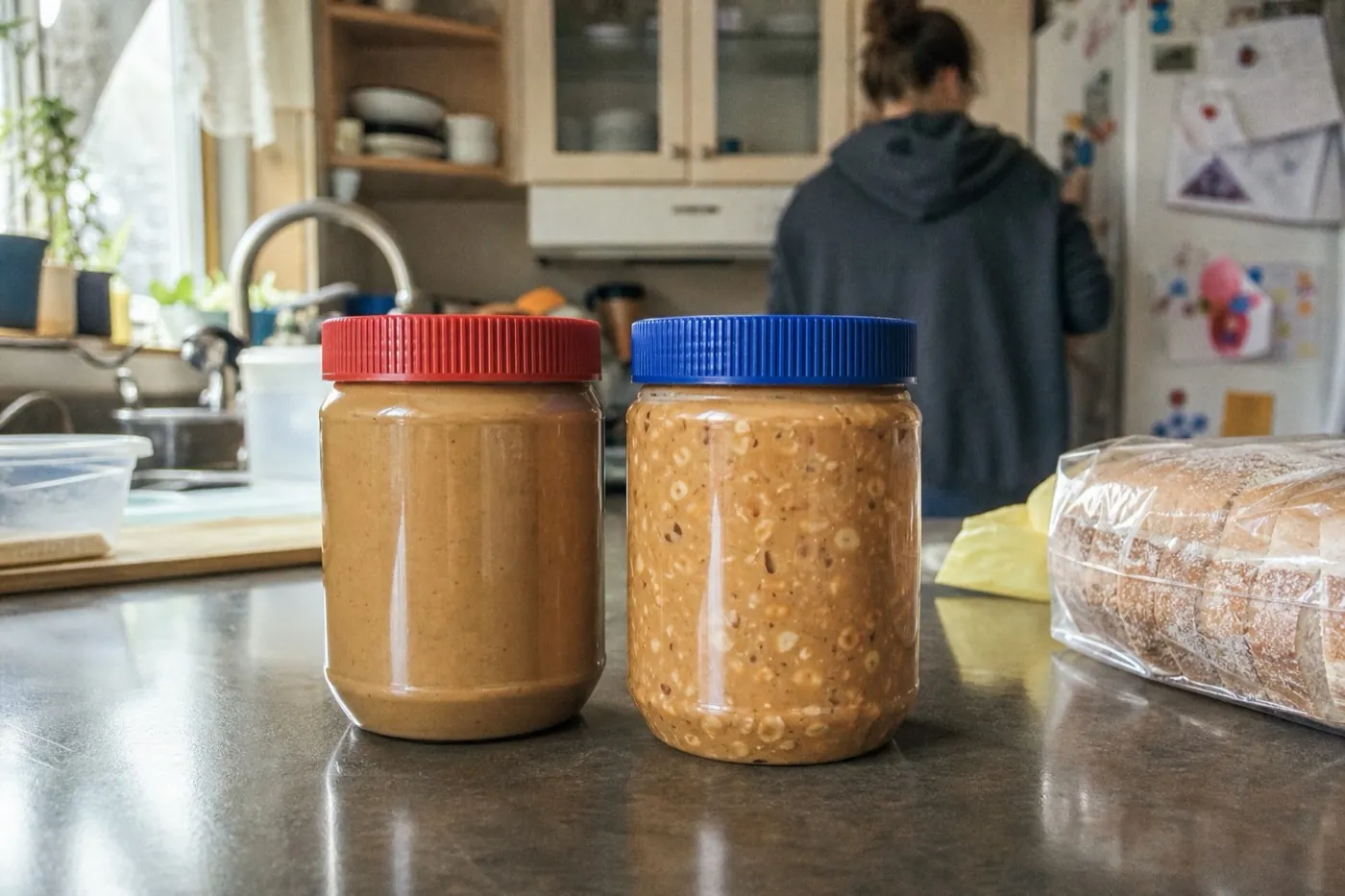
Smooth or crunchy peanut butter: which should you choose?
Choose smooth peanut butter for sauces, porridge, smoothies and cakes, and crunchy for sandwiches and cookies where you want some bite. If you only buy one jar for everything, take smooth. Compare the ingredients first and the texture second.
Smooth peanut butter dissolves in a warm liquid and mixes without lumps. Crunchy has small pieces of roasted peanuts that stay crisp even after baking. On ingredients the two versions of the same brand are usually very similar, because they differ mainly in how finely the nuts are ground.
Two recipes sit right under this section: noodles in a smooth peanut sauce and crunchy peanut butter oat cookies. They show how the same base works in two different forms.
Noodles in smooth peanut sauce
The sauce is whisked in a bowl while the noodles cook. Smooth peanut butter melts into warm water with no lumps.
Ingredients
- Wheat or rice noodles200 g
- Smooth peanut butter3 tbsp
- Soy sauce2 tbsp
- Lime1
- Garlic1 cloves
- Cucumber1
- Carrot1
- Spring onions2
- Warm water4 tbsp
Method
- Cook the noodles following the pack instructions.
- In a bowl, whisk the peanut butter with the soy sauce, lime juice, crushed garlic and warm water until smooth and pourable.
- Cut the cucumber and carrot into thin strips and slice the spring onions.
- Drain the noodles, rinse briefly in warm water and toss with the sauce. Serve topped with the vegetables.
Crunchy peanut butter oat cookies
The peanut pieces add crunch with no chopping. About 16 cookies from one tray.
Ingredients
- Crunchy peanut butter150 g
- Rolled oats100 g
- Plain flour60 g
- Brown sugar70 g
- Egg1
- Baking powder½ tsp
Method
- Heat the oven to 180°C and line a tray with baking paper.
- Mix the peanut butter, sugar and egg in a bowl until smooth.
- Add the oats, flour and baking powder. Stir with a spoon.
- Roll into walnut-sized balls, place on the tray and flatten lightly with a fork.
- Bake for 10–12 minutes until golden at the edges. Cool on the tray, as they break easily while warm.
How does smooth peanut butter differ from crunchy?
The table compares both types on what matters when you shop for two to four people. Prices are made-up examples to show the sum in the next section.
| Criterion | Smooth | Crunchy |
|---|---|---|
| Price per kg (example) | £2.00 for 350 g, so £5.71/kg | £4.50 for 1000 g, so £4.50/kg |
| Time | mixes in straight away | pieces stay in the sauce |
| Taste and texture | even and creamy | crisp bits of peanut |
| Best for | sauces, porridge, smoothies, cakes | sandwiches, cookies, desserts |
| Storing | cupboard or fridge, as on the label | same, as on the label |
| Ingredients | peanuts, sometimes salt, sugar or oil | as smooth, with added peanut pieces |
| Small children | safer, spread thinly | the NHS says whole nuts are not for children under 5, and nut butter should always be spread on food |
Differences in flavour and nutrition come more from additives than from texture, so read the ingredients on both.
What should be in the ingredients?
The simplest jars list one or two ingredients: peanuts and sometimes salt. Others add sugar, palm oil or other vegetable fats that stop the oil separating. Ingredients are listed in order of weight, so the first one is the biggest. The percentage of peanuts is often shown.
If you like to sweeten your porridge yourself, pick a jar without sugar. If you want one that does not separate after opening, look for a jar with a stabiliser and accept the added oil.
How many calories are in peanut butter?
According to USDA FoodData Central, 100 g of peanut butter has about 600 kcal, including around 51 g of fat and about 22 g of protein. A tablespoon is roughly 16 g (two tablespoons weigh 32 g), so a spoonful has far fewer calories than the figure per 100 g. The label on your jar gives exact values per 100 g.
The NCEZ healthy eating plate puts nuts among the protein foods eaten in smaller amounts. Think of peanut butter as an addition to a meal, not the main dish.
EUR-Lex: Rozporządzenie (UE) nr 1169/2011 w sprawie przekazywania konsumentom informacji na temat żywnościUSDA FoodData CentralNCEZ PZH: Talerz Zdrowego ŻywieniaNHS: Foods to avoid giving babies and young childrenUSDA FoodData Central: Peanut butter, smooth style, without salt (SR Legacy 172470)How do you work out the price per kilo of peanut butter?
Jars range from about 170 g to 1 kg, so the jar price tells you little. Shops must show a unit price, meaning a price per kilo, and that is the figure to compare. The sum takes a moment:
- Take the jar price and its net weight, say £2.00 and 350 g.
- Turn grams into kilos: 350 g is 0.35 kg.
- Divide: 2.00 ÷ 0.35 = £5.71 per kilo.
- Do the same for a bigger jar: £4.50 for 1 kg is £4.50 per kilo.
- Check whether you will finish the bigger jar before its best-before date.
In this example the big jar is cheaper per kilo, but only if you eat it in time. At a spoonful a day each, about 16 g, two people use about 30 g a day. That puts 1 kg at roughly a month, an editorial estimate based on the USDA spoon weight. In a home where a jar is opened once a week, a smaller pack can make more sense.
Is more expensive peanut butter better?
Not always, but price often reflects ingredients. A jar of just peanuts can cost more per kilo than a version with sugar and palm oil, because peanuts cost more than those additions. Compare jars with similar ingredients, not everything on the shelf.
To save money, buy a bigger jar of the version you like and spread your use over a few weeks. Just watch the date.
EUR-Lex: Dyrektywa 98/6/WE w sprawie podawania cen produktów (cena jednostkowa)USDA FoodData CentralIs peanut butter an allergen?
Yes. Peanuts are on the EU list of allergens that must be highlighted in the ingredients, for example in bold. If someone at home is allergic, keep peanut butter separate and use a separate knife. On a shared shopping list, add an allergy note to the products that must be peanut-free, so nobody buys them by mistake.
For health matters such as allergies and exclusion diets, always ask your GP or an allergy specialist.
What about aflatoxins in peanuts?
EFSA lists peanuts among the foods that can contain aflatoxins, toxins made by Aspergillus moulds. Maximum levels in the EU are set in law and producers and shops check batches. What you can do is keep the jar sealed and dry and use it before the date on the label.
Don't eat peanut butter that smells odd, bitter or musty. If in doubt, throw the jar away.
EUR-Lex: Rozporządzenie (UE) nr 1169/2011 w sprawie przekazywania konsumentom informacji na temat żywnościEFSA: AflatoxinsHow should you store peanut butter, and what if it goes mouldy?
Keep an unopened jar in a dry cupboard. Once opened, check the label: many jars with added stabilising fat can stay in the cupboard, while makers of pure peanut butter often recommend the fridge. In the fridge the butter thickens and is harder to spread, so take it out a few minutes early.
Use a clean, dry knife or spoon, because crumbs and moisture shorten a jar's life. If mould appears, throw the whole jar away. USDA FSIS lists peanut butter, legumes and nuts among the foods to discard completely if they go mouldy.
Is oil on top of peanut butter normal?
Yes. In butter without stabilising fat the peanut oil rises to the top. That is natural, not a sign it has gone off. Stir it in with a spoon before first use, or store the jar upside down so the oil spreads more evenly.
Butter with a bitter, rancid smell is not good to eat, though rancidity is a matter of quality, not mould. More on dry goods is in our guide to storing dry groceries in a cupboard.
USDA FSIS: Molds on Food: Are They Dangerous?When should you buy smooth and when crunchy?
Match the texture to the dish. These situations assume a household of two to four:
- Smooth: pasta or satay sauce, porridge, smoothies, dressings, cakes, families with small children.
- Crunchy: sandwiches, oat cookies, desserts, anywhere you like to feel the nut.
- One jar for everything: smooth, because it works in a sauce, in porridge and on toast.
If dates on jars confuse you, see use-by and best-before dates explained. More side-by-side guides are in product comparisons.
What can you use peanut butter for besides sandwiches?
Smooth peanut butter stirred with soy sauce, lime juice and a little warm water makes a quick sauce for noodles, slaws and roast vegetables. A spoonful in porridge or in a banana smoothie keeps you full for longer, and a teaspoon in a salad dressing can stand in for cream.
Crunchy butter suits dishes where structure matters: oat cookies, toast with banana or a crisp layer in energy balls. If you are unsure, buy a smaller jar of one version and see how often you reach for it.
Can you keep both types at home?
You can, but only if you will finish both before the date on the label. With two open jars it is easy for one to wait too long and go rancid or mouldy. It is usually wiser to buy one larger jar of smooth and add a handful of chopped roasted peanuts when you want crunch in cookies.
How do you add peanut butter to your BuyNest list?
Write the texture and the weight: smooth peanut butter 350 g or crunchy peanut butter. If someone at home has an allergy, add the note allergen: peanuts to the products that must not contain them.
For the recipes in this guide you can use the ready list for a peanut sauce and cookies and add it to BuyNest with the QR code or the button. Items land on a list split by shop, and everyone sharing it sees changes straight away.
If you buy a jar every month, save it in your own list template so it returns at the right time.
Peanut butter: a sauce and cookies
- Peanut butter
- Smooth peanut butter allergen350 g
- Crunchy peanut butter allergen350 g
- Dry goods
- Rice noodles250 g
- Rolled oats500 g
- Plain flour1 kg
- Brown sugar500 g
- Baking powder1 pack
- Sauces
- Soy sauce bottle1 pcs
- Vegetables
- Cucumber1 pcs
- Carrots500 g
- Spring onions bunch1 pcs
- Limes2 pcs
- Garlic bulb1 pcs
- Dairy and eggs
- Eggs6 pcs
- Bread
- Wholemeal bread for sandwiches1 loaf
Frequently asked questions
Does smooth peanut butter have the same calories as crunchy?
Usually very similar, since they differ mainly in how finely the nuts are ground. According to USDA FoodData Central, 100 g of peanut butter has about 590 kcal. Check the label on your jar for exact values.
Does peanut butter need to go in the fridge?
It depends on the label. Jars with a stabiliser are usually kept in the cupboard, while makers of pure peanut butter often suggest the fridge once opened. Follow the maker's advice.
Why is there oil on top of my peanut butter?
That is natural separation in butter without stabilising fat. Stir it back in with a spoon. A rancid smell is different and means the butter is best not eaten.
Can children eat peanut butter?
Hard nut pieces are a choking risk for small children, so smooth butter spread thinly is safer. Talk to your GP or health visitor about introducing peanuts to a child's diet.
Can you eat peanut butter after its best-before date?
A best-before date is about quality, not safety, but older butter may taste worse or be rancid. If it smells bitter or you see mould, throw the whole jar away.
Decide what you most often use peanut butter for and buy one jar with a short list of ingredients. Add it to your BuyNest list with the texture and weight, and compare the price per kilo at the shelf.
Open the ready list in BuyNestSources
- EUR-Lex: Rozporządzenie (UE) nr 1169/2011 w sprawie przekazywania konsumentom informacji na temat żywności
- EUR-Lex: Dyrektywa 98/6/WE w sprawie podawania cen produktów (cena jednostkowa)
- EFSA: Aflatoxins
- NCEZ PZH: Talerz Zdrowego Żywienia
- USDA FoodData Central
- USDA FSIS: Molds on Food: Are They Dangerous?
- NHS: Foods to avoid giving babies and young children
- USDA FoodData Central: Peanut butter, smooth style, without salt (SR Legacy 172470)
Take the shopping into BuyNest
BuyNest is on iPhone and Android. The app has no ads, including on the free plan.

