
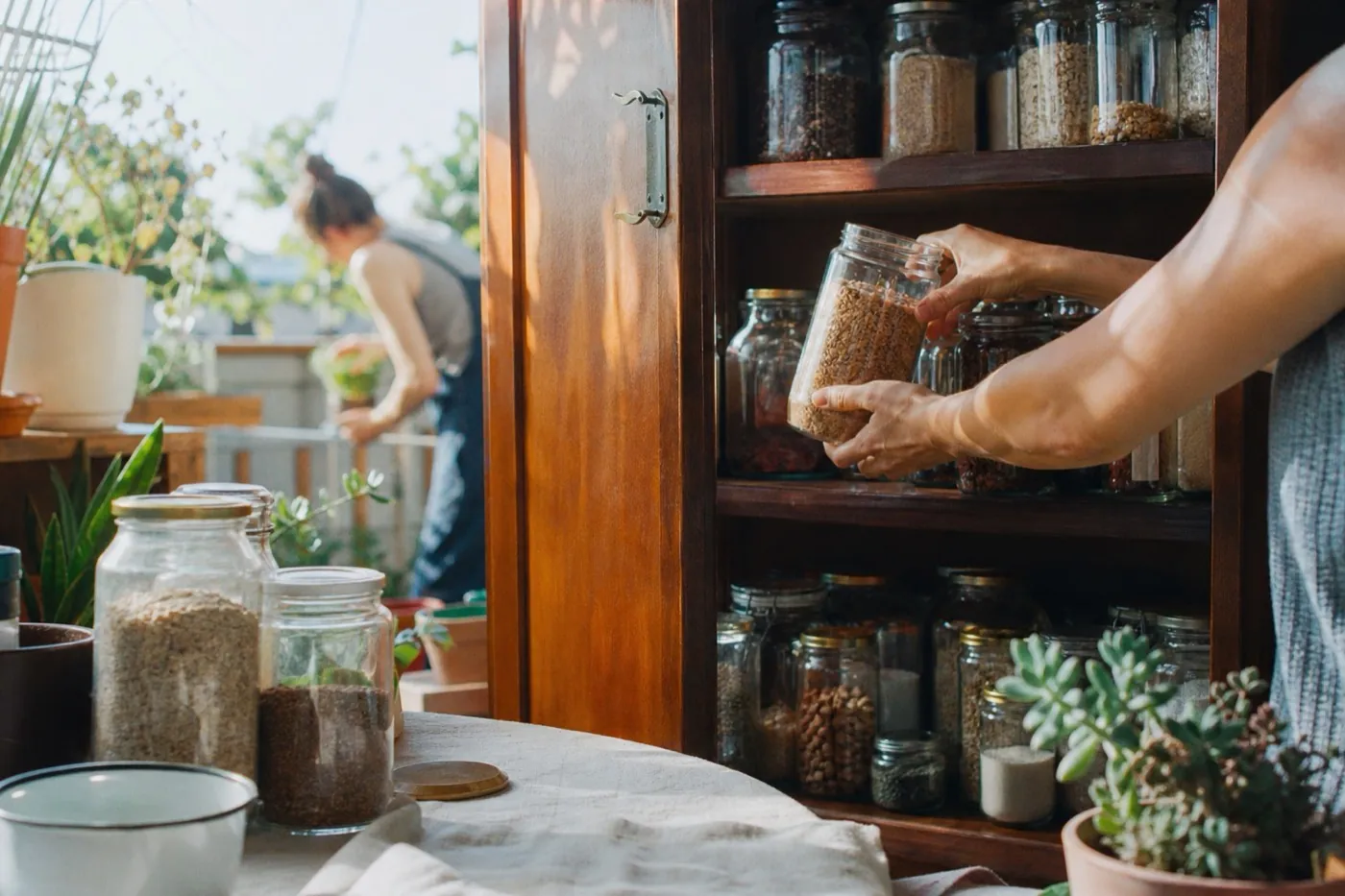
How do you store dry goods in a cupboard?
How to store dry goods: keep flour, grains, rice and pasta in airtight containers in a cool, dry cupboard away from the hob, dishwasher and cleaning products. Keep the label with its date and storage conditions, and put new shopping behind the old.
Dry foods keep well, but not forever. Damp causes mould and clumping, warmth speeds up rancidity in wholemeal flour and nuts, and loosely closed packs invite pantry pests. Four simple habits solve most problems.
This guide covers dry goods in an ordinary home cupboard. Opened tins and dinner leftovers are covered separately, because they need the fridge.
Cupboard pasta with chickpeas
A thick, warming pasta and chickpea stew in the style of Italian pasta e ceci. Apart from the onion and garlic, everything comes from the dry cupboard.
Ingredients
- Tinned chickpeas1 tin
- Ditalini or macaroni150 g
- Chopped tomatoes0.5 tin
- Tomato purée1 tbsp
- Onion1
- Garlic2 cloves
- Dried rosemary1 tsp
- Chilli flakes0.25 tsp
- Vegetable stock800 ml
- Olive oil3 tbsp
Method
- Finely chop the onion and soften it in 2 tablespoons of the oil for 5 minutes. Add the garlic, rosemary and chilli and fry for a minute.
- Stir in the tomato purée, then the tomatoes. Drain and rinse the chickpeas and add them to the pan.
- Mash about a third of the chickpeas in the pan with a fork. This thickens the sauce.
- Pour in the stock, bring to the boil and add the pasta. Cook for 10 to 12 minutes, stirring, until the pasta is tender. Add water if it gets too thick.
- Season with salt and pepper, drizzle with the rest of the oil and serve. Cool any leftovers in a shallow container, refrigerate and eat within 3 to 4 days, reheating until boiling.
Where in the kitchen should the dry-goods cupboard be?
Choose a cupboard that is dry, cool and dark. The worst spots are above the hob, next to the oven and above or beside the dishwasher, because heat and steam get in every time you cook. A cupboard under the sink is out because of damp and the risk of leaks.
The FDA advises not keeping non-perishable food near household cleaning products and chemicals. An accidental spill could cost you the whole cupboard. Keep chemicals separate, ideally lower down or in another room.
The cupboard should also be easy to reach. Put things you use daily at eye level and rarely used items, such as sushi rice or pizza flour, higher or further back. A cupboard where everything hides and nothing can be seen is a sure way to buy duplicates.
FDA: Are You Storing Food Safely?Which containers suit flour, grains, rice and pasta?
Choose containers that are airtight, clean and either clear or labelled. A good lid with a seal protects against damp, smells and pests, and clear walls show how much is left. Do not pour food into a container that held something strongly scented without washing and drying it properly.
The table below shows how to match a container to a food. Sizes are an estimate for typical shop packs, such as a kilo of flour or rice, not a standard.
| Food | Container | Notes |
|---|---|---|
| Plain flour (1 kg) | airtight container, 1.5 litre | match it to the pack so there is not much empty space |
| Rice, grains (500 g–1 kg) | airtight container, 1 or 1.5 litre | keep the original label too if it fits |
| Long pasta | tall narrow container | do not snap spaghetti, or you lose portion control |
| Spices, stock cubes | basket or spice box | keep away from light and heat |
| Sugar, salt | airtight jar | damp makes them clump |
Cut the date and storage line from the original pack or copy them onto masking tape stuck to the container. That way you do not lose information the producer is required to put on the label when you decant.
Should you keep the original label after decanting?
Yes, because it carries the date and storage conditions. Article 25 of EU Regulation 1169/2011 requires special storage conditions to be stated and, where appropriate, a time limit for use once the pack is opened. That information is on the pack, so do not throw it out with the flour bag.
The simplest way is to stick tape on the container with the product name and the best-before date. For products from different batches, add the month of purchase. Never top up an old container with fresh stock, because you lose the chance to use the oldest first and the date becomes meaningless.
On dry foods you will usually find “best before”, a quality date. We explain how it differs from “use by” in our guide to use-by and best-before dates.
Rozporządzenie (UE) nr 1169/2011 / Regulation (EU) No 1169/2011, art. 24, 25 i zał. XWhich foods should you decant and which can stay in the pack?
Not everything needs decanting. Decanting makes sense where the pack is paper, open or hard to close, such as flour, grains, cereal and rice in bags. Ready-made packs with a zip seal, or tins, can stay as they are.
Decanting can be a trap too, because you lose label information and can mix batches. If you live alone or as a pair and buy small packs, rolling the bag shut and using a clip is often enough. Keep containers for foods you reach for often and those at risk from pests.
- decant: flour, grains, rice in paper bags, cereal, sugar, pasta in thin bags
- leave in the original: foods in tight jars, tins and packs with zip seals
- leave with a clip: small bags of spices and yeast you will use within weeks
- decant and label: mixes you buy loose, with the purchase date
After decanting, do not throw away the label straight away. Only when you have copied the date and name is the pack no longer needed. That way, if a question about ingredients or allergens comes up, you know what is in the container.
How long do dry goods keep in a cupboard?
It depends on the food, the pack and the spot, so always go by the best-before date and any storage line on the pack. After that date a dry food is usually still edible, but may lose flavour, smell or texture. Looking and smelling decides the matter.
The pointers below are editorial rules of thumb based on common sense and do not replace the label. Where the producer gives a different time after opening, follow it.
- flour, grains, oats: check the smell, and if it is musty or bitter, throw it away
- rice and pasta: usually long-lasting, but only in a dry, tight container
- wholemeal flour and nuts: go rancid faster, so buy smaller packs
- spices: do not suddenly spoil, but lose aroma over time, so avoid big stockpiles
- sugar and salt: effectively no date, but they clump in damp
A practical rule is to buy what you will use before the date. The large pack is cheaper per kilo only if you do not bin half of it. We cover checking supplies before shopping in our guide to checking food supplies before shopping.
Rozporządzenie (UE) nr 1169/2011 / Regulation (EU) No 1169/2011, art. 24, 25 i zał. XHow do you arrange the shelves of a dry-goods cupboard?
A good layout saves daily guessing. Set it up once, during a stock review. A few moves and an hour of work are enough.
- Take everything out and group it: grains and flours, pasta, tins and jars, spices, sweets and snacks.
- Give each group a shelf or basket and name it on tape.
- Put heavy items such as tins and flour sacks on the lower shelves and light ones higher up.
- Keep spices on one shelf or in one basket, away from the hob.
- Place new shopping behind old and write the date on containers.
When the layout is fixed, everyone at home knows where things go and puts them back. That makes stock easier to track and unpacking the shopping quicker.
What if damp, mould or pests appear in the cupboard?
Act at once, because the problem spreads from one pack to the whole cupboard. The FDA says mould is a sign of spoilage, can grow even in the fridge, and the safest course is to discard mouldy food. That applies to flour, grains or cereal that have gone damp, clumped and changed smell.
- Take everything out of the suspect cupboard and throw away anything mouldy, clumped from damp or smelling odd.
- Check the remaining packs for tiny holes, webbing and small insects. If you find any, discard the food and wash the container.
- Wipe the cupboard with warm soapy water, dry it and air it. The cause of the damp, such as a leak or steam, has to go.
- Decant healthy food into clean airtight containers and label them with the date.
- Check the cupboard more often than usual for a few weeks.
How to use pest products depends on the product, so read the label. Do not spray anything where unwrapped food sits. Move the food out, wash the cupboard and only then refill it.
FDA: Are You Storing Food Safely?How do you rotate stock so the oldest is used first?
Use “first in, first out”. Put new shopping at the back and older stock at the front. Keep products with the nearest date on one shelf or in one basket labelled “use first”.
Every few weeks, do a quick review: take everything out, wipe the shelves and check the dates. Ten minutes gives you a picture of what you own and a list of what to use this week. You also learn what you do not need to buy.
Plan meals around the stock. Cupboard pasta with chickpeas is an example of a dinner that needs nothing fresh except herbs. The recipe is below, above the list.
How can you plan cupboard shopping in BuyNest?
The ready list for a dry-goods cupboard has airtight containers in two sizes, a spice basket, tape for labels and the basics: pasta, rice, grains, flour, chickpeas, tinned tomatoes, purée, olive oil, stock and spices. Import it with the QR code.
When several people shop at home, a shared list in BuyNest helps avoid double buying. Tick things off in the shop and add whatever is running low at home. The cupboard stays tidy and the stock covers the dinners you planned.
Dry cupboard stock
- Containers
- Airtight container 1.5 l flour, sugar, rice3 pcs
- Airtight container 1 l pasta, grains4 pcs
- Spice basket1 pcs
- Masking tape for labels1 pcs
- Pasta and grains
- Ditalini or macaroni500 g
- Spaghetti500 g
- Basmati rice1 kg
- Buckwheat groats400 g
- Plain flour1 kg
- Tins
- Chickpeas 400 g tins2 pcs
- Chopped tomatoes 400 g tins3 pcs
- Tomato purée1 pcs
- Oils and spices
- Olive oil500 ml
- Vegetable stock cubes1 pack
- Dried rosemary1 pack
- Chilli flakes1 pack
Frequently asked questions
Do you have to decant flour into a container?
You do not have to, but it is worth it if the opened pack will not close tightly. A container protects against damp, smells and pests. Keep the date from the original pack.
Where is the best place to keep rice and pasta?
In a dry, cool cupboard away from the hob, dishwasher and cleaning products, ideally in airtight, labelled containers. The FDA advises against keeping non-perishable food next to household chemicals.
Can you eat dry foods after the best-before date?
Usually yes, if they were stored well and have no mould, damp or odd smell. The date refers to quality, not safety. Throw away anything doubtful.
What if flour or grains clump?
Clumping means damp. If the food smells normal and has no mould, use it soon, but find the cause of the damp. If there is mould or a musty smell, throw out the lot.
Should tins go in the dry-goods cupboard too?
Yes, in a dry, cool cupboard, and put any opened leftovers in the fridge. Throw away swollen, leaking or heavily rusted tins, as the FDA advises.
How to store dry goods comes down to airtight containers, a cool cupboard and the date from the original label. Open the ready list in BuyNest, fill in containers and basics, and put older stock at the front.
Open the ready list in BuyNestSources
Take the shopping into BuyNest
BuyNest is on iPhone and Android. The app has no ads, including on the free plan.

