
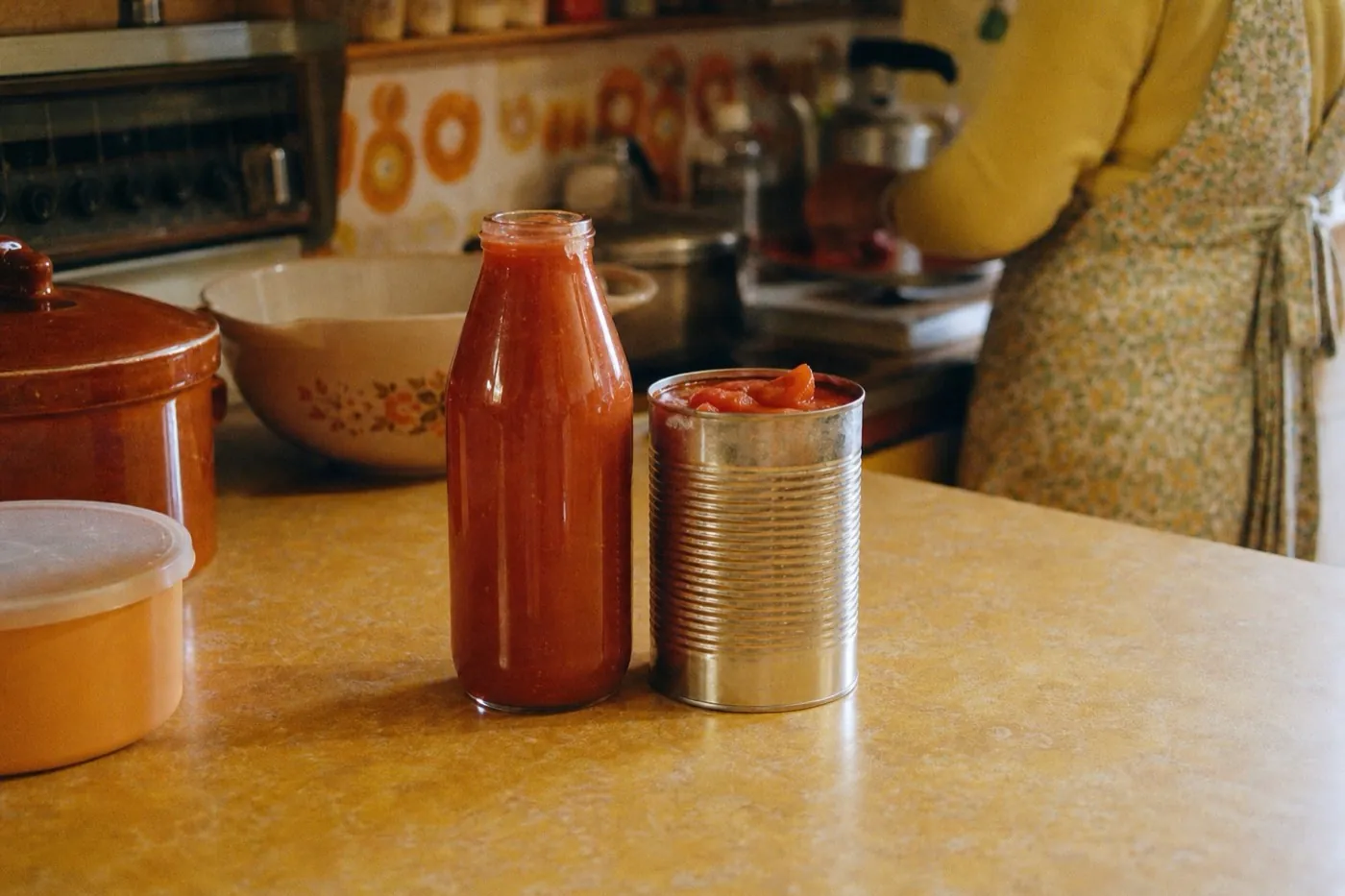
Passata or chopped tomatoes for a sauce: where do you start?
Passata or chopped tomatoes? Choose passata for a smooth, quick sauce for pasta, pizza or a blended soup. Choose chopped tomatoes for a chunky sauce, a stew, chilli or shakshuka. Both come in bottles, cartons or tins, so the texture you want and how much you will use tonight decide it.
Start with the recipe you plan to cook this week. If it says passata or sieved tomatoes, buy the smooth one. If it says tinned or chopped tomatoes, buy the chunks. If it says neither, ask yourself whether you want to see pieces of tomato on the plate.
Just below this section you will find two recipes for two people: a quick passata sauce for spaghetti and shakshuka with chopped tomatoes. The first uses 400 g of passata, the second two tins of chopped tomatoes, so you can see how differently they behave in the pan.
Whole plum tomatoes and their uses have their own guide: tinned tomatoes: whole, chopped or passata. Here we answer a single question: what to buy for a sauce.
Quick passata sauce for spaghetti
The sauce is ready while the pasta cooks. Smooth passata coats spaghetti straight away.
Ingredients
- Passata400 g
- Spaghetti200 g
- Garlic2 cloves
- Olive oil2 tbsp
- Dried oregano1 tsp
- Fresh basil a few leaves
- Parmesan grated30 g
- Salt and pepper
Method
- Put a pan of salted water on for the pasta.
- Warm the olive oil in a frying pan over low heat, add the sliced garlic and cook for a minute until fragrant. Do not let it brown, or it will turn bitter.
- Pour in the passata, add the oregano, a pinch of salt and some pepper. Simmer gently for about 10 minutes, stirring now and then.
- Cook the spaghetti for the time on the pack. Before draining, keep half a cup of the cooking water.
- Tip the pasta into the sauce, add a splash of the cooking water and toss until the sauce clings. Serve with basil and Parmesan.
Tip Make double the sauce and freeze half. It is a ready base for pizza or soup.
Shakshuka with chopped tomatoes
Eggs poached in a thick, chunky tomato and pepper sauce. Chopped tomatoes work better here than passata.
Ingredients
- Chopped tomatoes 400 g2 tin
- Eggs4
- Red pepper1
- Onion1
- Garlic2 cloves
- Ground cumin1 tsp
- Sweet paprika1 tsp
- Olive oil2 tbsp
- Parsley a handful
- Bread to serve
Method
- Dice the onion and pepper. Soften them in the olive oil in a wide frying pan for 6–8 minutes.
- Add the crushed garlic, cumin and paprika. Stir for half a minute.
- Pour in the chopped tomatoes, season with salt and simmer uncovered for 10–12 minutes until the sauce is clearly thicker. A wide pan makes this quicker.
- Make four hollows in the sauce with a spoon and crack an egg into each. Cover and cook over low heat until the whites are set and the yolks are done the way you like.
- Scatter with parsley and serve from the pan with bread.
What is the difference between passata and chopped tomatoes?
Passata is sieved tomato with the skins and seeds removed. It has the texture of a thick juice that coats pasta well. Chopped tomatoes are pieces of tomato in tomato juice, usually in a tin and sometimes in a carton.
You can see the difference on the label. EU Regulation 1169/2011, which still shapes food labels in the UK, requires ingredients to be listed from the largest amount down. Tomatoes should come first, and the rest tells you whether salt, sugar, citric acid or herbs have been added.
- Ingredients: the shorter the list, the easier it is to season the sauce your way.
- Net weight: the basis for working out the price per kilo.
- Drained net weight: required for solid food in a liquid, and useful if you pour off the juice.
- Date mark: tins usually carry a best before date.
- After opening: whether the maker says how many days to use the rest within.
You can check all five in a few seconds at the shelf. The same list works for both, so there is only one set of things to remember.
Rozporządzenie (UE) nr 1169/2011 w sprawie przekazywania informacji na temat żywnościHow do passata and chopped tomatoes compare side by side?
The table compares the two on the points that matter at the shelf. It assumes a typical dinner for two to four people, so one or two packs for one sauce.
| Criterion | Passata | Chopped tomatoes |
|---|---|---|
| Price per kilo | Work it out from net weight; bottles and cartons are often a different size from tins | Work it out from net weight, or drained weight if you pour off the juice |
| Time in the pan | Short: warm it with garlic and oil and the sauce is already smooth | Longer: the pieces need to soften and some juice needs to cook off |
| Taste and texture | Smooth, even, usually milder | Visible pieces, often sharper |
| Best uses | Spaghetti, pizza, lasagne, blended soup, meatball sauce | Shakshuka, chilli, stews, ratatouille, vegetable sauces |
| Storing unopened | Dry cupboard, until the date on the label | Dry cupboard, until the date on the tin; skip dented or bulging tins |
| After opening | Close the bottle and put it in the fridge | Move to a glass or plastic container and refrigerate |
When a recipe works with either, pick the one that leaves less behind after dinner. Half a large bottle is easier to forget than a tin you use up in one go.
USDA FSIS: Shelf-Stable Food SafetyHow do you work out the price per kilo of passata and tinned tomatoes?
The price per pack is misleading, because a bottle of passata and a tin of tomatoes are rarely the same weight. In the EU, Directive 98/6/EC requires shops to show a unit price per kilo or litre, and UK shelf labels show one too. Look for it on the shelf-edge label, usually in smaller print.
If you cannot see a unit price, or you are comparing two shops, work it out yourself.
- Turn the net weight into kilos: 690 g is 0.69 kg, 400 g is 0.4 kg.
- Divide the pack price by that number.
- For chopped tomatoes, if you pour off the juice, divide by the drained weight instead.
- Compare the result with how much you will actually use before the rest goes off.
An example with made-up prices, only to show the sum: a 690 g bottle of passata at £1.10 is 1.10 ÷ 0.69 = £1.59 per kilo. A 400 g tin of chopped tomatoes at £0.65 is 0.65 ÷ 0.4 = £1.63 per kilo. With numbers like these the gap is tiny, so the dish decides.
Pouring off the juice changes the sum. If the drained weight is, say, 240 g, the same tin costs 0.65 ÷ 0.24 = £2.71 per kilo of tomato pieces. The juice does not have to go down the sink: add it to a soup or the next day's sauce.
There are more worked examples in our guide to comparing the price per kilo across pack sizes.
Dyrektywa 98/6/WE w sprawie ochrony konsumenta przez podawanie cen produktów (cena jednostkowa)Rozporządzenie (UE) nr 1169/2011 w sprawie przekazywania informacji na temat żywnościWhen should you choose passata and when chopped tomatoes?
The easiest way to decide is by the dish and the time you have. The pointers below are for a dinner for two to four people from one or two packs.
When to buy passata for pasta and pizza
Passata works when the sauce should be smooth and quick. Soften garlic in olive oil, pour in the passata and season.
- a weeknight spaghetti or penne sauce,
- homemade pizza, where chunks would make the base soggy,
- lasagne and bakes with layers of sauce,
- tomato soup without blending,
- sauce for meatballs or stuffed peppers.
When to buy chopped tomatoes for a sauce
Choose chopped tomatoes when the dish simmers for longer and you want to see the pieces. They go well with peppers, onions, beans and lentils.
- shakshuka and eggs baked in tomato,
- chilli with beans or lentils,
- vegetable stews and ratatouille,
- sauces with courgette, aubergine or peppers,
- chunky vegetable soup.
What can you use instead of passata?
Blend chopped tomatoes and push them through a sieve if the seeds bother you. The sauce will be thinner, so simmer it a few minutes longer with the lid off. Our guide to using tinned tomatoes when you have no passata has more ideas.
How long does opened passata last, and how do you store tinned tomatoes?
Keep unopened packs in a cool, dry cupboard and use them in date order. The European Food Safety Authority (EFSA) explains that a best before date is about quality, and tinned goods usually carry that kind of date. Set aside dented or bulging tins rather than opening them.
Once opened, move tinned tomatoes into a glass or plastic container with a lid and refrigerate. The US Food Safety and Inspection Service (USDA FSIS) gives about 5–7 days in the fridge for opened high-acid tinned foods such as tomatoes. Close a bottle of passata and check the label for how many days the maker recommends.
You can freeze leftover sauce in a small container. Label it with the name and date, as in our guide to labelling freezer containers.
- stir it into tomato or vegetable soup,
- spread it on pizza or cheese on toast the next day,
- use it as a base for eggs in tomato at breakfast,
- add it to a stew or a bean sauce,
- freeze it in portions of a few spoonfuls for the next sauce.
These ideas assume leftovers from a dinner for two, usually half a bottle or half a tin.
USDA FSIS: Shelf-Stable Food SafetyEFSA: Food date labelling (use by, best before)How do you add passata and chopped tomatoes to your BuyNest list?
Write the type and the weight in the item name: passata 690 g or chopped tomatoes, 2 tins. Whoever does the shop will not need to ring home to ask which one. Everyone in the household sees a shared list straight away, so a last-minute change of recipe reaches the person at the shelf.
We have gathered everything for both recipes on this page in one place: the ready shopping list for passata pasta and shakshuka. Moving it into the app takes four steps.
- Open the ready list on this page.
- Scan the QR code with your phone or, if you are reading on your phone, tap the import button.
- Remove what you already have in the cupboard and adjust the amounts for your household.
- Assign items to shops and share the list with the people you live with.
You will find more comparisons in food comparisons and dinner ideas in BuyNest recipes.
Passata and chopped tomatoes: two dinners
- Tomatoes
- Passata bottle690 g
- Chopped tomatoes 400 g tins2 pack
- Dry goods
- Spaghetti500 g
- Dairy and eggs
- Eggs6 pcs
- Parmesan100 g
- Vegetables and herbs
- Red pepper1 pcs
- Onion2 pcs
- Garlic bulb1 pcs
- Basil pot1 pcs
- Parsley bunch1 pcs
- Spices and oils
- Olive oil500 ml
- Ground cumin1 pack
- Sweet paprika1 pack
- Dried oregano1 pack
- Bread
- Sourdough bread1 loaf
Frequently asked questions
Is passata the same as tomato purée?
No. In the UK, tomato purée is the thick concentrate sold in small tubes and tins, used a spoonful at a time. Passata is runny sieved tomato you can use as a sauce straight away. Check the label, as some products sold as sieved tomatoes are thicker than others.
How much passata do you need for pasta for two?
The recipe on this page uses 400 g of passata with 200 g of spaghetti for two portions. If you like plenty of sauce, use the whole bottle and keep the extra for the next day. For a bigger household, scale the amounts up in proportion.
Can I use chopped tomatoes instead of passata?
Yes, blend them and sieve them if you like. The sauce will be thinner, so cook it down a few minutes longer. Texture matters most on pizza and in lasagne.
Why is my chopped tomato sauce sour?
The sharpness comes from the tomatoes, and a short simmer does not soften it. Cooking longer with the lid off, a knob of butter or a pinch of sugar at the end all help. Check the ingredients too, as some brands add citric acid.
Can you keep an opened tin of tomatoes in the fridge?
It is better to move the rest into a glass or plastic container with a lid. USDA FSIS says you can refrigerate food in the tin, but it keeps its flavour better once transferred. Write the opening date on the container.
Can you freeze passata?
Yes, in an airtight container or freezer bag with a little space for it to expand. Portions for one sauce or one pizza are the most useful. Thaw in the fridge or straight in the pan.
Passata or chopped tomatoes: let the dish on this week's plan decide. Add your choice to the list with the pack weight. Import the ready list into BuyNest, and at the shelf you only need to compare the price per kilo.
Open the ready list in BuyNestSources
Take the shopping into BuyNest
BuyNest is on iPhone and Android. The app has no ads, including on the free plan.