
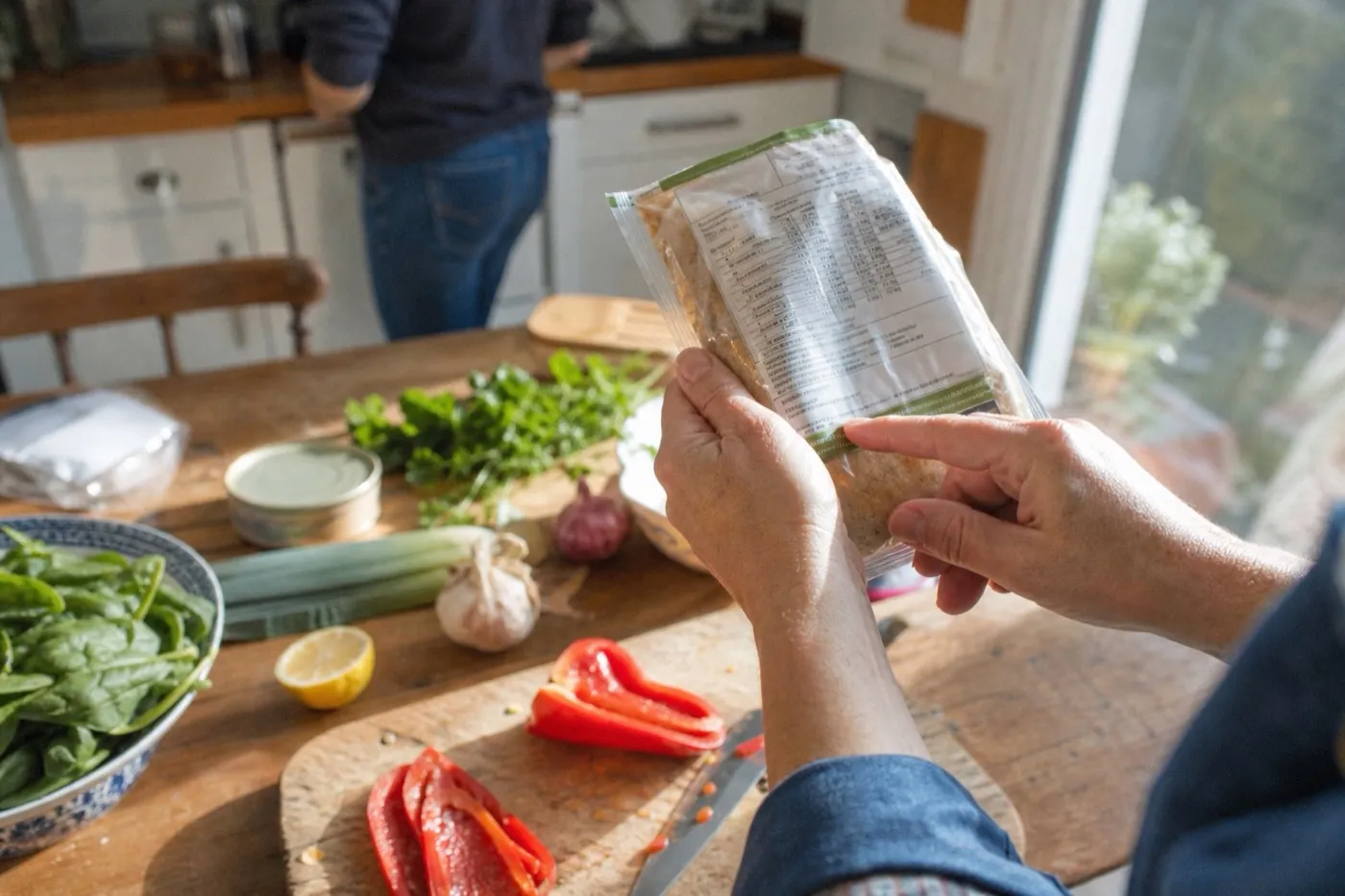
Where is salt on a food label and how do you read it?
Salt on food labels sits in the nutrition table, in a separate row called ‘salt’, given in grams per 100 g or 100 ml. Compare products of the same kind in that column, because the per-serving figure depends on how each manufacturer defines a serving.
In EU rules the salt row is compulsory on most pre-packed foods. Regulation 1169/2011 lists it next to energy, fat, saturates, carbohydrate, sugars and protein. A producer may add a per-serving figure, but the per-100 g one must always be there.
EUR-Lex: Rozporządzenie (UE) nr 1169/2011 w sprawie przekazywania konsumentom informacji na temat żywnościNHS: How to read food labelsTomato and lentil soup without a stock cube
Here the flavour comes from vegetables, roasted pepper and spices instead of a stock cube. You add the salt yourself, at the end, as much as you like.
Ingredients
- Rapeseed oil1 tbsp
- Onion1
- Carrots2
- Celery sticks2
- Garlic2 cloves
- Smoked paprika1 tsp
- Chopped tomatoes no added salt2 tin
- Red lentils120 g
- Water1 l
- Bay leaf2
- Lemon juice1 tbsp
- Flat-leaf parsley½ bunch
Method
- Heat the oil in a large pan. Dice the onion, carrots and celery and cook over medium heat for 8–10 minutes until soft and lightly browned. These give the soup its depth.
- Add the garlic and paprika and stir for a minute.
- Add the rinsed lentils, tomatoes, water and bay leaves. Cover and simmer for 20 minutes until the lentils break down.
- Remove the bay leaves and blend the soup. Add the lemon juice, which lifts the flavour in a similar way to salt.
- Taste, and only now add salt, a little at a time. Serve sprinkled with parsley.
Herb and radish cottage cheese spread
A sandwich spread to eat instead of ham or hard cheese. The flavour comes from herbs, garlic and vegetables.
Ingredients
- Quark or cottage cheese250 g
- Plain yoghurt3 tbsp
- Radishes6
- Chives½ bunch
- Dill½ bunch
- Garlic optional1 cloves
- Black pepper
Method
- Mash the quark with the yoghurt using a fork until smooth.
- Finely dice the radishes, chop the herbs and crush the garlic.
- Mix everything and season with pepper. Taste before adding salt: with herbs and garlic, a pinch or none is often enough.
- Keep in a closed container in the fridge and eat within 2 days.
What is the difference between salt and sodium on a label?
In the EU table, ‘salt’ means sodium converted to salt, which is the sodium content multiplied by 2.5. So the figure also counts sodium from sources other than table salt, such as flavour enhancers. That is why the salt on a label can be higher than your own salting at the stove would suggest.
Occasionally you will see only sodium, especially on imported products or older packs. The conversion is simple:
| Sodium per 100 g | Salt per 100 g | What it means |
|---|---|---|
| 0.12 g | 0.3 g | the level at which a ‘low’ claim is allowed |
| 0.4 g | 1 g | a middle level, depending on the kind of food |
| 0.6 g | 1.5 g | the point above which UK traffic-light labels turn red |
If the table shows only sodium, multiply it by 2.5 before comparing with a product that lists salt.
EUR-Lex: Rozporządzenie (UE) nr 1169/2011 w sprawie przekazywania konsumentom informacji na temat żywnościNHS: How to read food labelsHow much salt a day is advised, and what counts as a lot in a product?
The WHO recommends that adults eat less than 5 g of salt a day, which is less than about 2 g of sodium. For children the limit is lower and depends on how much energy they eat. The WHO also points out that in many countries a significant share of the sodium in the diet comes from processed foods.
On EU labels you may see a percentage of the reference intake. For salt it is 6 g a day, set in Regulation 1169/2011 as a reference value for an average adult. It is not advice on how much salt to eat, only the value against which a portion’s share is worked out.
For a quick judgement, use the scale from UK colour-coded labels. Per 100 g of food, more than 1.5 g of salt is high and 0.3 g or less is low; anything in between is medium. These bands come from NHS guidance, and they work as a rule of thumb on any label that gives salt per 100 g.
WHO: Salt reduction (fact sheet)EUR-Lex: Rozporządzenie (UE) nr 1169/2011 w sprawie przekazywania konsumentom informacji na temat żywnościGOV.UK: Front of pack nutrition labelling guidanceNHS: How to read food labelsWhat do ‘low salt’ and ‘no added salt’ claims mean?
Salt claims on the front of a pack are set out in the EU nutrition and health claims regulation, 1924/2006, and have fixed thresholds. They sound alike but mean different things. The table lists the common ones; thresholds refer to sodium per 100 g or 100 ml of product.
For ease, we add the matching salt figure, worked out with the rule from the previous section.
| Claim | Threshold (sodium per 100 g) | Roughly in grams of salt |
|---|---|---|
| Low sodium/salt | no more than 0.12 g | 0.3 g |
| Very low sodium/salt | no more than 0.04 g | 0.1 g |
| Sodium-free/salt-free | no more than 0.005 g | 0.0125 g |
| No added salt | no sodium or salt added, and sodium no more than 0.12 g | up to 0.3 g |
| Reduced salt | at least 25% less than in comparable products | depends on the product |
Look at the last row. ‘Reduced’ is a comparison with another product, so the food can still be fairly salty. Always check the number in the table.
EUR-Lex: Rozporządzenie (WE) nr 1924/2006 w sprawie oświadczeń żywieniowych i zdrowotnychHow can you compare two products in a minute?
Compare products of the same kind and always in the per-100 g column. Manufacturers’ servings differ, so per-serving figures mislead easily. Two tins of tomatoes, two loaves or two boxes of cereal can differ several times over in salt.
Five steps are enough at the shelf:
- Turn the pack over and find the ‘salt’ row in the nutrition table.
- Check that the figure is per 100 g and not only per serving.
- Compare it with another product of the same kind, such as a different brand of tinned tomatoes.
- Glance at the ingredients: salt, yeast extract, flavour enhancers and soy sauce usually point to a higher content.
- Save your pick in a note next to the item so you do not compare again next time.
When a product has a dozen ingredients and several sources of salt, its table is the best shortcut. The ingredient list shows the order from largest to smallest, but it will not tell you how much salt is in a portion.
Which products should you look at first?
Most attention belongs on foods you eat often and in large amounts: bread, cold meats, cheese, ready-made sauces, instant soups, stock cubes and snacks. One change in the basket does more than counting salt at every meal.
You do not need to change everything at once. Pick the two products your household eats most and compare them with alternatives. The effect shows from the next shop, because you change what you pick from the shelf, not how you cook.
What can replace some of the salt in cooking?
Herbs, garlic, lemon and salt-free spice blends can replace part of the salt. Smoked paprika, parsley and chives add flavour without reaching for the shaker. Vegetables browned in a pan taste stronger, so they need less seasoning.
Drain and rinse tinned chickpeas and beans, because the liquid contains salt. When buying spice mixes, read the ingredients: some list salt first.
How do you save a salt comparison on your shopping list?
For products you compare, add a note such as ‘salt per 100 g’ or the brand that came out best. Next time you will not have to check everything from scratch. The list ‘Shopping with less salt’ has a separate group, ‘Tins to compare’ (Puszki do porównania in Polish), where it pays to read the table in the shop.
In BuyNest you can save the list as your own template and share it with the household, so everyone buys the same chosen product. Two recipes sit further down, above the list. The tomato and lentil soup without a stock cube shows that vegetables browned in a pan, paprika and lemon give the flavour usually credited to the cube. The herb and radish cottage cheese spread can stand in for cold meat on a sandwich.
This text is general information. People with high blood pressure, kidney or heart conditions, as well as pregnant women and parents of young children, should agree the amount of salt with a doctor or dietitian.
Which traps catch people out when reading salt on a pack?
Even when you know the table, a few things are easy to miss. Here are the four that come up most often, with a short tip for each.
- The manufacturer’s serving is small, so the figure looks harmless. Convert it to what you really serve, or go back to the per-100 g column.
- The product is dry but you eat it made up. Instant soup or powdered sauce lists salt for the powder, so read the ‘as prepared’ column too, if the maker gives one.
- Bread seems neutral because it does not taste salty. But you eat a lot of it, so the gap between two loaves adds up fast.
- You trust the claim on the front and skip the back. A claim is a slogan; the real information is in the table.
All four come down to one habit: before a product goes in the basket, turn it over and read one row. After a few shops it takes seconds, and for your regular items you only do it once.
How do you read salt together with portions and other numbers?
Salt is only one figure in the table, and you judge the product as a whole. If you want to read the other rows, see our guide to understanding sugars on nutrition labels. How a manufacturer’s portion compares with what lands on your plate is covered in a serving on the label and a serving on your plate.
It is good practice to judge a product together with how often you reach for it. Cold meat eaten daily counts differently from cheese bought once a month, even if the two show a similar figure in the table.
Shopping with less salt
- Vegetables
- Onion2 pcs
- Carrots4 pcs
- Celery head1 pcs
- Garlic bulb1 pcs
- Radishes bunch1 pcs
- Lemons2 pcs
- Herbs and spices
- Flat-leaf parsley bunch1 pcs
- Chives bunch1 pcs
- Dill bunch1 pcs
- Smoked paprika1 pack
- Bay leaves1 pack
- Black pepper1 pack
- Tins to compare
- Chopped tomatoes salt per 100 g2 pcs
- Tinned chickpeas lowest salt2 pcs
- Cupboard
- Red lentils500 g
- Bread compare salt1 loaf
- Dairy
- Quark or cottage cheese250 g
- Plain yoghurt400 g
Frequently asked questions
How much salt a day does the WHO recommend?
For adults the WHO recommends less than 5 g of salt a day, which is under about 2 g of sodium. For children the limit is lower and depends on the energy they eat. With a long-term condition, agree the amount with your doctor.
Is sodium on a label the same as salt?
No, but it is easy to convert. Salt is sodium multiplied by 2.5. EU and UK nutrition tables list salt, so you rarely need to calculate unless a pack shows only sodium.
Does ‘no added salt’ mean the food has no salt?
Not always. It means no sodium or salt was added, but the ingredients can contain sodium naturally. Check the table, because the value must not exceed 0.12 g of sodium per 100 g.
Is sea salt or Himalayan salt healthier?
On a label the type of salt does not matter, because the amount of sodium is what counts. Switching to another kind will not replace using less. Go by the grams per 100 g.
Where does most of the salt in the diet come from?
According to the WHO, in many countries a significant share of dietary sodium comes from processed foods. That is why it pays to compare the labels on bread, cold meats, cheese, sauces and ready soups.
Salt on food labels is one row in the table, read in the per-100 g column and compared with another product of the same kind. Open the ready list in BuyNest, note the products that came out best and buy them without comparing again.
Open the ready list in BuyNestSources
- EUR-Lex: Rozporządzenie (UE) nr 1169/2011 w sprawie przekazywania konsumentom informacji na temat żywności
- EUR-Lex: Rozporządzenie (WE) nr 1924/2006 w sprawie oświadczeń żywieniowych i zdrowotnych
- WHO: Salt reduction (fact sheet)
- NHS: How to read food labels
- GOV.UK: Front of pack nutrition labelling guidance
Take the shopping into BuyNest
BuyNest is on iPhone and Android. The app has no ads, including on the free plan.

