
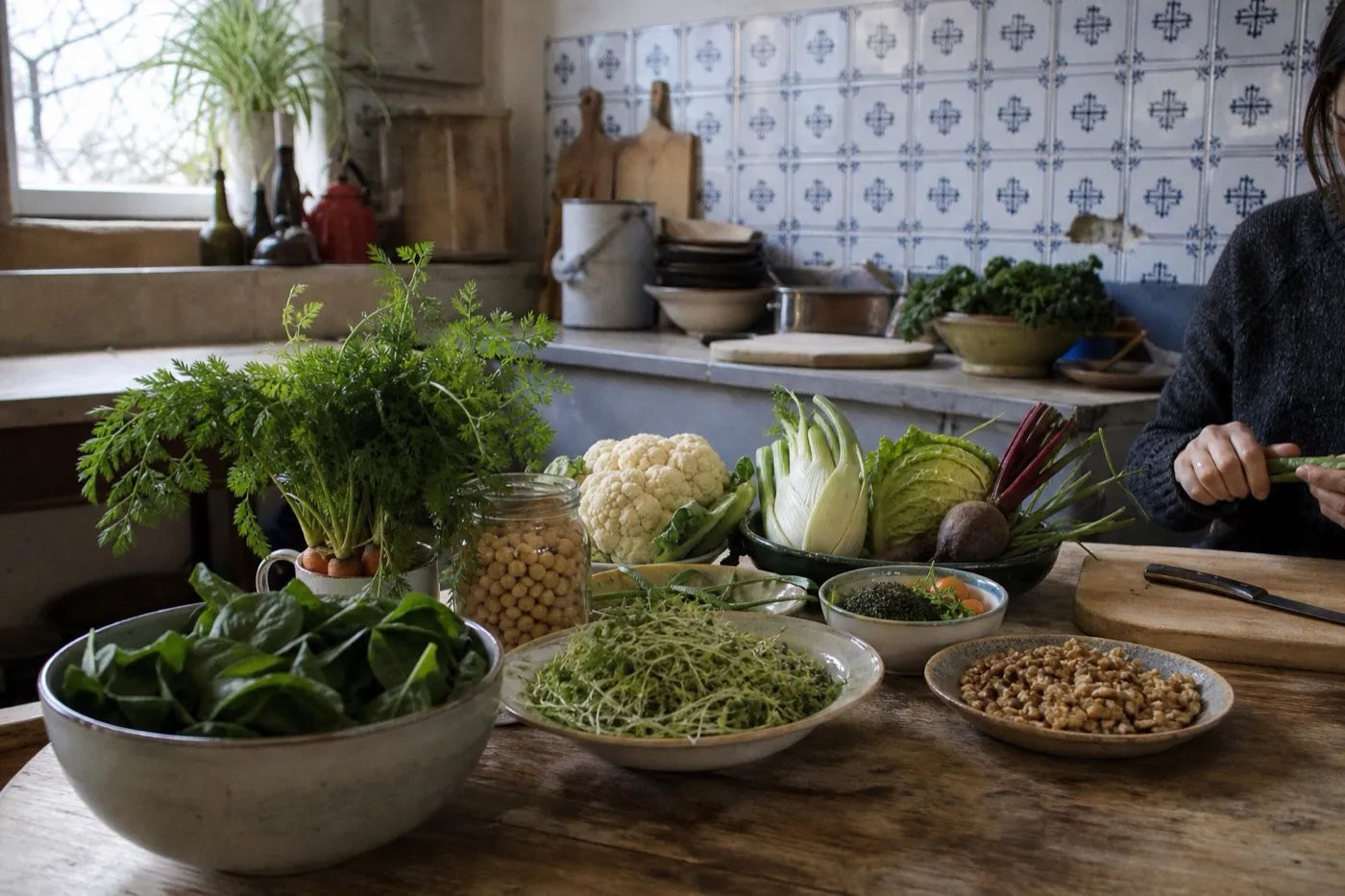
What are the types of vegetarian diet?
The main types of vegetarian diet differ in what they exclude besides meat and fish. A lacto-ovo vegetarian eats dairy and eggs, a lacto vegetarian only dairy, an ovo vegetarian only eggs, and a vegan eats no animal products at all. Before you shop for a guest or a housemate, ask which one they mean.
Below you will find short descriptions, label tips and a weekly shopping list. The text covers shopping, not a nutrition plan for a particular person.
Shakshuka with white beans
Eggs poached in a tomato and pepper sauce. The beans make it filling enough for dinner, not just breakfast. A version for people who eat eggs.
Ingredients
- Rapeseed oil1 tbsp
- Onion1
- Red pepper1
- Garlic2 cloves
- Sweet paprika1 tsp
- Chopped tomatoes 400 g1 tin
- Tinned white beans drained1 tin
- Eggs4
- Flat-leaf parsley½ bunch
- Wholemeal bread slices4
Method
- Heat the oil in a frying pan with a lid. Dice the onion and pepper and cook for 8 minutes until soft.
- Add the chopped garlic and paprika and stir for a minute. Pour in the tomatoes, add the beans and simmer uncovered for 5 minutes until the sauce thickens slightly. Taste and season.
- Make four hollows in the sauce with a spoon and crack an egg into each. Cover and cook over low heat for 6–8 minutes until the whites are set. The yolks can stay runny if you like them that way.
- Sprinkle with parsley and serve straight from the pan with the bread.
White bean and sun-dried tomato spread
A sandwich spread with no cheese or eggs, so it also works for a vegan version. You need a blender or just a fork.
Ingredients
- Tinned white beans drained1 tin
- Sun-dried tomatoes in oil50 g
- Garlic1 cloves
- Lemon juice1 tbsp
- Olive oil or oil from the tomatoes1 tbsp
- Dried basil½ tsp
Method
- Drain and rinse the beans. Drain the sun-dried tomatoes but keep the oil.
- Blend the beans with the tomatoes, garlic, lemon juice and a tablespoon of the oil. Without a blender, mash the beans with a fork and chop the tomatoes finely.
- Season with basil and pepper and add salt only after tasting. Spoon into a jar and keep in the fridge for up to 3 days.
How do lacto-ovo, vegan and pescatarian diets differ?
A table is the quickest way to compare them. The split is an editorial simplification based on how these labels are commonly used, because many people follow their own rules that do not fit one label.
| Name | Meat | Fish | Dairy | Eggs |
|---|---|---|---|---|
| Lacto-ovo vegetarian | no | no | yes | yes |
| Lacto vegetarian | no | no | yes | no |
| Ovo vegetarian | no | no | no | yes |
| Vegan | no | no | no | no |
| Pescatarian | no | yes | usually yes | usually yes |
| Flexitarian | rarely | usually yes | yes | yes |
Pescatarians are listed for clarity because they are often mistaken for vegetarians. They eat fish, so a shop needs different choices. Flexitarian eating has its own guide to the flexible approach to meat, and veganism is covered in the piece on plant-based and vegan diets.
What should you ask before you buy the food?
Many people follow rules that do not come from the name of the diet. One person eats only free-range eggs, another avoids cheese made with animal rennet, a third gives up only red meat. A short chat before shopping saves a second trip.
- Do you eat eggs and dairy, or do you leave out one of them?
- Do you eat fish and seafood?
- Do gelatine, animal rennet or meat stock in ready meals bother you?
- Are there brands or products you already trust?
- Is anyone at home allergic to something that must not be missed on the label?
Put the answers in a note on the list. That way the person in the shop does not have to ring you from the aisle.
What does “vegetarian” on a pack actually mean?
Not much in legal terms, for now. The EU has no shared binding definition of “vegetarian” and “vegan” on packaging. Regulation 1169/2011 allows the Commission to adopt rules on information about whether food suits vegetarians or vegans, but until it does, such marks are voluntary.
Producers therefore use their own wording or marks awarded by private organisations. Such a logo can help, but its rules are set by the body that awards it, not by law. In the end the ingredients list decides, and packaged food must carry one.
A missing “vegetarian” label does not mean a product is not. Plain pasta, tinned beans or porridge oats rarely carry such a mark, because there is no need.
Rozporządzenie (UE) nr 1169/2011 w sprawie przekazywania informacji na temat żywnościWhere do animal ingredients hide in the list?
Meat and fish are easy to spot, but additives are harder. The items below most often surprise people who shop for vegetarians for the first time.
- Gelatine, usually from pork or beef, turns up in gummy sweets, marshmallows, some yoghurts, desserts and jellies.
- Cochineal (E120), a colouring made from insects, is found in some sweets and drinks.
- Shellac (E904) is used to glaze sweets and fruit.
- Meat extract, beef fat and chicken stock appear in instant soups, sauces and stock cubes.
- Lard can be in puff and shortcrust pastry.
- Anchovies and fish sauce are in traditional Worcestershire sauce and many Asian sauces.
You do not have to remember every E number. Read the ingredients of processed food to the end and put doubtful items aside for later.
Is cheese always vegetarian?
Not always. Many matured cheeses are made with animal rennet taken from calf stomachs. The label often says only “rennet”, without saying where it comes from.
Some producers add “microbial rennet” or “non-animal”. If that is missing and it matters to someone, choose another cheese or ask the producer.
How can you add variety instead of relying on meat substitutes?
A vegetarian diet can be well balanced, but it needs variety. The NHS advises eating pulses, eggs or dairy, grain foods, vegetables and fruit regularly, and draws attention to iron, vitamin B12 and omega-3. For vegans the list of nutrients that need attention is longer.
In the basket this means more beans, lentils, chickpeas and tofu, not only ready-made meat substitutes. Plant burgers and sausages can be convenient but are often salty. Compare the nutrition table per 100 g just as you would with cold cuts.
What belongs in a vegetarian cupboard?
A good base is made of items that combine easily. Red lentils cook in 15–20 minutes, tinned beans and chickpeas are ready at once, and frozen spinach or peas keep well. Add pumpkin or sunflower seeds, nuts, eggs or tofu, and wholewheat pasta or grains.
From these you can make dinner in a quarter of an hour even when the fridge is nearly empty. Vegetable stock is useful too, but check stock cubes and concentrates, because some contain fat or meat extract.
What can replace ham on a sandwich?
A bean or chickpea spread, an egg, cottage cheese with vegetables, or a slice of cheese made with microbial rennet. These take minutes to make and keep for about 2–3 days in the fridge (an editorial estimate). One new spread a week is enough to see what the household accepts.
NHS, The vegetarian dietHow do you check ready meals and snacks for meat?
Ready meals, soups in cartons and snacks are where animal ingredients turn up most often. On your first shop with a new list, work through the steps below, and after a few visits you will remember the brands that passed.
- Read the product name, but do not stop there.
- Go through the whole ingredients list and look for meat, fish, gelatine, lard and stock.
- Check the allergens, which EU law requires to be highlighted in the ingredients.
- If you hesitate over one ingredient, put the product back and return to it when you have time.
- Save the checked product on the list together with the brand, so you do not have to read it again.
All ingredients of packaged food must be listed on the pack, so missing information usually means you are looking in the wrong place, not that something is hidden. More on allergens is in the guide to allergen information on shared shopping trips.
Rozporządzenie (UE) nr 1169/2011 w sprawie przekazywania informacji na temat żywnościHow can you cook one dinner for different diets?
In a home where one person skips eggs and another eats fish, you do not need to cook three dinners. A shared base with separate extras is enough, chosen so none needs its own pan.
Lentils, rice, grains or pasta work well as the base, with a tomato sauce and vegetables. A fried egg, cheese, yoghurt or a piece of fish goes on the plate separately.
That keeps the shopping list shorter, and each person gets what they eat. Save the shared base in BuyNest as one group and the extras as separate items with the name of the person in a note.
How do you plan a week of meat-free dinners?
The plan below is for two people who eat dairy and eggs. You can change the order, and one dish can stretch over two days. It is our own suggestion, not dietary advice.
| Day | Dinner | Cupboard base |
|---|---|---|
| Monday | shakshuka with white beans and bread | tinned beans, chopped tomatoes, eggs |
| Tuesday | red lentil soup | lentils, onion, carrot |
| Wednesday | wholewheat pasta with frozen spinach and pumpkin seeds | pasta, spinach, pumpkin seeds |
| Thursday | tofu with vegetables and rice | tofu, frozen vegetables, rice |
| Friday | sandwiches with bean and sun-dried tomato spread | beans, sun-dried tomatoes, bread |
Shakshuka contains eggs, so in a home with a vegan swap it for the bean spread or the soup. Neither contains dairy or eggs.
Who should talk to a doctor about a meat-free diet?
Children, pregnant women, older adults and people with chronic conditions should discuss a vegetarian diet with a doctor or dietitian. Needs differ, and a general text on shopping cannot work them out for you.
If you are moving to meat-free eating yourself, a useful general reference is the Polish Healthy Eating Plate: half the plate is vegetables and fruit, a quarter grain foods, a quarter protein foods including pulses. It shows proportions, not exact portions.
NCEZ / NIZP PZH-PIB, Talerz Zdrowego ŻywieniaHow do you set up a list for a home where everyone eats differently?
With shared shopping, the word “cheese” or “stock” alone is not enough. In BuyNest add a note to the product, such as “microbial rennet” or “no meat in the ingredients”, so the person in the shop knows what to look for.
Two recipes sit just above the list. Shakshuka with white beans is the egg version. The white bean and sun-dried tomato spread has no dairy or eggs, so it suits every type. The ready vegetarian basket for the week covers both dishes and stock for a few more meals: lentils, pasta, tofu and frozen spinach.
If the household eats differently, you can split the list into groups or assign products to one person. Then it is clear at a glance what is shared and what you buy for one person only. More meat-free ideas are in the diets and recipes section.
A vegetarian basket for the week
- Vegetables
- Onions2 pcs
- Red peppers2 pcs
- Garlic bulb1 pcs
- Flat-leaf parsley bunch1 pcs
- Lemon1 pcs
- Frozen spinach450 g
- Pulses and cupboard
- Tinned white beans tins3 pcs
- Red lentils500 g
- Chopped tomatoes 400 g tin2 pcs
- Sun-dried tomatoes in oil jar1 pcs
- Wholewheat pasta500 g
- Wholemeal bread1 loaf
- Pumpkin seeds100 g
- Dairy and eggs
- Eggs10 pcs
- Plain yoghurt400 g
- Cheese with non-animal rennet check label200 g
- Plain tofu180 g
- Spices and oil
- Rapeseed oil1 l
- Sweet paprika1 pack
- Vegetable stock cubes meat-free1 pack
Frequently asked questions
Does a vegetarian eat eggs and dairy?
It depends on the type. A lacto-ovo vegetarian eats both, a lacto vegetarian only dairy, and an ovo vegetarian only eggs. The safest approach is to ask before you shop.
Is a pescatarian a vegetarian?
No, because a pescatarian eats fish and seafood. They are often described as meat-free, but in a shop they need different choices from a vegetarian.
Does “vegetarian” on a label guarantee no animal products?
There is no shared legal definition in the EU. The wording is voluntary, and private marks follow their own rules. Check the ingredients list.
Is hard cheese vegetarian?
Not always, because many matured cheeses are made with animal rennet. Look for microbial or non-animal rennet on the label, or ask the producer.
Can a child eat without meat?
A doctor or dietitian decides about a child's or a pregnant woman's diet. This guide only covers shopping and labels, so it cannot replace individual advice.
The types of vegetarian diet differ in small details that make a big difference in a shop. Ask about the rules, read the ingredients to the end and keep notes on the list, and the next shop will go faster.
Open the ready list in BuyNestSources
Take the shopping into BuyNest
BuyNest is on iPhone and Android. The app has no ads, including on the free plan.