
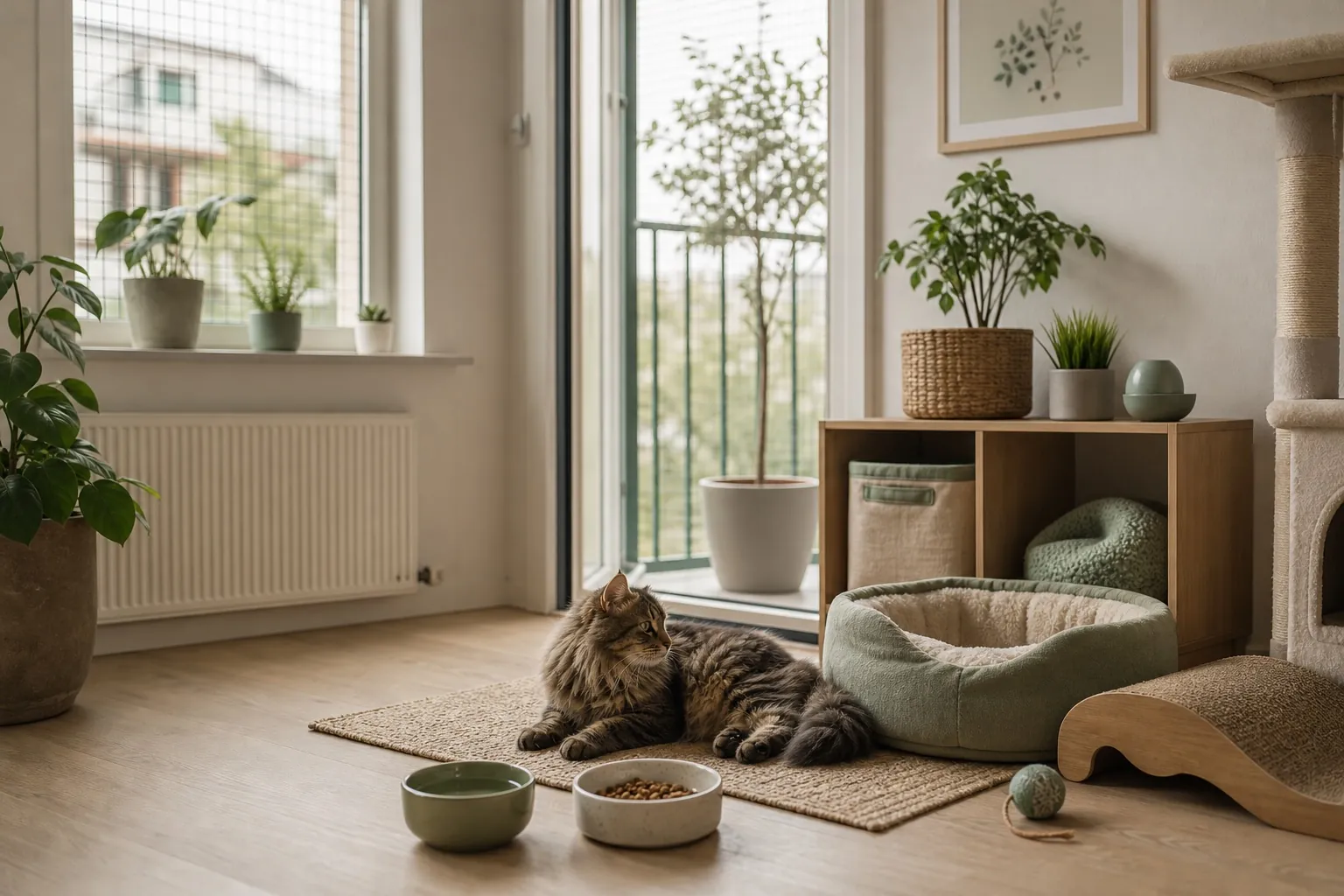
Getting your home ready for a cat takes more than setting up a litter tray and bowls. You need to secure windows, the balcony, plants, cables and appliances, and also give your cat calm places to hide, rest, scratch and watch the surroundings. The safest start is a single adjustment room where your cat finds everything it needs. Once it feels more confident, it can explore the rest of the home gradually.
A ready-made checklist for preparing your home for a cat
Checklist for preparing your home for a cat (part 1 of 2)
- Cat information
- Find out what food the cat eats now.
- Ask about feeding times and routine.
- Check which litter and tray type it uses.
- Ask where it likes to sleep and whether it uses high spots.
- Find out which surfaces it scratches.
- Find out how it reacts to the carrier and travel.
- Ask about medicines, illnesses and allergies.
- Collect vaccination, microchip and treatment records.
- Find out how it reacts to children, dogs and other cats.
- Ask whether it has been outdoors before.
- Confirm what comes with the cat.
- Choose a vet and save a 24-hour clinic's number.
- Adjustment room
- Pick a quiet room that closes.
- Secure windows and the balcony, if it opens onto one.
- Put away cables and small objects.
- Put the litter tray away from food and water.
- Put water some distance from food.
- Set up a hiding place at floor level.
- Provide a safe high spot.
- Set up a stable scratching post.
- Prepare a blanket or simple bed.
- Remove plants not confirmed as safe.
- Block dangerous gaps behind furniture and appliances.
- Limit access for children, visitors and other pets.
- Home safety
- Fit permanent window protection.
- Make tilted windows safe from wedging.
- Secure the balcony from floor to top edge or roof.
- Put away medicines and supplements.
- Lock away cleaning products and laundry detergents.
- Check all houseplants and bouquets.
- Secure electrical cables and chargers.
- Put away string, ribbon, hair ties and thread.
- Clear small objects from the floor.
- Block access to washing machine, dryer and dishwasher.
- Secure the bins.
- Check shelves, decorations and tall furniture are stable.
- Secure candles, fireplace and hot surfaces.
- Block gaps behind appliances and inside sofa beds.
Checklist for preparing your home for a cat (part 2 of 2)
- Household rules
- Decide who is responsible for feeding.
- Decide who cleans the litter trays each day.
- Plan time for calm play.
- Decide who arranges vet visits.
- Introduce a rule of checking windows and doors.
- Explain to children not to pull the cat out of hiding.
- Limit visitors in the first few days.
- Plan cat care for when you are away.
- Other pets
- Prepare a separate room and resources for the cat.
- Spread out trays, water, food, hiding places and posts.
- Plan a scent swap before they meet.
- Don't allow instant face-to-face contact.
- Give the cat escape routes and high spots.
- Keep the dog away from the cat's tray and food.
- Supervise first meetings and end them before tension builds.
- Arrival day
- Close windows, balcony and outside doors.
- Carry the closed carrier straight to the adjustment room.
- Put the carrier on the floor and open it.
- Step back and let the cat come out in its own time.
- Don't pull the cat from the carrier or hiding place.
- Keep it quiet and let the cat hide.
- Don't invite visitors.
- Don't introduce everyone and every pet at once.
- Don't let the cat outside.
- Check it has water, food and a clean tray.
Create separate shopping and preparation lists in BuyNest for your cat's arrival. Share the one you choose with someone in your household so you both can see what is still to do.
How to prepare for a cat: start with its needs
Not every cat needs the same settling-in plan. Before it arrives, ask its current carer about its temperament, previous living conditions and daily habits. Information about the following is especially useful:
- favourite resting places;
- whether it uses high spots;
- how it tolerates touch and being picked up;
- how it scratches;
- how it uses the litter tray;
- how it behaves around children and other animals;
- any attempts to escape through doors or windows;
- how it behaves in a carrier;
- medicines, diet and special health needs.
The equipment you need before arrival is covered in a separate guide: new cat checklist: what to buy before your cat arrives. This article focuses on preparing the space, sharing out tasks and the first days in the new home.
How to set up an adjustment room for a cat
An adjustment room should be a calm room with a door that closes, where your cat won't be overwhelmed by too much going on. It could be a bedroom, a study or another room that people use in a predictable way. A utility room with a noisy washing machine, or somewhere completely cut off from people, usually works less well.
In the room, set up:
How to set up an adjustment room for a cat
- a litter tray with familiar litter
- familiar food
- water set apart from the food
- a comfortable resting place
- at least one hiding place
- a safe high spot
- a stable scratching post
- two or three simple toys
- an open carrier with a blanket
Don't put all the resources side by side. The litter tray should be well away from food and water, and the water bowl doesn't have to sit right next to the food. A hiding place should give your cat a sense of safety, but it shouldn't lead into a gap it can't be safely coaxed out of. Also provide a stable high spot, because watching the room from above helps many cats regain a sense of control.
Following the environmental needs approach, a cat should have a safe place, key resources kept apart, the chance to play and hunt, predictable contact with people and surroundings that respect its sense of smell. The adjustment room should meet these needs simply, without too much equipment.
Balcony netting for cats and window safety
An ordinary insect screen won't always hold a cat's weight or push. Protection should be firmly fixed to the frame, able to take pressure and free of gaps a cat could squeeze its head through. Check not only the middle of the netting but also its edges, fixings and the space by the windowsill.
On a balcony you need to secure the whole route of a possible escape or fall, from the floor to the top edge or the roof. Remove furniture and objects that could help a cat climb to an unprotected spot. After fitting, check the netting and its joins regularly.
A tilted window is a danger, because a cat can slip into the narrowing gap and get wedged. Don't leave one open without proper protection. Until a permanent solution is fitted, open windows only in a room your cat can't enter.
Plants poisonous to cats: what to remove from your home
Before your cat arrives, check the exact species name of every houseplant, cut flower and bouquet ingredient. Don't rely on the shop name alone, or on the belief that your cat "isn't interested in plants". Its behaviour may change after a move.
True lilies of the genera Lilium and Hemerocallis are especially dangerous to cats. The risk comes from eating part of the plant, from pollen on the fur that the cat then licks off while grooming, and from drinking water from the vase. The safest approach is not to bring them into a home with a cat.
Plants poisonous to cats: what to remove from your home
- Remove plants not confirmed as safe.
- Check the contents of bouquets you are given.
- Keep vase water out of your cat's reach.
- Note the plant's name and take a photo if you suspect contact.
- Contact a vet immediately if you suspect poisoning.
Don't induce vomiting yourself or give home remedies unless a vet tells you to. A quick call matters even if your cat has no symptoms yet.
How to secure cables and small objects
Put away or permanently secure:
- electrical cables and chargers;
- hair ties and rubber bands;
- string, thread, ribbon and tape;
- needles, pins, staples and paper clips;
- batteries and small electronic parts;
- medicines and supplements;
- cling film, bits of packaging and plastic handles;
- small children's toys;
- decorations a cat could knock down or swallow.
Fishing-rod toys and string toys are for playing together, but once playtime is over they should go in a closed cupboard. Also block gaps behind the fridge, cooker and furniture where a cat could get stuck or reach cables.
How to secure the washing machine, tumble dryer and other appliances
Cats like to climb into warm, dark spaces. Introduce fixed rules:
How to secure the washing machine, tumble dryer and other appliances
- Washing machine and dryer doors stay closed.
- Always check inside the drum before starting a machine.
- The dishwasher is kept closed and detergent out of reach.
- Household chemicals are kept in a closed cupboard.
- Check the mechanism before folding a sofa or armchair.
- The cat can't reach a hot hob, oven or flame.
- Candles are put out and put away before leaving the cat unsupervised.
- The toilet lid is down, especially with a kitten.
The rules must apply to everyone in the household. A one-off check of the home won't replace daily habits.
How to arrange your cat's resources around the home
Litter trays
Follow the rule that the number of trays equals the number of cats plus one. Put them in separate, quiet, easy-to-reach places. Trays standing right next to each other may be seen by a cat as a single resource. Avoid putting them near a washing machine, a noisy corridor or the bowls, or anywhere another animal could block the exit.
Food and water
Put food and water away from the litter tray. It also helps to keep water apart from food and to set up several water points in different parts of the home. In a home with several cats, the layout should let each cat use the resources without having to walk past a rival.
Scratching posts
Put scratching posts in places that matter from a cat's point of view: by its resting area, at the entrance to the room and next to a surface the cat might choose to scratch. Offer at least one stable vertical post and a horizontal surface.
Hiding places and high spots
Prepare several options: a cardboard box, a cat house, a shelf, a windowsill or a sturdy piece of furniture. In a home with many animals, a single high spot with one way up can be blocked. A cat should be able to leave by another route and choose where to rest without a confrontation.
How to prepare a child for a cat
A child should know the rules before the animal arrives:
How to prepare a child for a cat
- Doesn't pull the cat out of the carrier or hiding place.
- Doesn't pick it up without an adult's permission and supervision.
- Doesn't disturb it while eating, using the tray or sleeping.
- Doesn't pull its tail, paws or fur.
- Doesn't chase the cat.
- Doesn't use hands and feet as toys.
- Doesn't shut the cat in a wardrobe, box or room.
- Calls an adult if the cat hisses, hides or tries to escape.
An adult is responsible for feeding, cleaning the litter tray, treatment and safety. A child being around must never mean the cat is constantly touched or left without a quiet place.
How to prepare your home for a second cat
A new cat shouldn't be let into the whole home straight away or put face to face with the resident cat. Prepare:
How to prepare your home for a second cat
- a separate adjustment room
- separate litter trays
- separate bowls and water points
- several hiding places
- several scratching posts
- resources spread around the home
- items for a controlled scent swap
- a way to meet gradually through a barrier
Don't hold the cats in your arms facing each other, and don't shut them in together to "sort it out themselves". The pace of introductions depends on how both animals react. If one cat blocks the other's access to the litter tray, food or rest, follows it constantly or the two fight intensely, talk to a vet and a qualified cat behaviour specialist.
How to prepare your home when you have a dog
A cat needs a room the dog can't enter, plus high spots and ways to retreat. The cat's litter tray and food must be out of the dog's reach.
How to prepare your home when you have a dog
- Prepare a barrier or a door that closes.
- Give the cat stable high spots.
- Leave more than one escape route.
- Feed the animals separately.
- Don't let the dog near the litter tray.
- Keep first meetings short and controlled.
- If needed, keep the dog on a loose lead.
- End contact before chasing or strong fear begins.
Don't let the dog practise chasing the cat, even if it looks like play at first. The cat should always be able to increase the distance and return to a safe room.
What to prepare the day before your cat arrives
On the last day, go through everything once more:
What to prepare the day before your cat arrives
- Windows are secured.
- Tilted windows are not a trap.
- The balcony is fully secured.
- Dangerous plants have been removed.
- Medicines and chemicals are locked away.
- String and small objects are put away.
- Gaps behind furniture and appliances are blocked.
- The adjustment room is ready.
- The tray has familiar litter in it.
- Food and water are away from the tray.
- The cat has a hiding place and a high spot.
- The scratching post is stable.
- Everyone in the home knows the rules.
- Visitors have been put off until later.
- You have a vet's contact details.
Don't use strong air fresheners, scented products or essential oils. Smell matters a great deal to a cat, and a new home already brings plenty of unfamiliar things.
A cat in a new home: the first day
Carry the closed carrier straight to the adjustment room. Put it down steadily on the floor, open the door and step back. Don't tilt the carrier or pull the cat out with your hands. It may come out straight away, after a few minutes, or only once it is left alone.
On the first day:
A cat in a new home: the first day
- keep quiet
- let the cat hide
- don't force it to be stroked
- don't show it the whole home at once
- don't introduce other animals
- don't invite visitors
- don't change food and litter at the same time
- keep water available at all times
- check that it uses the tray
- watch its behaviour without disturbing its hiding place
Hiding after a move can be a normal reaction. If you are worried about your cat's condition, or it won't eat or drink, has trouble urinating, vomits, has diarrhoea, struggles to breathe or is clearly weak, contact a vet instead of waiting for it to settle in.
When to give your cat the rest of the home
Don't set one fixed deadline. Widen the space when your cat:
- moves around the room more freely;
- eats and drinks regularly;
- uses the litter tray;
- rests outside its deepest hiding place;
- shows interest in the door and the surroundings;
- reacts more calmly to people in the home.
Open up one room at a time and keep the adjustment room as a safe base. Check the safety measures in each new space first. If your cat clearly withdraws, reduce the area and try again later.
How to adapt your home for a kitten, an adult cat and a senior
How to adapt your home for a kitten, an adult cat and a senior
- Preparing for a kitten
- Block even small gaps.
- Put away all small objects and cables.
- Secure the toilet, washer, dryer and sofa beds.
- Prepare a tray with a low entry.
- Limit the height of places a kitten could fall from.
- Open up further rooms gradually.
- Plan frequent, short, supervised play.
- Preparing for an adopted adult cat
- Keep its familiar food, litter and daily rhythm.
- Provide a calm adjustment room.
- Prepare several hiding places.
- Limit visitors and new stimuli.
- Let the cat start contact itself.
- Plan gradual introductions to children and pets.
- Preparing for a senior cat
- Put the tray near its resting place.
- Use a tray with a low entry.
- Put water in several easy-to-reach places.
- Add non-slip mats.
- Provide warm, soft beds.
- Add steps or low platforms by favourite spots.
- Reduce the need to jump.
- Book a vet check-up.
A kitten is small, fast and likely to explore with its mouth. Check the safety measures from floor level, not just from an adult's point of view.
An adult cat may need more time if it has been through frequent changes, conflict with other animals or life in a confined space. A lack of instant closeness doesn't mean settling in won't work.
Changes in a senior cat's behaviour, such as reluctance to jump, trouble with the litter tray, irritability or poorer grooming, may come from pain or illness rather than age itself.
How to track your preparations in BuyNest
Split the checklist into stages instead of making one long list:
- To agree with the current carer: food, litter, health, behaviour and daily routine.
- Home safety: windows, balcony, plants, cables, appliances and gaps.
- Adjustment room: where to put the litter tray, water, food, hiding places, scratching post and high spots.
- Arrival day: transport, quiet, limiting visitors and checking basic needs.
- After arrival: vet visit, updating microchip details and opening up the home gradually.
In BuyNest you can keep separate lists in one place, for example home safety and things to sort out before you collect your cat. Share the list you choose with someone else. When one of you ticks off collecting the paperwork or booking an appointment, the other sees straight away what is done and what is left. That way you don't double up on tasks.
Preparing your home for a cat: frequently asked questions
Should my cat have access to the whole home straight away?
It is usually safer to start with one calm room. A smaller space makes it easier to find the litter tray, water, food and a hiding place, and reduces the number of new things to take in. Open up the rest of the home gradually.
Where should I put the litter tray?
In a quiet, easy-to-reach spot, away from food, water and noisy appliances. Your cat should be able to get in and out without the risk of being blocked by a person or another animal.
Can my cat be left alone on the first night?
It can stay alone in a safe room if it has water, food, a litter tray, a hiding place and a suitable temperature. Don't leave a new cat completely unchecked for long, though. Look in on it calmly, without forcing contact.
What if my cat won't come out of the carrier?
Leave the door open, step back and keep things quiet. Don't pull the cat out. Make sure the room is safe and that the litter tray, water and a hiding place are available.
How long does it take a cat to settle into a new home?
There is no single timeline. One cat will start exploring after a few hours, another will need many days or longer. The pace should follow the cat's behaviour, not the household's expectations.
Is it safe to leave a tilted window open with a cat around?
Not without proper protection. A cat can get wedged in the narrowing gap. Until a permanent solution is fitted, keep the window closed in any room your cat can reach.
Does a cat need high places?
Many cats use them to watch the surroundings and rest. They must be stable, securely fixed and suited to the cat's age and mobility.
How do I prepare my home for two cats?
Spread out the resources: litter trays equal to the number of cats plus one, several water points, separate feeding spots, hiding places, scratching posts and high spots. When introducing a new cat, start with a separate room and gradual introductions.
A safe home gives your cat a choice
A well-prepared home doesn't force a cat into one way of resting, one place to drink or instant contact with people. It gives the cat choice, the chance to withdraw and easy access to every resource. Secure the space before your cat arrives, begin settling in within a calm room and widen the space as your cat's behaviour allows. Share the checklist in BuyNest so everyone has the current state of the preparations to hand.
Sources
- ASPCA: Toxic and Non-Toxic Plants, cats
- FDA: Lovely Lilies and Curious Cats, a Dangerous Combination
- FDA: Potentially Dangerous Items for Your Pet
- Defra: Code of practice for the welfare of cats
- GOV.UK: Get your dog or cat microchipped
- Ministerstwo Rolnictwa i Rozwoju Wsi: Czipowanie psów obowiązkowe w całej Polsce, Sejm przyjął ustawę o KROPiK
- Gov.pl: Prezydent podpisał ustawę o Krajowym Rejestrze Oznakowanych Psów i Kotów
Take the shopping into BuyNest
BuyNest is on iPhone and Android. The app has no ads, including on the free plan.

