
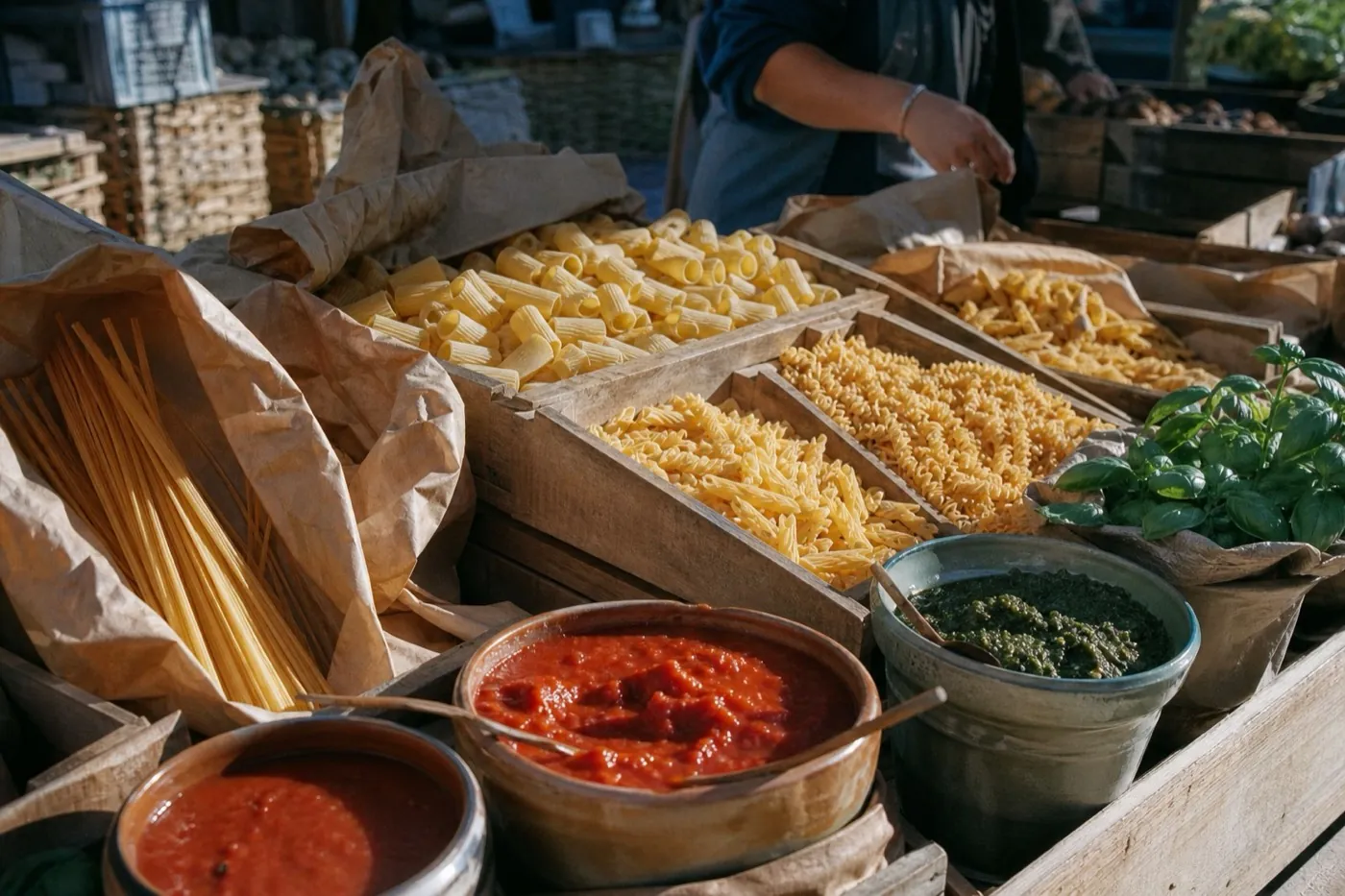
Matching pasta shapes to sauces: what is the rule?
Matching pasta shapes to sauces follows one rule: the sauce should cling to the pasta. Long, thin strands such as spaghetti suit smooth and oily sauces. Short tubes and twists with hollows, such as penne or fusilli, catch thick sauces with pieces of vegetable. Wide ribbons love creamy sauces.
A good match means the sauce does not run to the bottom of the plate and the pieces do not end up on their own. Below you will find a table of shapes, rules for matching, the label, portions and storage.
This guide covers dry wheat pasta. Fresh, rice or pulse pasta have different cooking times, so apply these rules to them with care.
Spaghetti with garlic, olive oil and chilli
The simplest example of long, thin pasta with a light sauce. The sauce is just olive oil and pasta cooking water.
Ingredients
- Spaghetti200 g
- Olive oil5 tbsp
- Garlic4 cloves
- Chilli flakes½ tsp
- Parsley½ bunch
- Salt for the water1 tbsp
- Parmesan optional30 g
Method
- Bring 2 litres of water to the boil, salt it and add the pasta. Cook for one minute less than the al dente time on the pack.
- Meanwhile slice the garlic thinly. Put the oil in a cold frying pan with the garlic and chilli and warm over low heat for 3–4 minutes until the garlic turns pale gold. Do not let it burn or it will turn bitter.
- Save a cup of the cooking water before draining.
- Lift the pasta with tongs straight into the pan, add half a cup of the cooking water and toss hard over medium heat for a minute. The oil and the starchy water come together into a light sauce. Add a little more water if it looks dry.
- Toss with chopped parsley and serve at once, with Parmesan if you like.
Penne with a chunky tomato, courgette and pepper sauce
Pieces of vegetable get inside the tubes, so every mouthful has pasta and sauce. Good the next day for lunch too.
Ingredients
- Penne400 g
- Courgette1
- Red pepper1
- Onion1
- Garlic2 cloves
- Chopped tomatoes 400 g1 tin
- Olive oil3 tbsp
- Dried oregano1 tsp
- Feta or mozzarella150 g
Method
- Dice the onion, pepper and courgette into pieces about 1 cm, roughly the width of a penne tube.
- Fry the onion and pepper in the oil for 5 minutes. Add the courgette and fry for another 5 minutes over fairly high heat until lightly browned. Add the garlic and oregano.
- Pour in the tomatoes, season with salt and pepper and simmer uncovered for 10 minutes.
- Meanwhile cook the penne in plenty of salted water. Save a cup of the cooking water and drain the pasta a minute before the time on the pack.
- Toss the pasta with the sauce over low heat, loosening with the cooking water. Serve with crumbled feta or torn mozzarella. Refrigerate leftovers within 2 hours.
Which pasta shapes are in the shop and what are they for?
The pasta shelf looks endless, but shapes fall into a few groups. The table shows typical examples and the sauces they suit. Names and sizes differ between brands, so with an unfamiliar product go by the shape, not the name.
| Group | Examples | Sauces that suit | Why |
|---|---|---|---|
| Long, thin | Spaghetti, spaghettini, linguine | Oil and garlic, smooth tomato sauce, seafood | Sauce coats the strands without clumps |
| Long, wide | Tagliatelle, pappardelle, fettuccine | Creamy, mushroom and meat sauces | A broad surface holds the sauce |
| Short tubes | Penne, rigatoni, macaroni | Thick vegetable sauces, bakes | Sauce runs inside the tube |
| Twists and hollows | Fusilli, farfalle, conchiglie | Chunky sauces, pesto, pasta salads | Spirals and shells catch the sauce |
| Small | Elbows, little bows, soup pasta | Soups, bakes, dishes for children | They are small and cook fast |
The surface matters too. In our kitchen experience, smooth pasta, usually extruded through Teflon dies, holds sauce less well than rough pasta pushed through bronze or copper ones. You sometimes find this in the description on the pack.
How do you match pasta to a sauce?
Look at the sauce first, then at the pasta. If the sauce is smooth and thin, pick a long, thin shape. If it has pieces, pick a shape that can hold them. A thick meat or tomato sauce with vegetables needs tubes, and a creamy one needs wide ribbons.
Which pasta for an oil and garlic sauce?
For a classic spaghetti with garlic, olive oil and chilli choose long, thin strands. Oil, garlic and chilli flakes make a light emulsion that coats the strands evenly. Add a spoonful of the cooking water so the sauce turns slightly creamy.
Thick pieces do not belong in this sauce, because short pasta would leave an oily puddle on the plate.
Which pasta for a thick vegetable sauce?
For a sauce of tomatoes, courgette and pepper choose penne or another short tube. Pieces of vegetable fall inside and into the ridges, and the sauce does not spread across the plate. Fusilli and farfalle work just as well if those are what you find.
Two recipes sit below, above the list: spaghetti with garlic, olive oil and chilli, and penne with a chunky tomato, courgette and pepper sauce. The first takes a quarter of an hour, the second needs a little time to soften the vegetables.
Which pasta for a bake or a soup?
For a bake take tubes that will not overcook in the oven, such as penne or rigatoni, and boil them for less time than usual. In a bake the pasta finishes cooking in the sauce. For soups choose a small shape that fits on a spoon. If you run out of pasta, see pasta alternatives for a bake.
What should you check on a pasta label?
A pasta label is short, but worth a look before you buy. The rules for what must appear come from EU Regulation 1169/2011 on food information, which also applies in Poland. Here is a checklist.
Read from the ingredients to the cooking time.
- Ingredients: plain dry pasta is usually flour or durum wheat semolina and water. Egg pasta also has eggs, and wholemeal pasta wholemeal flour.
- Allergens: wheat contains gluten, which the rules require to be highlighted in the ingredients, and eggs are an allergen too. People with coeliac disease need pasta labelled gluten-free.
- Net weight: check it when comparing prices, because packs are usually half a kilo but not always.
- Cooking time: the producer prints it on the pack, and it differs between shapes and brands.
- Nutrition table: it describes the dry product, so a cooked portion weighs more and the values per 100 g of cooked pasta are lower.
- Date: dry pasta carries a best-before date.
How do you make a sauce that clings to the pasta?
Even a well-chosen shape will not help if the sauce is too thin or the pasta too dry. The secret is in the last minute: the pasta finishes cooking in the sauce, not beside it. Then the starch on the surface binds the sauce and gives it a gloss.
The rules below are for sauces made in a pan, such as oil and garlic or a tomato sauce with vegetables.
- Scoop out a cup of cooking water before draining and add it to the sauce a spoonful at a time until it turns creamy.
- Take the pasta out a minute before the time on the pack and finish it in the sauce.
- Tip the pasta into the pan with the sauce, rather than spooning sauce onto pasta on a plate.
- Season at the end, because the cooking water is salty and the sauce thickens as it reduces.
- Serve straight away, because pasta cools and soaks up the sauce.
With vegetable sauces, add the pieces to the pasta in the pan shortly before the end so they do not turn to mush. If the sauce is too thick, loosen it with cooking water, not plain tap water.
Add Parmesan and other hard cheeses off the heat so they do not clump. Stir in parsley, basil and oregano at the end to keep their aroma.
Should you drain pasta in a colander?
Drain it, but do not rinse if the pasta is going into a warm sauce, because rinsing washes off the starch and the sauce clings less well. Rinsing in cold water makes sense for pasta salads, where the pasta must cool quickly and not stick.
How much pasta should you cook per person?
A typical recipe for four uses 400 g of dry pasta, or 100 g a head. That is the editors' estimate based on recipes, not a legal figure. If pasta is the main part of dinner, 100 g is enough for most adults. For children, or when there are rich extras, use less.
By our estimate, cooked pasta weighs roughly twice as much as dry, because it soaks up water. In the USDA FoodData Central database, 100 g of cooked pasta has far fewer calories than 100 g of dry. So when you compare portions from different sources, always check which version they mean.
How do you cook pasta so it is not overdone?
The steps below are for dry wheat pasta. The producer gives exact times on the pack, and you should set a timer a minute early to taste.
- Bring plenty of water to the boil in a big pan and salt it once it boils.
- Add the pasta and stir after a minute so it does not stick.
- Cook for the time on the pack, and taste a piece at the earliest time to see if it is al dente.
- Before draining, scoop out a cup of the cooking water for the sauce.
- Toss the pasta with the sauce in a pan for a minute so the sauce binds.
How do you store dry and cooked pasta?
Dry pasta is a shelf-stable product that can sit in a dry cupboard. Once opened, pour the rest into an airtight container so it does not take up damp. Label the container with the shape and date, because poured out, penne and rigatoni look alike.
Put cooked pasta into the fridge within 2 hours, in a shallow container, and eat it within 3–4 days. Reheat it until piping hot before serving. Do not leave pasta with sauce on the worktop, because it spoils quickly.
Can you freeze pasta?
You can freeze pasta with sauce, for example for a bake, but after thawing it can be softer. Plain cooked pasta, tossed with a little oil, can be frozen in portions and dropped into boiling water for a moment. Label the container with the date.
USDA FSIS: Shelf-Stable Food SafetyUSDA FSIS: Leftovers and Food SafetyHow do you put pasta on a BuyNest list?
Write the shape in the item name, for example “spaghetti 500 g” and “penne 500 g”, not just “pasta”. Then in the shop you are not guessing at the shelf which shape you meant to take. You can open the ready list for two sauces in BuyNest and tick items off on your way to the pasta aisle.
The list holds both shapes from the recipes, the vegetables for the sauce, cheese and spices, grouped by shop section. The amounts are the editors' estimate, based on typical portions in recipes for a few people.
If you plan dinners together, a shared list shows straight away that the penne is already in the basket. For tomato sauces, our guide to passata or chopped tomatoes will help.
Pasta: two sauces for the week
- Pasta
- Spaghetti500 g
- Penne500 g
- Vegetables
- Courgette1 pcs
- Red pepper1 pcs
- Onion1 pcs
- Garlic bulb1 pcs
- Parsley bunch1 pcs
- Dairy
- Feta cheese150 g
- Parmesan100 g
- Pantry
- Chopped tomatoes 400 g tin1 pack
- Olive oil500 ml
- Chilli flakes1 pack
- Dried oregano1 pack
Frequently asked questions
Which pasta goes with tomato sauce?
A smooth tomato sauce suits spaghetti or linguine, and a thick one with vegetable pieces suits penne or rigatoni. The rule is simple: the more pieces in the sauce, the shorter and more hollow the pasta.
Can you swap penne for spaghetti?
Yes, but the sauce will behave differently. A thick sauce with pieces clings to tubes better than strands, and a smooth sauce is the other way round. If you swap, adjust the amount of sauce and toss the pasta in it in a pan.
How much pasta per person?
Usually about 100 g of dry pasta per adult when it is the main part of dinner. That is the editors' estimate based on recipes for several people. Use less for children or with rich extras.
How long can you keep cooked pasta?
In the fridge, in a closed container, 3–4 days according to FSIS. Put it away within 2 hours of cooking and reheat it until piping hot. Treat pasta with sauce the same way.
Does wholemeal pasta suit the same sauces?
Yes, but it has a stronger flavour and can be firmer. It copes well with sauces of vegetables, oil and garlic. Check the cooking time on the pack, because it is often longer.
Before you go for pasta, decide which sauce you are making and pick the shape for it: strands for smooth, tubes for thick. You can open the ready shopping list in BuyNest with one tap. Then matching pasta shapes to sauces is settled before you reach the shelf.
Open the ready list in BuyNestSources
Take the shopping into BuyNest
BuyNest is on iPhone and Android. The app has no ads, including on the free plan.