
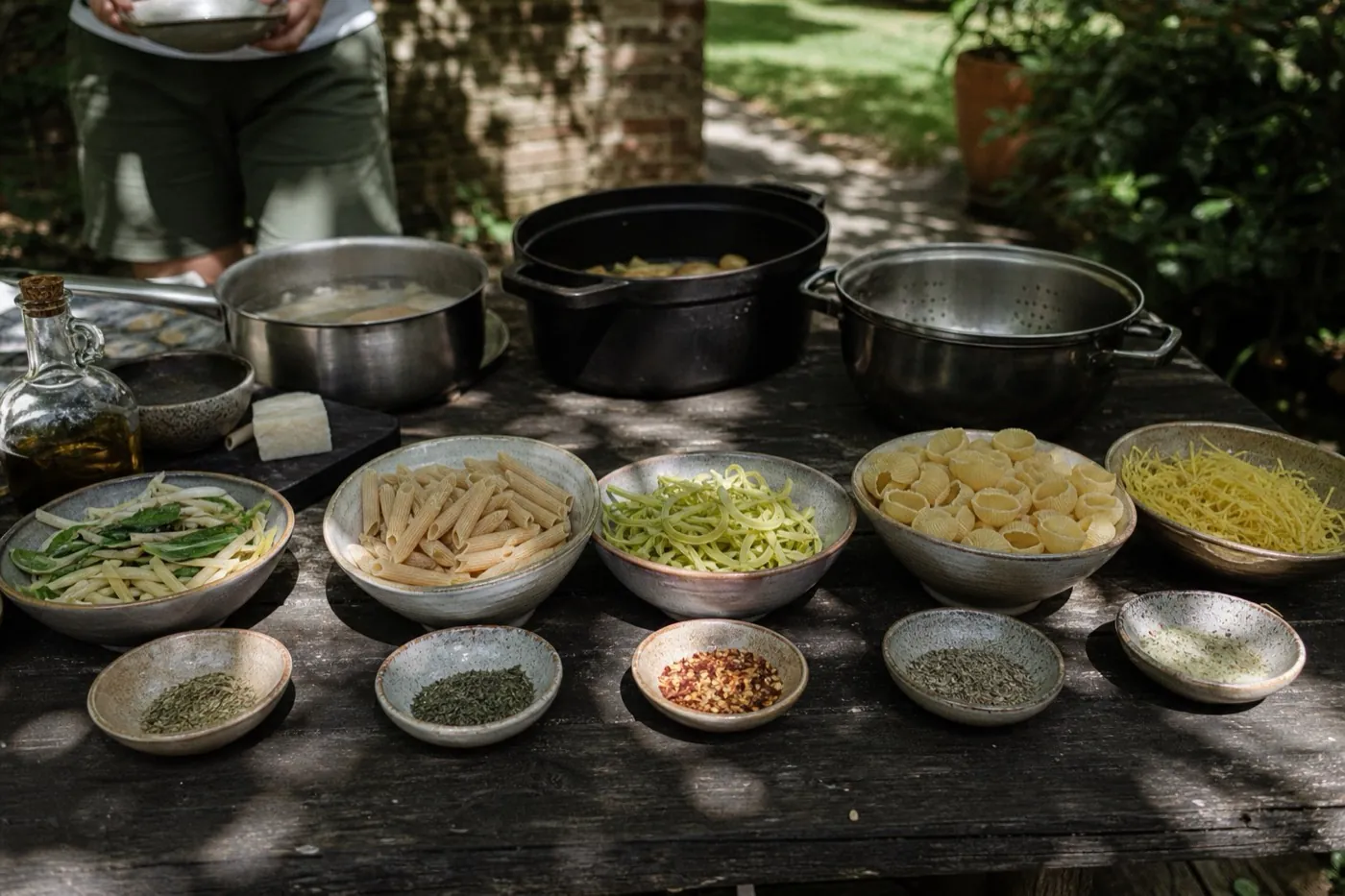
What is a good pasta substitute for a bake, and what changes?
A good pasta substitute for a bake is thinly sliced potatoes, courgettes or aubergines, wheat tortillas or another pasta shape. In a 20×30 cm dish, about 1 kg of potatoes or three medium courgettes stands in for 250 g of lasagne sheets.
The biggest change is liquid. Dry lasagne sheets soften by absorbing sauce, so recipes for them are fairly wet. Potatoes absorb less, and courgettes and aubergines release water of their own, so the sauce must be thickened or loosened to suit. The amounts in the table are an editorial rule of thumb.
| Instead of | Use | Amount | Notes |
|---|---|---|---|
| 250 g lasagne sheets | Thinly sliced potatoes | about 1 kg | Parboil or pre-bake the slices. The sauce can be slightly looser. |
| 250 g lasagne sheets | Sliced courgettes | about 3 medium | Salt and drain for 15–20 minutes. Reduce the sauce for longer. |
| 250 g lasagne sheets | Sliced aubergines | about 2 medium | Roast the slices with oil before layering. |
| 250 g lasagne sheets | Wheat tortillas | about 4–5 | Sauce can be looser, as tortillas absorb less than pasta. The bake is thinner. |
| 250 g lasagne sheets | Another pasta shape | about 250 g dried | Boil for less time than the packet says, as it finishes in the oven. |
Two recipes, a layered potato bake with a meat and tomato sauce and a courgette lasagne with ricotta and spinach, are below, above the shopping list.
Layered potato bake with meat and tomato sauce
Thin potato slices take the place of lasagne sheets. Parboiling them for 5 minutes shortens the baking and makes sure the middle is soft.
Ingredients
- Potatoes floury or all-rounder1 kg
- Beef mince400 g
- Onion1
- Garlic2 cloves
- Chopped tomatoes 400 g1 tin
- Tomato purée1 tbsp
- Dried oregano1 tsp
- Mozzarella one ball, drained125 g
- Cheddar-style cheese grated60 g
- Rapeseed oil1 tbsp
Method
- Peel the potatoes and slice them 3–4 mm thick. Drop them into boiling salted water and cook for 5 minutes, until soft at the edges but still firm in the middle. Drain and spread them on a board to steam dry.
- Soften the chopped onion in the oil, add the mince and fry, breaking it up with a spatula, until no longer pink. Add the garlic, tomato purée, oregano and tomatoes. Simmer uncovered for 10 minutes. The sauce should be thicker than for pasta, because potatoes absorb less liquid than dry lasagne sheets.
- Heat the oven to 190°C. In a dish of about 20×30 cm, layer a third of the potatoes, half the sauce, another third of the potatoes, the rest of the sauce and the last of the potatoes.
- Tear the mozzarella over the top and scatter with the grated cheese. Cover with foil and bake for 25 minutes, then uncover and bake for 15–20 more, until the cheese browns.
- Check with a knife that the potatoes in the middle are tender. A thermometer in the centre of the dish should read at least 74°C.
- Leave to stand for 10 minutes before cutting. The layers settle and the portions hold together.
Tip For a meat-free version, use a green lentil sauce: 150 g dry lentils and 400 ml extra water, simmered for 30 minutes before layering.
Courgette lasagne with ricotta and spinach
Courgette slices instead of pasta. The key is getting the water out of the courgettes before baking, or the dish ends up with soup at the bottom.
Ingredients
- Courgettes medium, about 900 g3
- Ricotta250 g
- Frozen spinach300 g
- Egg1
- Passata500 g
- Garlic2 cloves
- Parmesan grated40 g
- Mozzarella125 g
- Olive oil2 tbsp
- Nutmeg a pinch
Method
- Slice the courgettes lengthways 4–5 mm thick. Lay them on lined trays, brush with oil, salt them and roast for 10–12 minutes at 220°C, until soft and weeping. Pat dry with kitchen paper.
- Thaw the spinach and squeeze out the water with your hands or in a sieve. This matters: every spoonful of water from the courgettes and spinach thins the bake.
- Mix the ricotta with the spinach, egg, half the Parmesan, salt, pepper and nutmeg.
- Mix the passata with the crushed garlic and salt. Do not add water: unlike dry pasta, courgettes need no liquid to soften.
- Lower the oven to 190°C. In the dish, layer a thin coat of passata, courgette slices, half the ricotta mix, more passata and courgettes, the rest of the ricotta, and finish with courgettes and passata. Scatter with mozzarella and the remaining Parmesan.
- Bake for 30–35 minutes, until browned on top and hot in the middle. Let it stand for 10–15 minutes before cutting, so the portions run less.
Tip This version has no gluten, but it contains milk and egg, two of the EU-listed allergens.
How do you prepare each pasta substitute step by step?
Each swap needs its own preparation. One task is common to all: get rid of excess water before the layers go into the dish. Without that, the bake turns heavy and wet at the bottom.
How do you prepare potatoes for a bake instead of pasta?
Slice potatoes about half a centimetre thick and parboil them for a few minutes in salted water, or roast them on a tray. Raw slices may not soften before the sauce is done.
Overlap them as you would lasagne sheets. The sauce between layers can be a touch looser, because potatoes absorb it more slowly than pasta.
How do you prepare courgettes and aubergines?
Slice the vegetables lengthways, salt them and leave them for 15–20 minutes in a colander. Pat dry with kitchen paper. Roast aubergine with oil on a tray until lightly browned.
Courgette gives a lighter bake, but it releases water even after draining. Reduce the sauce uncovered for longer and let the finished dish rest for 10 minutes before cutting.
How do you use tortillas or another pasta shape?
Lay tortillas like lasagne sheets, trimming them to the shape of the dish. The bake is thinner and crisper at the edges. Check the label, as tortillas are made with wheat.
If you use another shape, such as fusilli or penne, boil it 2–3 minutes less than the packet suggests. It finishes cooking in the oven and will not fall apart in the sauce.
How do you adjust the sauce when a bake has no pasta?
The sauce behaves differently in a bake without pasta. Pasta used to absorb liquid, whereas the substitutes either release it or absorb little. So match the consistency to the substitute you chose.
It helps to make the sauce in two thicknesses: thicker for the base and middle, looser for the top. The top of a bake dries out fastest.
- With potatoes: the sauce can be looser, provided you parboiled the slices. Add half a cup of water or passata.
- With courgettes and aubergines: reduce the sauce uncovered for longer, until clearly thick.
- With tortillas: add a little more sauce, as tortillas absorb liquid but hold their shape.
- With another pasta shape: leave the sauce as in the original recipe.
- With any swap: scatter the cheese over the top for the last 15 minutes so it does not burn.
How do you layer a bake without pasta?
The order of layers is the same as for lasagne, but a few small details change the result. The scheme below suits a 20×30 cm dish for four to six people and works with any swap in the table.
Set the oven to about 180 °C. That is typical for bakes, but every oven differs, so go by how the dish looks rather than the clock alone.
- Spread a thin layer of sauce over the base of the dish so the substitute does not stick.
- Lay the first layer of your substitute, overlapping slices or sheets.
- Spoon over half the sauce and spread it to the edges.
- Add a layer of cheese or filling, such as ricotta with spinach or grated mozzarella.
- Repeat, finishing with the substitute, sauce and cheese on top.
- Bake covered with foil for the first half of the time, then uncover so the top browns.
- Take it out and rest it for 10 minutes before cutting into portions.
Foil at the start protects the top from burning and lets the vegetables soften in steam. The last 15 minutes uncovered give a crisp, golden crust.
Which cheese and filling suit a bake without pasta?
Without pasta, cheese does more work, because it binds the layers and makes the dish filling. The choice depends on the swap: a well-flavoured melting cheese for potatoes, and mozzarella, ricotta and Parmesan for courgette and aubergine.
For people who do not eat meat, swap the meat sauce for a lentil one. Our guide to lentils in a meat-free pasta sauce shows how.
- Potatoes: a Cheddar-style or Gouda-style cheese that melts well and has a distinct flavour.
- Courgette: ricotta with spinach and Parmesan, which add creaminess and absorb excess water.
- Aubergine: mozzarella and a pinch of oregano, the classic pairing with tomato sauce.
- Tortillas: grated cheese and a little passata so the layers do not dry out.
- Any swap: a pinch of nutmeg in the ricotta filling lifts the flavour.
When does a pasta swap in a bake not work?
Substitutes have limits. It is worth knowing them before you swap pasta in a recipe built around it.
| Bake | Swap that fails | Why | Use instead |
|---|---|---|---|
| Pasta bake in a cream sauce | Courgette | Courgette water thins and splits the sauce | Potatoes or another pasta |
| Quick weeknight bake | Raw potatoes | They will not soften in time | Tortillas or pasta |
| Bake for guests avoiding gluten | Wheat tortillas, wheat pasta | They contain gluten | Potatoes, courgette or gluten-free pasta with a label |
| Bake with a strong tomato sauce | Unroasted aubergine | Bitter and spongy | Roasted aubergine or courgette |
| Bake made a day ahead | Courgette | It releases water over time | Potatoes, which reheat better |
Gluten, dairy and other allergens in a bake without pasta
Swapping pasta for vegetables reduces gluten but does not remove it automatically. Jarred sauce, stock cubes and tortillas can contain gluten-containing cereals, which are among the allergens in Annex II of Regulation 1169/2011.
The same annex lists milk and eggs. Mozzarella, ricotta, Parmesan and Cheddar-style cheese are dairy, and eggs often bind a filling. If you cook for someone with an allergy, check the labels on everything, including the cheese and the passata. For packaged products the label always matters more than general rules.
Rozporządzenie (UE) nr 1169/2011 w sprawie przekazywania konsumentom informacji na temat żywnościHow do you know the bake is done, and what do you do with leftovers?
A bake with meat is safe once it reaches 74 °C (165 °F) in the centre, following USDA guidance for casseroles and leftovers. The surest check is a thermometer pushed into the middle of the dish. Without one, look for sauce bubbling in the centre as well as at the edges.
Rest the bake for 10 minutes before cutting so the layers set. Refrigerate leftovers within 2 hours of leaving the oven and eat them within 3–4 days. When reheating, bring the portion to 74 °C all the way through. Potato bakes reheat better than courgette ones, which weep water.
USDA FSIS: Safe Minimum Internal Temperature ChartUSDA FSIS: Leftovers and Food SafetyWhat should you buy for a pasta-free bake, and how do you plan the list?
The basis is your chosen substitute, a tomato sauce with meat or vegetables, cheese and seasoning. Potatoes and tinned tomatoes can be bought ahead, whereas courgettes, spinach and fresh cheeses are best bought a day or two before baking.
Use the ready shopping list for a bake without pasta. It covers the ingredients of both recipes, so you can decide in the shop which version to make. If you shop with someone, share the list: ticked-off items show for everyone.
If you want a swap for rice rather than pasta, see our guide to rice alternatives for dinner. More swaps sit in the substitutes guides.
Bakes without pasta: shopping list
- Vegetables
- Potatoes1 kg
- Courgettes3 pcs
- Onion1 pcs
- Garlic bulb1 pcs
- Meat and frozen
- Beef mince400 g
- Frozen spinach about 450 g1 pack
- Dairy and eggs
- Mozzarella 125 g balls2 pcs
- Ricotta250 g
- Parmesan small piece1 pcs
- Cheddar-style cheese small1 pack
- Eggs6 pcs
- Tins and dry goods
- Chopped tomatoes 400 g tin1 pcs
- Passata500 g
- Tomato purée1 pcs
- Check the cupboard
- Olive oil1 pcs
- Dried oregano1 pcs
- Nutmeg1 pcs
Frequently asked questions
Does a bake without pasta need longer in the oven?
It depends on the swap. Bakes with raw vegetables usually need a little longer than ones with pasta, and tortilla bakes less. Instead of counting minutes, check that the vegetables are tender and the sauce bubbles in the centre.
How do I stop a courgette bake being watery?
Salt the slices, leave them for 15–20 minutes and pat dry. Reduce the sauce for longer. After baking, let the dish rest for 10 minutes before cutting.
Can I use potatoes without cooking them first?
Raw slices may stay firm, especially in a short bake. Parboil or roast them first, then assemble. Thin slices soften faster.
What can replace pasta in a bake for someone avoiding gluten?
Potatoes, courgettes or aubergines are the simplest choice. You can also use pasta labelled gluten-free. Check the sauce and stock, as gluten can appear in ready-made additions.
Can I freeze a bake without pasta?
Potato and meat sauce bakes usually freeze better than courgette ones, which release water on defrosting. Freeze in portions, defrost in the fridge and reheat to 74 °C all the way through.
A pasta substitute for a bake can be potatoes, courgettes, aubergines, tortillas or a different shape, as long as you adjust the sauce to the swap. Open the ready list in BuyNest and buy everything in one trip.
Open the ready list in BuyNestSources
Take the shopping into BuyNest
BuyNest is on iPhone and Android. The app has no ads, including on the free plan.