
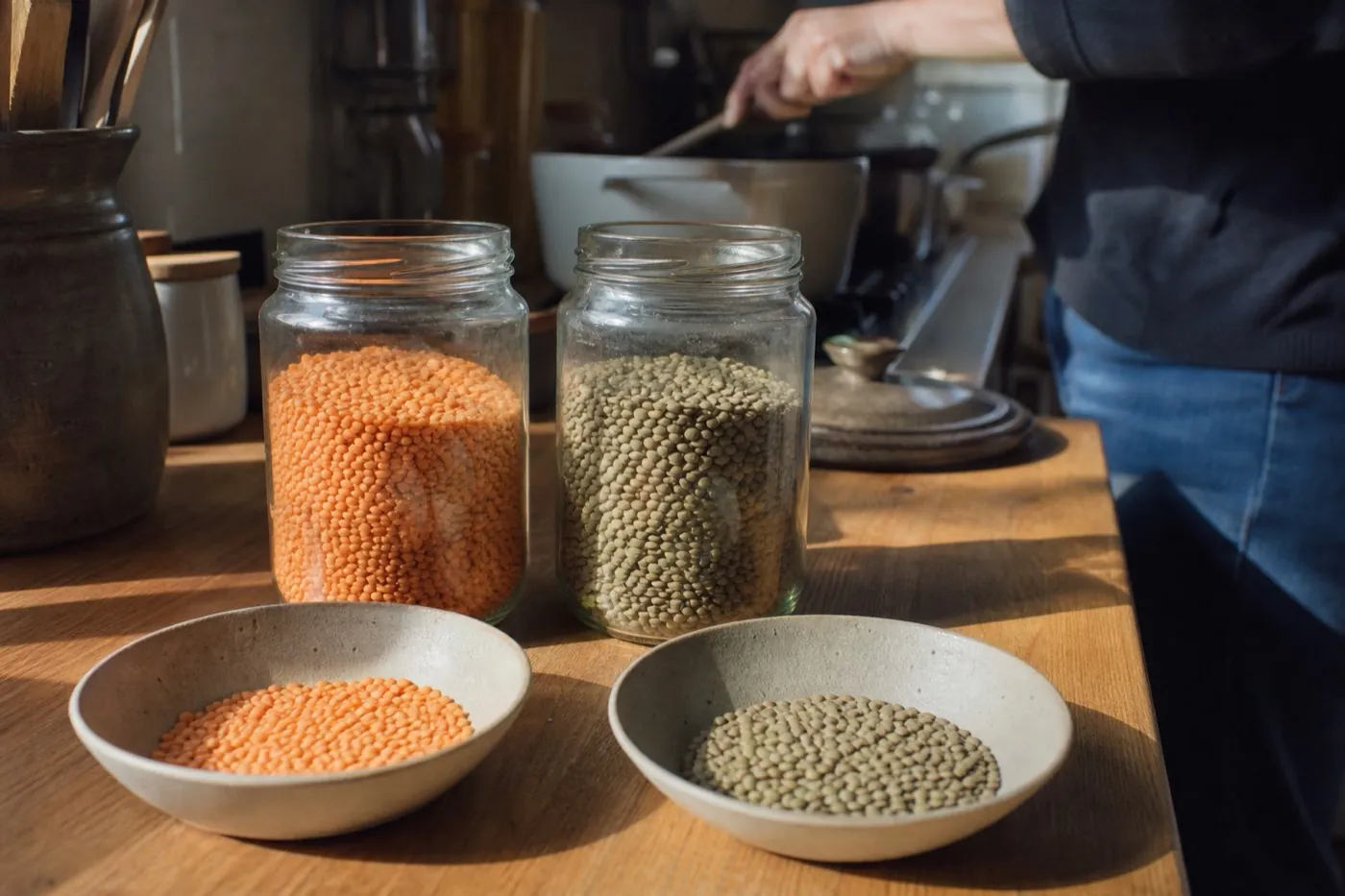
Red or green lentils: which should you cook with?
Red or green lentils? Pick red for soups, purées, sauces and dal, because they break down into a smooth mass. Pick green or brown for salads, fillings and side dishes, because they hold their shape. If you cook widely, keep both in the cupboard.
The difference mostly comes down to whether the seed keeps its skin. Red lentils are usually sold hulled and split, so they soften fast and need no soaking. Green and brown lentils keep their skin, which holds the seed together.
The table below covers the common types. Times are typical for supermarket packs, but your packet gives the exact time, because it depends on variety and freshness.
| Type | Best for | Cooking time | Texture |
|---|---|---|---|
| Red (split) | Soups, purées, dal, sauces, spreads | About 10–15 minutes | Breaks down into a smooth, thick mass |
| Green | Salads, side dishes, fillings | About 20–30 minutes | Keeps its shape, slightly springy |
| Brown | Chunky soups, stews, lentil burgers, sauces | About 20–30 minutes | Soft, partly breaks down |
| Black (beluga) and Puy-style green | Warm salads and sides | About 20–30 minutes | Firm, holds its shape well |
If you only buy one kind to start with, choose green or brown. It suits more dishes, and cooked a little longer it also works in soup.
Red lentil soup with tomatoes
Red lentils collapse in 15 minutes and thicken the soup on their own. Blending is optional.
Ingredients
- Red lentils250 g
- Onion1
- Carrot2
- Garlic2 cloves
- Chopped tomatoes 400 g tin1 tin
- Vegetable stock1.2 l
- Olive oil2 tbsp
- Ground cumin1 tsp
- Sweet paprika1 tsp
- Lemon½
- Parsley1 bunch
Method
- Rinse the lentils in a sieve under cold water until it runs almost clear, and look through them for small stones.
- Dice the onion and coarsely grate the carrots. Soften them in the oil for 5 minutes, add the crushed garlic, cumin and paprika and cook for another minute.
- Add the lentils, tomatoes and stock. Bring to the boil, lower the heat and simmer with the lid ajar for 15–20 minutes, stirring now and then because the lentils catch on the bottom.
- Once the lentils have broken down, taste and add salt. For a smooth soup, blend half and stir it back in.
- Finish each bowl with lemon juice and chopped parsley.
Tip The soup thickens in the fridge. Loosen it with water or stock when reheating.
Green lentil salad with feta
Green lentils cooked until just tender keep their shape and last a day in the fridge, so this salad travels well to work.
Ingredients
- Green lentils200 g
- Bay leaf1
- Cherry tomatoes250 g
- Cucumber1
- Red onion½
- Feta cheese150 g
- Parsley1 bunch
- Olive oil3 tbsp
- Lemon juice1
- Mustard1 tsp
Method
- Rinse the lentils, put them in a pan and cover with three times their volume of cold water. Add the bay leaf but no salt yet: season at the end.
- Bring to the boil and simmer gently for 20–25 minutes. Start tasting at 18 minutes. The lentils should be soft inside but still whole.
- Drain, remove the bay leaf and spread the lentils on a plate so they cool quickly and stop cooking in their own heat.
- Meanwhile halve the tomatoes, dice the cucumber and slice the onion thinly. Whisk the oil, lemon juice, mustard, salt and pepper.
- Toss the warm lentils with the dressing first, then with the vegetables. Crumble the feta on top and scatter with parsley.
How do red and green lentils differ in the kitchen?
Colour is only the surface. For cooking, what matters is the skin, the size and the time the seed needs to soften.
When should you cook red lentils?
Red lentils are the fastest, so they rescue dinner when you have half an hour. Rinse them in a sieve, cover with water or stock and simmer for about a quarter of an hour. They thicken the soup themselves, so you need no cream or roux.
They go well with tomatoes, cumin, curry spices and ginger. If you like a soup with a few visible pieces, add them for the last minutes and stir gently.
What are green lentils best for?
Green lentils take longer but stay firm. In a salad with feta and fresh vegetables they keep their shape even after a night in the fridge. They also take a vinaigrette well, so dress them while still warm.
They work as a side for meat and roast vegetables in place of rice or grains.
Are brown lentils a good compromise?
Brown lentils sit in the middle: in soup they soften and partly break down, while in a stew or filling you can still feel the seed. If you do not want three packets at home, brown lentils replace both others best, though they never match either perfectly.
How do you cook lentils without mush or hard seeds?
The ratio here is our editorial estimate from typical recipes: about three parts water to one part lentils by volume. If your packet gives a different ratio or time, follow the producer's instructions.
The method works for every type. Only the cooking time changes.
- Rinse the lentils in a sieve under running water and look through them for tiny stones.
- Cover with cold water or stock at about 1 part lentils to 3 parts liquid and bring to the boil.
- Turn the heat down and simmer, covered, for the time on the packet: less for red, more for green and brown.
- Take the pan off the heat when the seeds are soft but not yet falling apart in your fingers. They carry on softening after draining.
- Drain and season at once. Add acidic ingredients, such as lemon juice or tomatoes, near the end, because acid slows softening (our kitchen experience, not an official rule).
Lentils do not need soaking. If you soak them anyway, shorten the cooking by a few minutes and watch the pan. Skim off any foam that forms on top.
Two recipes sit lower down, above the list: red lentil soup with tomatoes and green lentil salad with feta. The first shows a smooth texture, the second a seed that is meant to stay whole.
Dried or tinned: what should you compare at the shelf?
Dried lentils are usually cheaper per portion and keep for a long time in the cupboard. Tinned or jarred lentils are ready once drained, which saves twenty minutes, but they cost more and come with liquid that often contains salt.
Compare cooked weight, not pack prices. Dry lentils absorb water, so 100 g dry gives far more once cooked. The full sum is in the guide to dried or tinned lentils, so I will not repeat it here.
Lentils absorb water as they cook, so 100 g cooked has clearly fewer calories, less protein and less fibre than 100 g raw. The gap comes from the water, not from lost nutrition. Always use the label on your own product.
What should you check on a lentil label?
On a lentil label, check the name of the type, the ingredients, the country of origin if it is given, and the date. EU Regulation 1169/2011 requires a clear product name, a list of ingredients, the net quantity and a minimum durability date.
A few things are worth a look at the shelf.
- Name of the type. “Red lentils” and “split red lentils” are usually the same, but plain “lentils” often means brown. If a recipe needs a specific kind, look at the picture and the description.
- Ingredients. Dried lentils should list a single ingredient. For tins or jars, check whether salt, vinegar or spices appear besides lentils and water.
- Date. It is usually “best before”, a minimum durability date. Old lentils take longer to cook and may stay hard, even though they are not unsafe.
- Net weight and price per kilogram. Compare the price per kilogram, because packs differ in weight. For tins, look at the drained weight too, if the producer gives it.
- Pack condition. The bag should be intact, and a tin should show no bulges, leaks or deep dents.
How do you store dried and cooked lentils?
Keep dried lentils in an airtight container in a dry, cool cupboard, away from the hob. You need not decant them at once, but close the bag firmly after opening. A container with the date from the packet helps you use stock on time.
Cool cooked lentils and refrigerate them within two hours of cooking. According to the US food safety agency FSIS, leftovers are best eaten within three to four days, and should be reheated to 74°C (165°F).
If you cooked a big batch, freeze it in portions. FSIS says food kept constantly at −18°C (0°F) stays safe, with time affecting only quality. Defrost frozen lentils in the fridge or tip them straight into soup.
USDA FSIS: Leftovers and Food SafetyUSDA FSIS: Freezing and Food SafetyWhat can you cook with lentils during the week?
Lentils cope well with repetition, because one packet gives several quite different dishes. Here are ideas for a week for two or three people, arranged so you do not eat the same thing every day.
Amounts depend on appetite, so treat them as a starting point rather than a rule. A typical portion of dry lentils in dinner recipes is about a handful per person, roughly what fits in a cupped hand.
- Monday: red lentil soup with tomatoes and cumin, with a slice of bread. Make extra, because the soup reheats well the next day.
- Wednesday: green lentils as a side to roast vegetables and a hard-boiled egg. Add a mustard and lemon dressing while the lentils are still warm.
- Friday: green lentil salad with feta, cucumber and parsley. Cook the lentils a day ahead and keep them in the fridge.
- Weekend: red lentil dal with coconut milk or yoghurt, served with rice or bread. Freeze the rest in portions.
If you want to start with one dish, make the soup, because red lentils forgive mistakes. The salad needs attention to cooking time, so leave it for next time.
For recipes that also use tinned tomatoes, the guide to tinned tomatoes will help. Lentils with tomatoes are one of the simplest pairings anyway.
How do you write lentils on a shopping list?
Name the type on each line, for example “red lentils 500 g” and “green lentils 400 g” separately. That way you do not wonder at the shelf which packet the recipe needs.
If you plan a soup and a salad from the same shop, the list “Lentils: soup and salad” holds both types, vegetables, stock and spices. In BuyNest you can open it by QR code or button and tick items off in the shop.
For more lentil dinners, see the guide to three lentil dinners on one shopping list. If you want a meat-free option for pasta, read about lentils in a meat-free pasta sauce.
Lentils: a soup and a salad
- Pulses
- Red lentils500 g
- Green lentils400 g
- Vegetables
- Onions2 pcs
- Red onion1 pcs
- Carrots3 pcs
- Garlic bulb1 pcs
- Cherry tomatoes250 g
- Cucumber1 pcs
- Parsley bunches2 pcs
- Lemons2 pcs
- Pantry
- Chopped tomatoes 400 g tin1 pack
- Vegetable stock1.5 l
- Ground cumin1 pack
- Mustard1 pcs
- Dairy
- Feta cheese150 g
Frequently asked questions
Do red lentils need soaking?
No. Red lentils are hulled and split, so they cook quickly without soaking. Just rinse them in a sieve.
Can I swap red lentils for green?
You can, but the result differs. Green lentils will not break down into a smooth soup, and red ones turn to mush in a salad. When swapping, adjust the cooking time to the packet.
How long do green and red lentils take to cook?
Typically about 10–15 minutes for red and about 20–30 minutes for green. Your packet gives the exact time, because it depends on variety and freshness.
Why are my lentils still hard after cooking?
Usually because they are old, or because you added acidic ingredients, such as lemon juice or tomatoes, too early. Cook them longer and add acid near the end.
How long can cooked lentils stay in the fridge?
According to FSIS, leftovers are best for three to four days in the fridge. If you cooked more, freeze part of it in portions.
Before you shop, decide whether you are making soup or salad, and the choice between red and green lentils becomes obvious. Open the ready list in BuyNest, tick items off in the shop and add only what your cupboard lacks.
Open the ready list in BuyNestSources
Take the shopping into BuyNest
BuyNest is on iPhone and Android. The app has no ads, including on the free plan.