
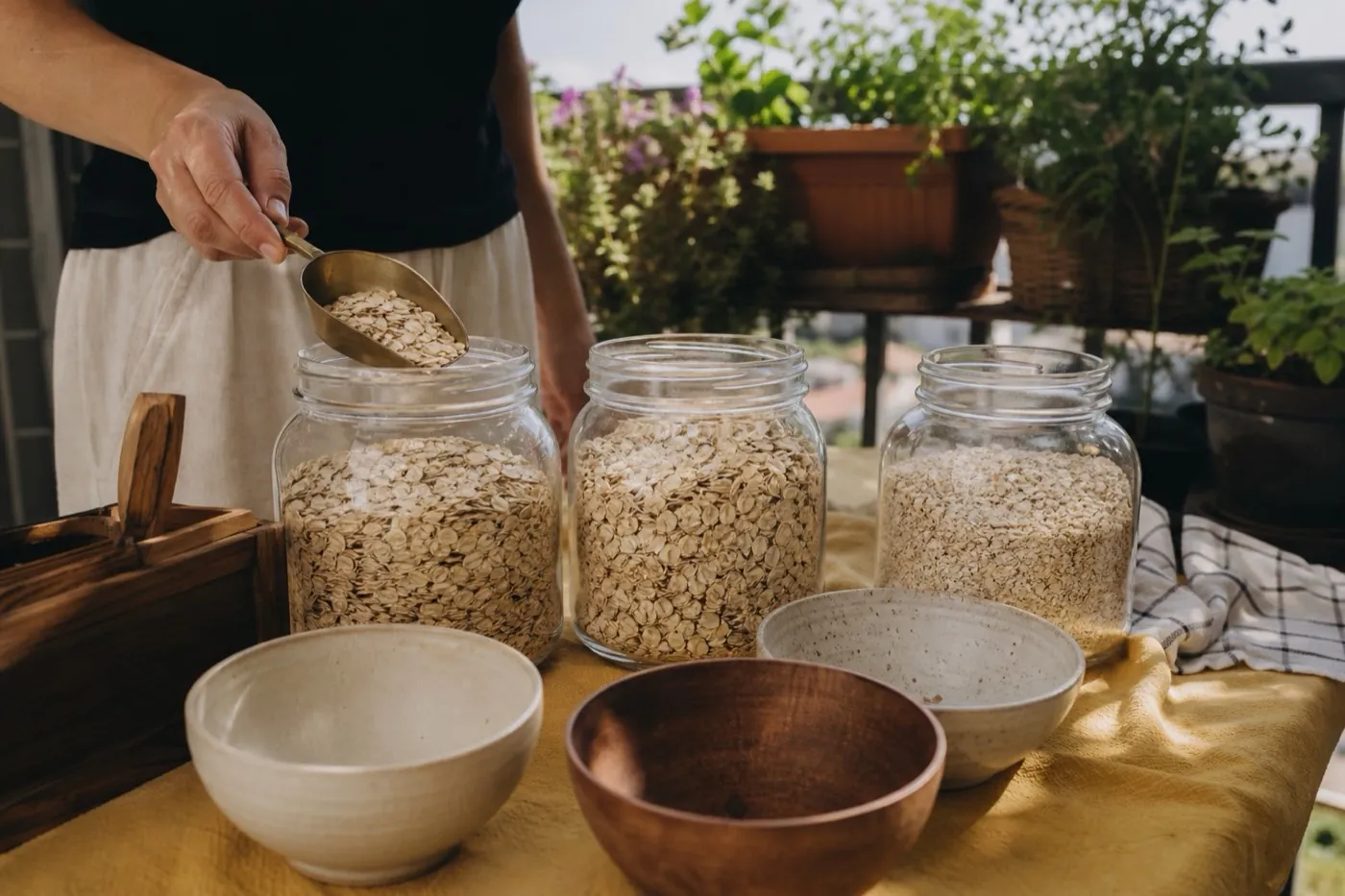
Rolled oats, jumbo oats or quick oats: which suits your recipe?
Pick rolled oats, jumbo oats or quick oats by the dish: jumbo for porridge cooked on the hob and for granola, rolled for overnight oats, pancakes and biscuits, quick for a fast breakfast at work. All three come from the same grain, so a wrong choice only changes cooking time and texture.
Oat grains are cleaned, hulled, steamed and pressed between rollers. The type depends on whether the grain is cut first and how thinly it is flattened. The thinner the flake, the faster it absorbs liquid and the sooner it loses its shape.
The table below sorts the three main types. Cooking times are typical for supermarket packs, but the producer's time on your own packet always wins, because flake thickness varies even between brands.
| Type | Best for | Preparation time | Texture |
|---|---|---|---|
| Jumbo (whole, thick) | Porridge on the hob, granola, crunchy bakes | About 8–10 minutes of cooking | Chewy, flakes keep their shape |
| Rolled (medium) | Overnight oats, pancakes, biscuits, quick porridge | About 3–5 minutes of cooking or a night in the fridge | Creamy, with some flake still felt |
| Quick (fine) | Smoothies, thickening, breakfast with boiling water | Pour over hot water or milk and wait a moment | Smooth, turns sticky easily |
| Flavoured sachets | Breakfast for trips or the office | As described on the sachet | Depends on additions and processing |
Names are not standardised, so look at the picture and the preparation instructions. If the packet says to cook for several minutes, the flakes are thick. If boiling water is enough, they are thin.
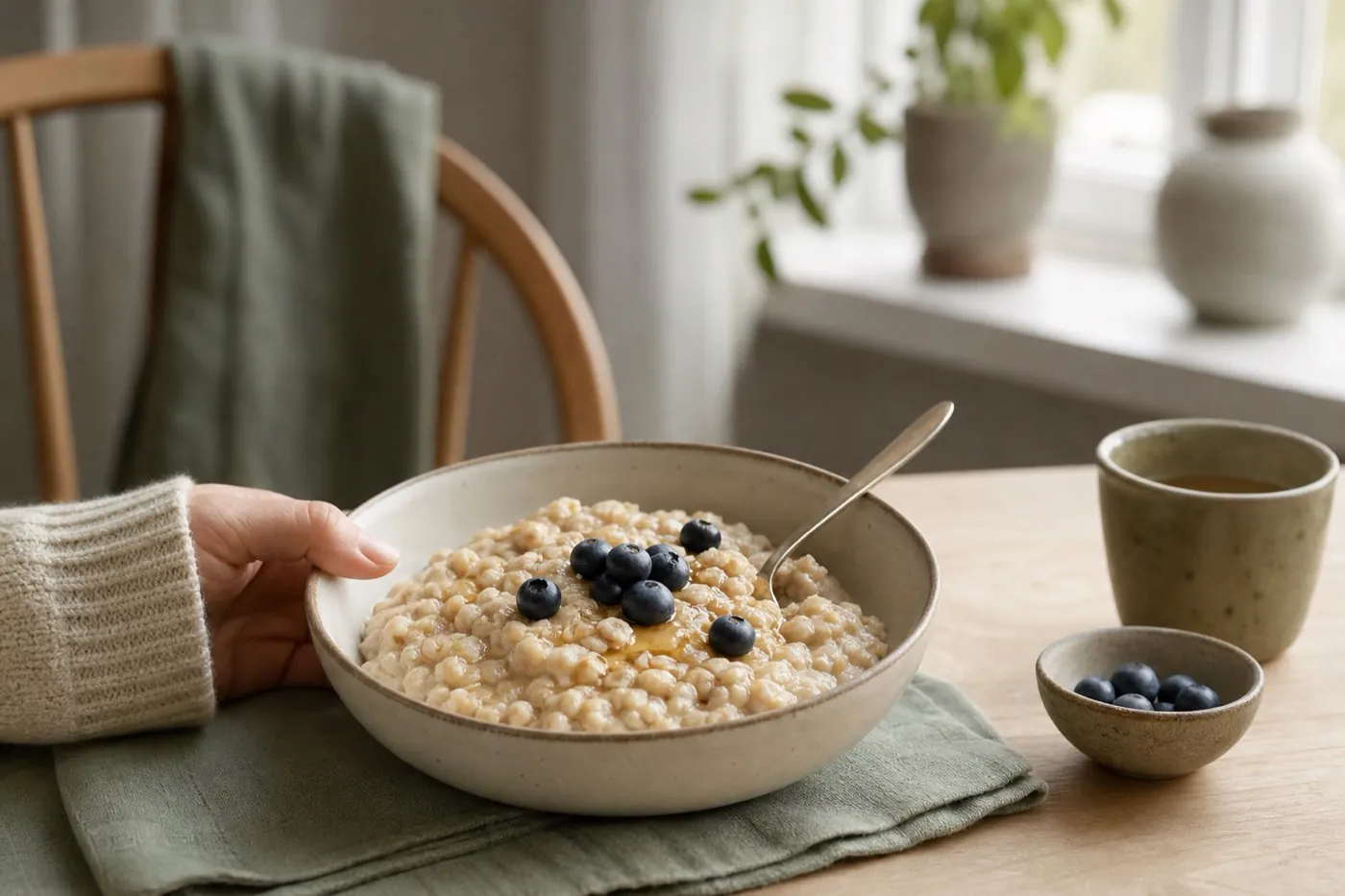
Basic porridge with jumbo oats
The recipe to start with. Jumbo oats give porridge with texture that never turns gluey.
Ingredients
- Jumbo oats100 g
- Milk or plant drink400 ml
- Water100 ml
- Pinch of salt
- Banana1
- Frozen berries100 g
- Walnuts20 g
- Cinnamon½ tsp
Method
- Put the oats in a pan with the milk, water and a pinch of salt. The salt is not there to make it salty: it brings out the sweetness of the fruit.
- Bring to the boil over medium heat, then lower the heat and cook for 6–8 minutes, stirring often. Jumbo oats need a little longer than rolled oats.
- Add the frozen berries for the last minute so they warm through and release their juice.
- Take off the heat and rest for 2 minutes. Porridge thickens on its own, so do not cook it until it is very thick in the pan.
- Serve with sliced banana, chopped walnuts and cinnamon.
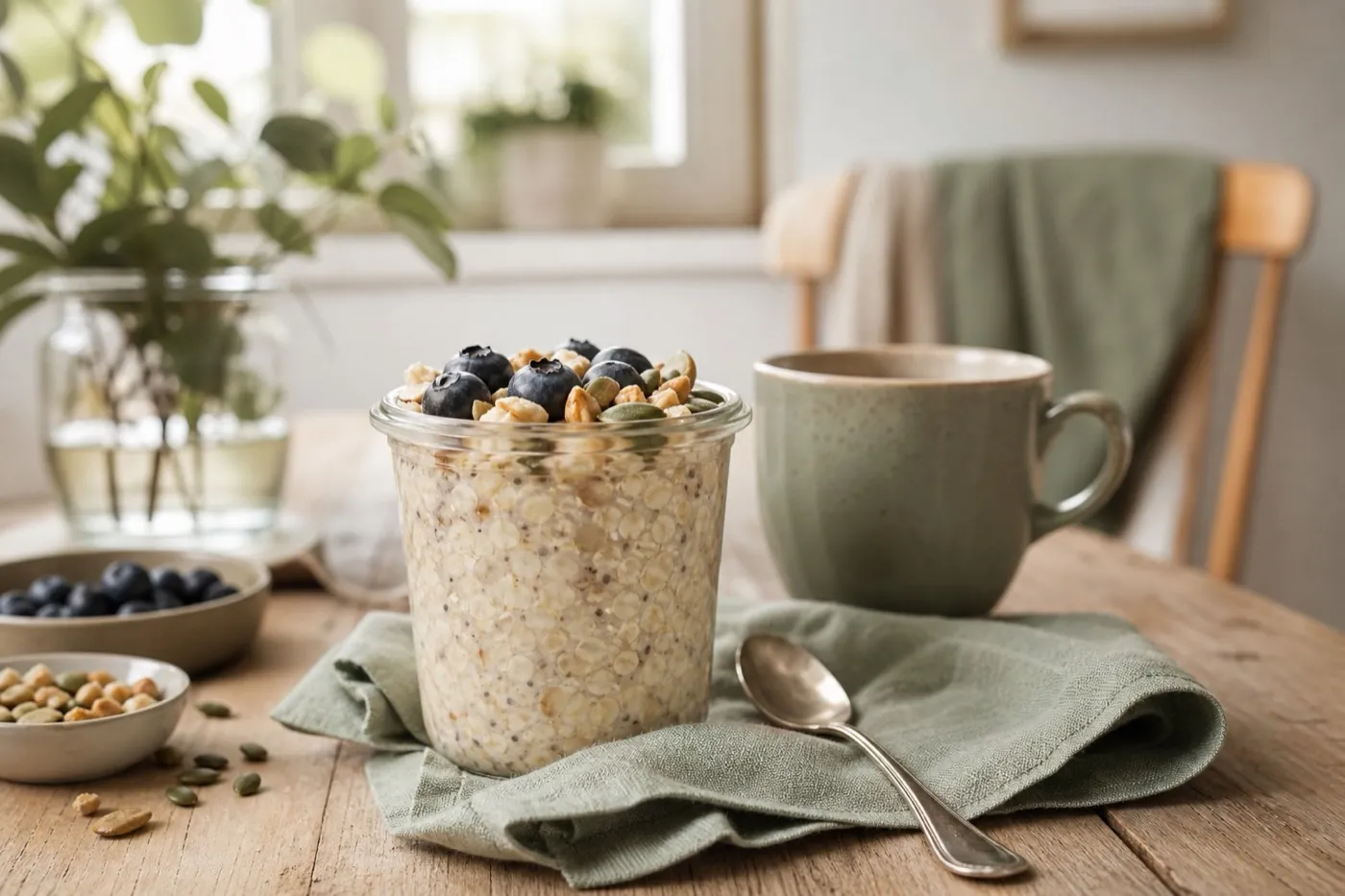
Overnight oats in a jar
No cooking: two minutes in the evening, a ready breakfast to take in the morning. Rolled oats work best.
Ingredients
- Rolled oats50 g
- Plain yoghurt100 g
- Milk100 ml
- Apple grated½
- Honey optional1 tsp
Method
- Put the oats in a jar with a lid, add the yoghurt, milk and grated apple. Stir well so no dry oats are left at the bottom.
- Close the jar and put it in the fridge overnight, for at least 6 hours.
- Stir in the morning. Loosen with a spoonful of milk if it is too thick. Drizzle with honey and eat it straight away or take it with you.
How do jumbo, rolled and quick oats differ?
The main differences are thickness and how far the oats are processed. Here is how each type behaves in an ordinary kitchen.
When should you reach for jumbo oats?
Jumbo oats are whole grains pressed thickly. After a few minutes of cooking they stay noticeable and the porridge is hearty rather than creamy. If you like to feel the flake, this is your type.
In the oven jumbo oats stay crisp, which is why they are the base of homemade granola and crumble toppings. They are a poor choice for pancake batter, because they leave coarse pieces in it.
What are rolled oats best for?
Rolled oats are thinner because the grain is cut into smaller pieces before pressing. They are the most versatile type, so they are the one to buy if you only keep a single packet.
They suit porridge cooked briefly, overnight oats in a jar, pancakes and oat biscuits, where the flakes should partly dissolve into the batter. They mix evenly with wheat flour and do not spoil the structure of a bake.
Are quick oats a good choice?
Quick oats are the thinnest and are often lightly pre-cooked, so they soften when you pour hot water over them. They work where time matters: at the office, on a trip, in a smoothie or as a thickener for soup.
The drawback is texture. Porridge from quick oats is smooth, but it turns into paste if it stands for a few minutes. If you cook at home most mornings, treat them as an extra rather than your staple.
How do you cook porridge from each type of oats?
The proportions here are our editorial estimate based on typical single-portion recipes: roughly twice as much liquid as oats by volume. If your packet gives different ratios, follow it, because the producer knows its own product.
The method is the same for every type. Only the time on the hob changes.
- Measure the oats into a saucepan and cover with water, milk or a mix, about 1 part oats to 2 parts liquid.
- Heat over a medium flame, stirring now and then so the oats do not stick to the base.
- Cook for the time on the packet: longer for jumbo, shorter for rolled. For quick oats, simply pour over the hot liquid.
- Take the pan off the heat, cover for a minute, and only then add fruit, nuts or honey so the porridge does not cool.
- If it is too thick, stir in a little warm milk rather than cold water from the tap.
Two recipes sit lower down, above the list: a basic porridge with jumbo oats and overnight oats in a jar, which only needs rolled oats. Overnight oats need no cooking, so they suit mornings when you do not want to stand at the hob.
Treat flavoured oats and sachets with additions as a separate category. They usually contain sugar, flavourings and dried fruit, so their ingredients look different from plain oats.
What should you check on an oat packet?
On a packet of oats, check the ingredients, the nutrition table, the gluten statement and the date. EU Regulation 1169/2011 requires nutrition values to be given per 100 g, which makes it easy to compare brands.
This short list gathers the things worth a glance at the shelf before the packet goes into your basket.
- Ingredients. Plain oats should list one item: oat flakes. Ingredients appear in descending order by weight, so additions near the top mean you are holding a flavoured product.
- Sugars. In the table, read the line “of which sugars” per 100 g. For plain oats it is low. For flavoured ones it rises, because of added sugar and dried fruit.
- Gluten. Oats are not wheat, but crops and mills easily pick up grains that contain gluten. People who must avoid it should buy only oats labelled “gluten-free”. Under Implementing Regulation 828/2014 that label means no more than 20 mg of gluten per kilogram.
- Allergens. Cereals containing gluten are highlighted in the ingredients, for example in bold. If you shop for someone with an allergy, read the “may contain” warnings too.
- Date. For oats it is usually “best before”, a quality date rather than a safety deadline. After it the flakes may lose flavour or turn rancid, so smell them before use.
- Price per kilogram. Compare this, not the price of the packet, because packs differ in weight. A big pack is cheaper per kilo only if you finish it before the date.
Does the type of oats change the nutrition?
The type matters little for nutrition. According to the US FoodData Central database, 100 g of dry oats gives roughly 370–380 kcal, about 13 g of protein and about 10 g of fibre. Always use the label on your own packet, because values depend on variety and processing.
Oats contain beta-glucan, a soluble fibre. EU Regulation 432/2012 allows producers to say that oat beta-glucan helps maintain normal blood cholesterol, but only at a daily intake of 3 g of beta-glucan. That takes more than one bowl of porridge, so do not read the wording as a promise of results.
The bigger difference is how quickly you eat and how long you feel full. Thicker flakes need cooking and more chewing, which many people find more filling. If you are planning a diet for medical reasons, talk it over with your doctor or a dietitian.
USDA FoodData Central: OatsRozporządzenie (UE) nr 432/2012: dozwolone oświadczenia zdrowotneUSDA FoodData Central: Cereals, oats, regular and quick, not fortified, dry (SR Legacy 173904)How do you store oats once the packet is open?
Once opened, tip the oats into an airtight container and keep it in a dry, cool cupboard, away from the oven, kettle and hob. Steam and warmth encourage damp, and the fat in oats can go rancid faster.
Decant big packs in stages: put a few weeks' worth into the container and leave the rest sealed in the original bag. Write the date from the packet on the container so you know when to use up the stock.
Rancid oats smell sharp, a little like paint, and taste bitter. Do not try to rescue them with toppings. Throw them away and start a fresh packet.
How do you write oats on a shopping list?
Write the type, not just “oats”, because at the shelf it is easy to buy something other than you planned. Add what each is for next to the item: hob porridge, overnight oats, baking.
For a week of oat breakfasts one set is enough: Oat breakfasts for the week includes jumbo and rolled oats, milk, yoghurt, fruit and toppings, and in BuyNest you can open it by QR code or button and tick things off in the shop.
If you are still choosing a yoghurt for your porridge, see the guide to reading a plain yoghurt label. For what “wholegrain” really means, read the wholegrain guide.
A week of oat breakfasts
- Oats
- Jumbo oats500 g
- Rolled oats500 g
- Dairy
- Milk2 l
- Plain yoghurt400 g
- Fruit
- Bananas4 pcs
- Apples3 pcs
- Frozen berries450 g
- Toppings
- Walnuts100 g
- Honey1 pcs
- Cinnamon1 pcs
Frequently asked questions
What is the difference between jumbo and rolled oats?
Jumbo oats are thicker because they are pressed from whole grains, while rolled oats are thinner because the grain is cut first. Jumbo oats take longer to cook and stay chewy. Rolled oats soften faster and blend into batters.
Are quick oats worse than rolled oats?
Not in ingredients, because plain quick oats are still just oats. They differ in texture: fine, fast to soften and easily sticky. They suit a quick breakfast or a smoothie well.
Are oats gluten-free?
Not always. Oats do not contain wheat, but they can meet cereals with gluten during growing and processing. If you must avoid gluten, buy only oats labelled “gluten-free”.
Can I make overnight oats with jumbo oats?
Yes, but they stay firmer and need a full night in the fridge. For a creamier result, use rolled oats.
What does the date on a packet of oats mean?
Usually “best before”, a minimum durability date. After it the oats may lose quality but are not automatically unsafe. Check the smell and taste before you eat them.
Next time you shop, decide first what you are cooking, and choosing oats takes seconds. Open the ready list of oat breakfasts in BuyNest, tick items off in the shop and add only what is missing from your cupboard.
Open the ready list in BuyNestSources
- Rozporządzenie (UE) nr 1169/2011 w sprawie przekazywania informacji na temat żywności
- Rozporządzenie wykonawcze (UE) nr 828/2014: informacje o braku lub zmniejszonej zawartości glutenu
- Rozporządzenie (UE) nr 432/2012: dozwolone oświadczenia zdrowotne
- USDA FoodData Central: Oats
- USDA FoodData Central: Cereals, oats, regular and quick, not fortified, dry (SR Legacy 173904)
Take the shopping into BuyNest
BuyNest is on iPhone and Android. The app has no ads, including on the free plan.