
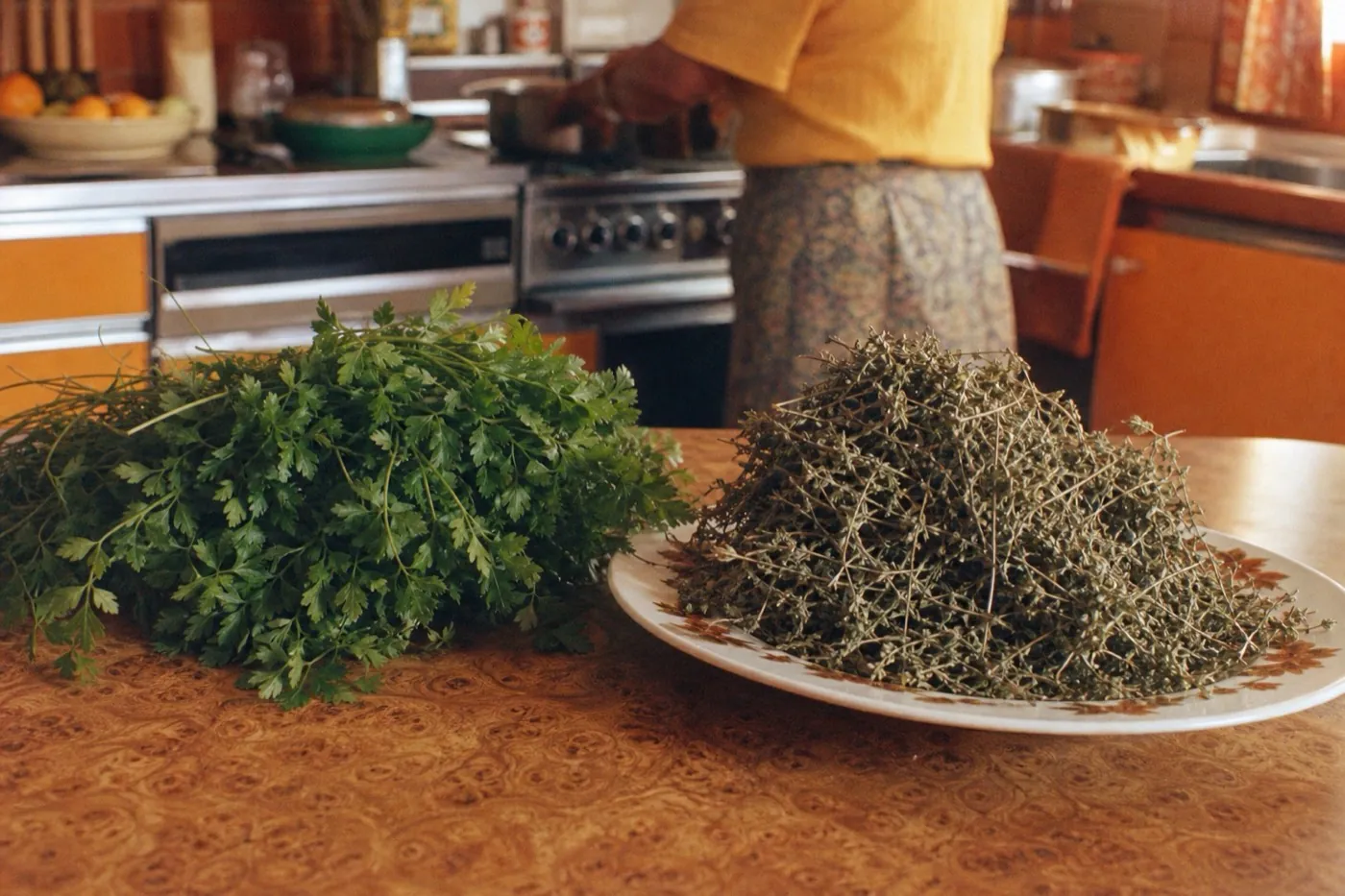
Fresh or dried herbs: which should you buy?
Buy soft-leaved herbs such as basil, parsley, dill and coriander fresh, and keep hardy ones such as oregano, thyme, rosemary and marjoram dried. It depends on the herb and the cooking time: add dried ones at the start and fresh ones at the end.
Dried herbs need heat and fat to release their flavour, so stir them into frying onions, a sauce or a marinade. Delicate fresh herbs turn dark and lose their scent when cooked for long, which is why they go in just before serving.
Two recipes follow: roast potatoes with dried thyme and rosemary, and tabbouleh with a big bunch of parsley. They show both cases, and the second uses up a whole bunch.
Roast potatoes with dried thyme and rosemary
Dried herbs added at the start release their aroma into the oil and do not burn.
Ingredients
- Potatoes800 g
- Olive oil3 tbsp
- Dried thyme1 tsp
- Dried rosemary1 tsp
- Garlic unpeeled3 cloves
- Salt1 tsp
Method
- Heat the oven to 220°C.
- Wash the potatoes and cut them into quarters. No need to peel them.
- Toss them on a tray with the oil, thyme, rosemary, salt and the unpeeled garlic cloves. Spread in one layer.
- Roast for 35–40 minutes, turning once, until golden outside and soft inside.
Tabbouleh with a big bunch of parsley
A salad where parsley is the main ingredient, not a garnish. It uses the whole bunch.
Ingredients
- Flat-leaf parsley large1 bunch
- Fresh mint a handful
- Bulgur wheat60 g
- Tomatoes3
- Spring onions3
- Lemon1
- Olive oil3 tbsp
Method
- Pour 150 ml of boiling water over the bulgur, cover and leave for 15 minutes. Fluff with a fork and let it cool.
- Wash the parsley and mint, dry them well and chop finely, including the thin parsley stems.
- Dice the tomatoes finely and slice the spring onions thinly.
- Mix everything with the lemon juice, olive oil, salt and pepper. Serve straight away or within a few hours.
Tip Dried parsley will not stand in here. This is a recipe where the form of the herb makes the dish.
How do fresh and dried herbs compare?
The table compares both forms on what matters in everyday cooking for two to four people. Prices are made-up examples to show the sum in a later section.
| Criterion | Fresh | Dried |
|---|---|---|
| Price per kg (example) | a bunch of parsley £0.80 for 50 g, so £16/kg | a 10 g pot £0.70, so £70/kg |
| Time | washing and chopping before use | straight from the jar |
| Taste | bright, green, fresh | concentrated, earthy |
| Best for | salads, pesto, cold sauces, garnish | stews, sauces, marinades, roasting |
| Storing | fridge or windowsill, a few days | jar in a dark cupboard, up to a year (editorial estimate) |
| Waste | high if you only use a handful | low, but herbs fade with time |
| Availability | depends on the season | all year |
The price per kilo of dried herbs looks surprisingly high because herbs weigh so little. Compare the cost of one use, not just the unit price.
Which herbs are better fresh?
Basil, parsley, dill, coriander, chives and mint lose much of their aroma when dried and the flavour changes. Use them in salads, pesto, cold sauces and as a garnish for soup and pasta. Chives in curd cheese and fresh mint in drinks have no real dried equivalent.
If you are missing a fresh herb, see our guide to replacing fresh herbs in a sauce.
Which herbs dry well?
Oregano, thyme, rosemary, marjoram and bay leaves cope well with drying and work as well as fresh in long-cooked dishes. Dried oregano is classic on pizza and in tomato sauces. For roast potatoes pick dried thyme or rosemary.
EUR-Lex: Dyrektywa 98/6/WE w sprawie podawania cen produktów (cena jednostkowa)How much dried herb replaces fresh?
Dried herbs are stronger by weight because they contain no water. A widely used kitchen rule is one teaspoon of dried herb for one tablespoon of chopped fresh. That is a rule of thumb, not a standard, so treat it as a starting point. Dried herbs fade with time, so older ones may need more.
A simple way to avoid overdoing it:
- Start with 1 teaspoon of dried herb for each tablespoon of fresh the recipe asks for.
- Add the dried herb at the start of cooking, into the fat or the sauce.
- Taste after a few minutes and add more if the flavour is faint.
- Add delicate fresh herbs at the end, on the plate.
If a dried herb has sat in the cupboard for more than a year, start with a larger amount. It is easier to add more than to rescue an over-seasoned dish.
Can you use dried basil instead of fresh in pesto?
It is not worth it. Pesto relies on a fresh, green aroma, and dried basil gives a different, more herby flavour and won't colour the sauce. For pesto buy a pot or a bunch and use it within a few days. Dried basil suits a long-simmered tomato sauce better.
What do herbs cost and how much goes to waste?
Dried herbs come in small pots and bags, often 5 to 20 g, so the price per kilo on the shelf label looks high. Still, compare the unit price the shop shows on the label. A bigger pack or refill jar is usually cheaper per kilo.
An example with made-up prices:
- A 10 g pot of dried oregano for £0.70: 0.70 ÷ 0.01 = £70 per kilo.
- A 50 g jar for £2.20: 2.20 ÷ 0.05 = £44 per kilo.
- A teaspoon of dried oregano weighs about 1 g, so one use costs pennies either way.
With fresh herbs the sum depends on how much you use. A £0.80 bunch of parsley where you use a handful and the rest wilts is expensive. The same bunch used in tabbouleh and as a soup garnish is cheap. A pot of basil costs more than a bunch, but on a windowsill it gives several harvests if you pick the top leaves rather than whole stems.
Can you use dried herbs past the date on the pack?
Dried herbs carry a best-before date. After it they are still edible if stored dry, but they lose their aroma. It is better to buy a small jar you will use within a year than a big one that goes stale. Throw out herbs with mould, damp lumps or a strange smell.
EUR-Lex: Dyrektywa 98/6/WE w sprawie podawania cen produktów (cena jednostkowa)EUR-Lex: Rozporządzenie (UE) nr 1169/2011 w sprawie przekazywania konsumentom informacji na temat żywnościHow should you store fresh and dried herbs?
Parsley, coriander and dill: trim the stalk ends, stand the bunch in a glass of water like flowers, cover loosely with a bag and put it in the fridge. Change the water every two days. Chives and mint keep well wrapped in a slightly damp paper towel in a tub. Basil hates the cold, so keep it in a glass of water on the worktop, out of the sun.
Wash herbs under running water just before use, not before storing. The FDA advises washing fresh produce under running water before preparing or eating it, without soap. Water left on leaves speeds up rotting, but that is our own observation, not an FDA line.
Can you freeze fresh herbs?
Yes. Chop them, put them in an ice-cube tray, top up with oil or water, freeze, then tip the cubes into a bag. USDA FSIS notes that food kept frozen stays safe and that freezer time only affects quality. Drop the cubes straight into a sauce or soup.
Frozen herbs are not suited to salads, because they are soft once thawed.
How do you keep dried herbs from losing flavour?
Store them in sealed jars in a dark, dry cupboard away from the hob. Don't shake them into the pan straight from the jar over steam, as moisture clumps the contents. Tip a portion into a spoon or your hand and close the jar at once.
More on dry goods is in our guide to storing dry groceries in a cupboard.
FDA: Selecting and Serving Produce SafelyUSDA FSIS: Freezing and Food SafetyWhat should you buy fresh and what dried?
The simplest split is soft herbs fresh for a particular dish this week and hardy herbs dried as a cupboard staple. A few situations for a household of two to four:
- Cupboard staples: oregano, thyme, marjoram, bay leaves, rosemary.
- Fresh to a plan: a bunch of parsley, dill or coriander for particular dishes this week.
- A pot of basil: when you use it several times a week.
- Frozen cubes: when you bought a bigger bunch than you will use.
More side-by-side guides are in product comparisons, and dishes that use fresh herbs are in recipes.
How do you add herbs to your BuyNest shopping list?
Write the herb and its form: parsley, bunch or dried oregano. A plain entry of herbs tells you nothing at the shelf, and it is easy to buy the wrong thing.
For the recipes in this guide you can use the ready list for two dishes with fresh and dried herbs and add it to BuyNest with the QR code or the button. Items land on a list split by shop, and everyone sharing it sees changes straight away.
Add dried herbs to your own staples template, so they come back on the list when a jar runs low.
Fresh and dried herbs: two dishes
- Fresh herbs
- Flat-leaf parsley large bunch1 pcs
- Fresh mint bunch1 pcs
- Basil pot1 pcs
- Dried herbs
- Dried thyme1 pack
- Dried rosemary1 pack
- Dried oregano1 pack
- Bay leaves1 pack
- Vegetables
- Potatoes1 kg
- Tomatoes3 pcs
- Spring onions bunch1 pcs
- Garlic bulb1 pcs
- Lemons2 pcs
- Dry goods and oils
- Bulgur wheat400 g
- Olive oil500 ml
- Household
- Ice cube tray for freezing herbs1 pcs
Frequently asked questions
How much dried herb equals a tablespoon of fresh?
Usually about a teaspoon of dried for a tablespoon of chopped fresh. That is a rule of thumb, not a standard, so start small, taste and add more. Old herbs may need more.
Do dried herbs go off?
After the best-before date they mainly lose aroma. Throw them out if you see mould, damp lumps or a strange smell. A sealed jar in a dry cupboard helps them last.
Can you freeze fresh herbs?
Yes. Chop them, cover with water or oil in an ice-cube tray and freeze. The cubes work well in sauces and soups, but they are soft once thawed, so don't use them in salads.
Should you wash herbs before putting them in the fridge?
Better not, because moisture on the leaves speeds up rotting (our own observation). Wash them under running water just before use and dry them; the FDA advises washing fresh produce under running water.
Is a pot of herbs better than a bunch?
A pot costs more but gives several harvests if you pick the top leaves. It pays off for herbs you use several times a week. Choose a bunch for a single dish and use it up at once.
Check which dried herbs you have and how old the jars are, then add only fresh herbs for this week's dishes. At the shelf compare the price per kilo, but think mostly about the cost of one use.
Open the ready list in BuyNestSources
Take the shopping into BuyNest
BuyNest is on iPhone and Android. The app has no ads, including on the free plan.