
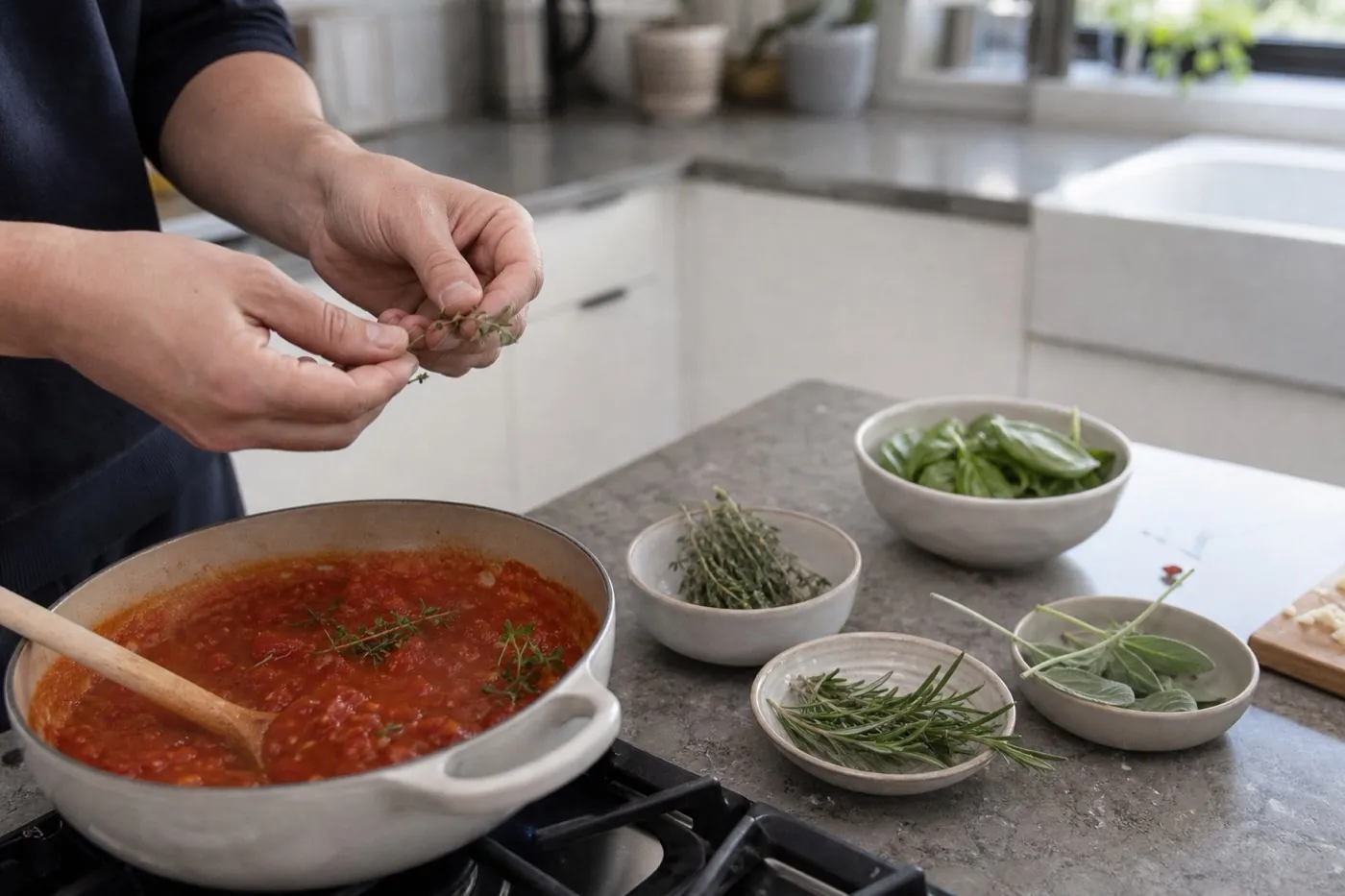
How do you replace fresh herbs in a sauce with dried ones?
To replace fresh herbs in a sauce with dried ones, use roughly one third of the amount: a teaspoon of dried stands in for a tablespoon of fresh. Add dried herbs at the start of cooking, as they need ten minutes or more to give up their flavour. Fresh ones go in at the end.
Dried leaves have lost their water, so the same volume carries more aroma. Not every herb dries well, though: oregano and thyme do, basil and parsley far less so.
The amounts in this text are BuyNest editorial practice, not a standard. Always taste before serving, because herbs differ in strength.
Meatballs in tomato sauce with dried oregano and thyme
A sauce where dried herbs beat fresh ones, because it simmers long enough for them to release their flavour. Fresh parsley only goes on at the end, if you have it.
Ingredients
- Pork and beef mince500 g
- Egg1
- Breadcrumbs3 tbsp
- Onion1
- Garlic3 cloves
- Passata or blended tinned tomatoes700 g
- Dried oregano1 tsp
- Dried thyme½ tsp
- Bay leaf2
- Olive oil2 tbsp
- Flat-leaf parsley optional, to serve
Method
- Grate half the onion and finely chop the other half for the sauce. Mix the mince with the egg, breadcrumbs, grated onion, one crushed garlic clove, salt and pepper. Shape about 20 walnut-sized meatballs.
- Heat the oil in a wide pan and brown the meatballs in batches, 2–3 minutes a side. They do not need to be cooked through yet. Set them aside on a plate.
- In the same fat, soften the chopped onion and add the rest of the garlic. Add the dried oregano and thyme, rubbing them between your fingers over the pan, and fry for 30 seconds. Warm fat brings out the aroma of dried herbs.
- Pour in the tomatoes, add the bay leaves and 100 ml of water. Return the meatballs to the sauce and simmer, lid ajar, for 20–25 minutes on low heat.
- Check one meatball with a thermometer: minced meat should reach at least 71°C in the centre. Remove the bay leaves.
- Taste the sauce and only now season with salt. If you have fresh parsley, scatter it over just before serving.
Tip Egg and wheat breadcrumbs are both EU-listed allergens. Without the egg the meatballs are more fragile, so turn them gently.
Dill sauce with frozen dill
Frozen dill is the closest thing to fresh: it keeps its colour and much of its scent. The sauce goes with new potatoes, eggs and fish.
Ingredients
- Butter2 tbsp
- Plain flour2 tbsp
- Vegetable stock warm400 ml
- Frozen dill or 3 tbsp fresh3 tbsp
- Thick plain yoghurt4 tbsp
- Lemon juice½
- Salt and pepper to taste
Method
- Melt the butter in a small pan, add the flour and stir over medium heat for 1–2 minutes, until it smells toasty but has not browned.
- Add the warm stock a little at a time, whisking all the while to stop lumps forming. Simmer for 3–4 minutes, until thick.
- Add the frozen dill straight from the freezer and cook for another minute. Frozen dill needs no thawing and is about as strong as fresh, so swap spoon for spoon.
- Take the pan off the heat. Mix the yoghurt in a small bowl with two spoonfuls of the hot sauce, then stir it into the pan. This stops it splitting.
- Season with lemon juice, salt and pepper. Do not boil the sauce again after adding the yoghurt.
Tip If you only have dried dill, use 1 teaspoon for 3 tablespoons of fresh and add it with the stock, so it has time to soften.
How do you convert herbs? A table of instead of, use, amount and notes
The table covers a sauce for about four portions where the recipe calls for a handful or a tablespoon of chopped fresh herbs. Amounts are based on the volume of chopped leaves, and frozen herbs are the kind sold in bags.
| Instead of | Use | Amount | Notes |
|---|---|---|---|
| 1 tablespoon fresh oregano or thyme | Dried | 1 teaspoon | Add at the start, with the onion or the liquid. |
| 1 tablespoon fresh rosemary | Dried, crumbled | 1 teaspoon | Grind in a mortar or lift out before serving. |
| A handful of fresh basil | Frozen basil or basil in oil | 2 tablespoons frozen or 1 teaspoon paste | Dried basil loses most of its aroma. |
| 1 tablespoon fresh parsley or dill | Frozen | 1 tablespoon, no thawing | Add near the end of cooking. |
| 1 tablespoon fresh chives | Green part of spring onion or leek | 1 tablespoon finely chopped | Add at the end to keep it fresh. |
| Fresh mint or coriander | Another fresh herb | same volume | Dried ones change the flavour. Pick parsley or basil. |
| A mix of fresh herbs | Italian or Provençal mix | 1 teaspoon per tablespoon of fresh | Check the label, as mixes may contain salt. |
If you only have dried herbs and the sauce is already finished, stir them in with a little warm water or oil and give them a few minutes.
When should you add dried herbs and when fresh ones?
Timing matters more than the ratio. Soft-leaved herbs usually go in at the end, because long cooking darkens them and kills their scent. Add dried ones at the start, with the onion and garlic or right after the liquid.
They need 10–15 minutes in warm fat or sauce to soften and release flavour. Added at the very end they stay hard and smell more of dust than herb. We describe kitchen practice here, not a standard.
How do you wake up dried herbs before adding them?
Rub them between your palms to release the oils, and drop them into hot fat for a few seconds. The aroma then spreads through the whole sauce. Take care not to burn them, or they turn bitter.
When do fresh herbs go in?
After taking the sauce off the heat, or for the last two minutes of cooking. Chop them just before use, as they lose scent quickly once cut. If the sauce is very hot, leave the parsley for the top of each portion.
Which herbs dry well and which do not?
The split is simple and helps you decide whether a swap makes sense at all. Here are the two groups, from kitchen practice.
- They dry well: oregano, thyme, marjoram, rosemary, savory and bay. In sauces cooked for more than a quarter of an hour they work almost like fresh.
- They dry badly: basil, parsley, coriander, dill, chives and mint. Dried, they give a general herby note but not the scent of fresh leaves.
- Frozen herbs: dill, parsley and basil keep more aroma frozen than dried, so for soft herbs it is the better choice.
In a tomato sauce, dried oregano and thyme do very well. Dried basil is a compromise, so it is better to look for frozen basil or a basil paste.
How much herb goes into which sauce?
The amount depends on the type of sauce and whether it should taste clearly herby or just lifted by aroma. The values below are for a sauce for four and are a starting point from editorial practice. Start with less, because adding is easier than taking out.
- Tomato pasta sauce: 1–2 teaspoons of dried oregano or Italian mix, added at the start with the onion.
- Sauce for meatballs: a teaspoon of dried oregano and half a teaspoon of thyme, plus a bay leaf to lift out before serving.
- Yoghurt or dill sauce: 2–3 tablespoons of frozen dill or parsley, added at the end to a warm, not boiling, sauce.
- Gravy: a teaspoon of dried thyme or marjoram, stirred into the meat stock.
- Cream sauce for pasta: a teaspoon of dried Provençal herbs and a pinch of nutmeg.
If the herbs still taste raw after stirring, leave the pan on a low heat for a few more minutes. The flavour evens out by itself.
How can you speed up an herb sauce when you only have dried herbs?
A quick sauce with dried herbs takes about a quarter of an hour if you get the order right. The steps below suit a tomato base, but the same layout works in a cream sauce.
- Heat a tablespoon of oil in a pan and soften finely chopped onion.
- Add garlic and dried herbs and stir for a minute until fragrant.
- Pour in tomatoes or stock, bring to the boil, then lower the heat.
- Simmer uncovered for 10–15 minutes until the sauce thickens.
- At the end add anything fresh or frozen, such as parsley, dill or a little lemon zest.
If the sauce is too herby, loosen it with a little water or cream and add a pinch of salt. Too much dried herb is hard to remove, so start with less.
What can you do when you have no herbs at all?
Having no herbs does not have to mean a flat sauce, but the swap will change its character. Instead of the herb, add something that does a similar job in taste: freshness, bitterness or depth.
Lemon zest adds the freshness that parsley usually gives. A pinch of chilli flakes and good olive oil at the end give a tomato sauce punch without basil. The green parts of spring onion or leek, finely chopped, replace chives in a yoghurt sauce.
Tomato sauces
Add a pinch of sugar, a little good olive oil and a teaspoon of purée for depth. Garlic fried at the start will replace some of the basil aroma.
Cream and butter sauces
Nutmeg and white pepper work well. A few drops of lemon juice balance the heaviness of cream. For more on swapping cream, see the guide on alternatives to cream in soup.
Sauces for meat
You can add a teaspoon of mustard or a dash of soy sauce. Bear in mind that it is now a different dish from the recipe, and soy sauce is salty and contains allergens.
How do you check the label of herb mixes and seasonings?
Herb mixes, such as Italian or Provençal herbs, can be salted and contain additives. Regulation 1169/2011 requires allergens to be highlighted in the ingredients and, for most packaged food, a nutrition declaration including salt.
If you cook for someone with an allergy or a low-salt diet, read the label. A single-ingredient herb, such as plain oregano, is a safer choice than a mix of unknown composition.
Rozporządzenie (UE) nr 1169/2011 w sprawie przekazywania konsumentom informacji na temat żywnościHow do you keep herbs so you search for them less often?
Divide a bunch of fresh herbs: use some right away and freeze the rest. Put chopped parsley, dill or basil in a bag in a flat layer, or in an ice cube tray with a little oil. Such a stock covers several sauces.
Keep dried herbs in sealed jars away from light and heat, not above the hob. Over time they lose aroma (kitchen practice, not a sourced figure), so write the purchase date on the jar. We compare the two kinds in the guide to fresh or dried herbs.
How do you shop for herb sauces?
You can open the ready list before you head out for herbs. The shopping list for herb sauces covers dried and frozen herbs, tomatoes, yoghurt, mince for meatballs and extras. The items are grouped by shop section.
Two recipes sit just below, above the list: meatballs in tomato sauce with dried oregano and thyme, and a dill sauce from frozen dill. Cook the meatballs right through, until there is no pink in the middle, as the NHS advises for minced meat. Find more ideas in the recipes.
NHS: Meat in your dietHerb sauces: shopping list
- Meat and dairy
- Pork and beef mince500 g
- Eggs6 pcs
- Thick plain yoghurt about 180 g1 pcs
- Butter1 pack
- Tins and dry goods
- Passata700 g
- Breadcrumbs1 pack
- Vegetable stock1 pack
- Plain flour1 kg
- Herbs
- Dried oregano1 pcs
- Dried thyme1 pcs
- Bay leaves1 pack
- Frozen dill1 pack
- Flat-leaf parsley bunch, optional1 pcs
- Vegetables
- Onion1 pcs
- Garlic bulb1 pcs
- Lemon1 pcs
- New potatoes for the dill sauce1 kg
Frequently asked questions
How much dried herb equals fresh?
Usually a third of the amount: a teaspoon of dried replaces a tablespoon of fresh. That is a kitchen rule, not a standard, so adjust to the strength of the herbs and taste the sauce before serving.
Can dried basil replace fresh in tomato sauce?
Partly. Dried basil loses most of its aroma and gives a general herby note. Frozen basil, a basil paste or another herb such as oregano works better.
When should you add dried herbs to a sauce?
At the start of cooking, with the onion or the liquid. They need 10–15 minutes in the warmth to give up their flavour. Added at the very end they stay hard.
Are frozen herbs better than dried?
For soft herbs such as dill, parsley and basil, yes. They keep more aroma than dried ones. Add them near the end of cooking, without thawing.
What can you use if you have no herbs at all?
Lemon zest, chilli flakes, good olive oil and garlic will replace some of the aroma. The sauce changes character but stays tasty.
Can a ready herb mix replace fresh herbs?
Yes, but check the label, as mixes may be salted and contain additives. Use a teaspoon of mix per tablespoon of fresh herbs and add it at the start. The taste will be more general than with a single herb.
To replace fresh herbs in a sauce, use dried ones at a ratio of one to three, added at the start, and frozen ones for soft herbs. Open the ready list in BuyNest and add whichever herbs your cupboard lacks.
Open the ready list in BuyNestSources
Take the shopping into BuyNest
BuyNest is on iPhone and Android. The app has no ads, including on the free plan.