
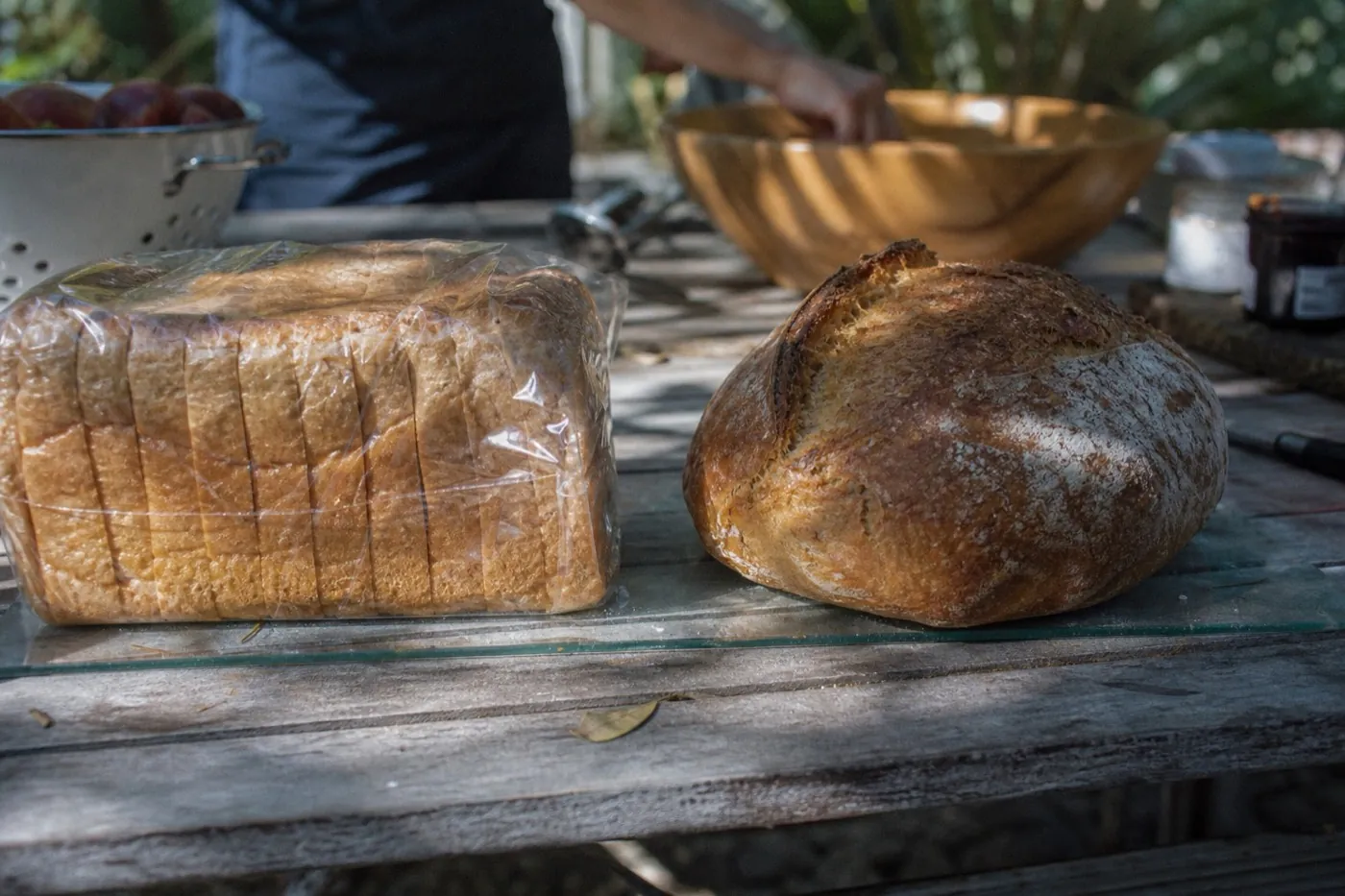
Sliced bread or a whole loaf: which should you buy?
Choose sliced bread if your household eats a few slices a day and you want to freeze some. Buy a whole loaf if it will be eaten in a day or two, or if you want thick slices and bakery bread. What decides it is how fast the bread disappears, not the shape.
The crust protects the crumb from drying out, so an uncut loaf stays moist for longer. Each cut exposes more crumb, and factory-sliced bread has a lot of that surface. That is why it is usually sealed in plastic and often contains additives that slow staling, which you can check on the label.
Right under this section there are two recipes for stale bread: French toast and tomato soup with oven croutons. They use about half a loaf.
French toast from stale bread
Stale bread soaks up the egg without falling apart in the pan. Best with thick slices from a loaf.
Ingredients
- Stale white bread thick slices4
- Eggs2
- Milk150 ml
- Cinnamon½ tsp
- Butter20 g
- Seasonal or frozen fruit150 g
- Plain yoghurt100 g
Method
- Beat the eggs with the milk, cinnamon and a pinch of salt in a shallow dish.
- Dip the slices in the mixture for 20–30 seconds on each side. Stale bread needs a moment to soak it up.
- Melt the butter in a frying pan over medium heat. Fry the slices for 2–3 minutes on each side until golden.
- Serve with fruit and yoghurt.
Tomato soup with oven croutons
Croutons from stale bread cubes and a quick passata soup. The croutons keep for a few days in a tin.
Ingredients
- Stale bread cubed150 g
- Olive oil3 tbsp
- Passata700 g
- Onion1
- Garlic2 cloves
- Vegetable stock400 ml
- Dried oregano1 tsp
- Single cream optional100 ml
Method
- Heat the oven to 200°C. Toss the bread cubes with 2 tablespoons of oil, the oregano and salt. Bake on a tray for 10–12 minutes until crisp.
- Soften the chopped onion in a tablespoon of oil in a pan for 5 minutes, add the garlic and cook for a minute.
- Add the passata and stock, bring to the boil and simmer for 10 minutes. Blend, season with salt and pepper, and stir in the cream.
- Serve with the croutons. Cool the remaining croutons and keep them in an airtight container.
How do sliced bread and a whole loaf compare?
The table compares both forms on what matters in an ordinary kitchen for two to four people. Prices are made-up examples to show the sum in the next section.
| Criterion | Sliced bread | Whole loaf |
|---|---|---|
| Price per kg (example) | £1.20 for 500 g, so £2.40/kg | £1.60 for 800 g, so £2.00/kg |
| Time | straight into the toaster or sandwich | a few minutes to slice |
| Taste and texture | soft, even, can be spongy | distinct crust, denser crumb |
| Best for | sandwiches, toast, croutons | thick slices, bruschetta, soups, cubes |
| Storing | sealed plastic, stays soft longer | bread bin or paper, dries sooner |
| Freezing | take out one slice at a time | slice before freezing |
| Waste | lower if you freeze slices | higher if you eat little and rarely |
The type of bread matters too. Sourdough and rye usually stay fresh longer than white yeast bread, so compare the same type in both forms.
What should you check on the label?
Packaged bread has an ingredient list and a date. Loose bread from a bakery does not need a label on the bag, but allergen information, such as gluten, sesame or milk, must still be available. Ask at the counter or look for a sign.
A short list is a good sign: flour, water, sourdough or yeast, salt. If you want more wholegrain in your diet, the Polish National Centre for Nutrition Education plate guide suggests swapping white bread for wholegrain.
EUR-Lex: Rozporządzenie (UE) nr 1169/2011 w sprawie przekazywania konsumentom informacji na temat żywnościNCEZ PZH: Talerz Zdrowego ŻywieniaWhat does a kilo of bread cost, and how much gets wasted?
Packaged bread shows its net weight and the shelf label gives a price per kilo. At a bakery loaves are often sold by the piece, so ask for the weight or compare loaves of similar size. The unit price (required by EU Directive 98/6/EC; check the rules where you shop) is what makes the comparison fair.
Here is the sum in three steps, with made-up prices:
- A rye loaf of 800 g for £1.60: 1.60 ÷ 0.8 = £2.00 per kilo.
- The same bread sliced, 500 g for £1.20: 1.20 ÷ 0.5 = £2.40 per kilo, so slicing and packing add 40p a kilo.
- Add the waste: if you throw away a quarter of the loaf, the 600 g you eat cost 1.60 ÷ 0.6 = £2.67 per kilo.
In this example sliced bread that you eat or freeze whole works out cheaper than a loaf that half goes stale. Once a week, look at how many slices you binned and adjust the size you buy.
EUR-Lex: Dyrektywa 98/6/WE w sprawie podawania cen produktów (cena jednostkowa)Should you keep bread in the fridge?
For the next few days keep bread at room temperature, in a bread bin, a linen bag or a paper bag. Sealed plastic stops it drying out but traps moisture, which helps mould grow. The fridge usually makes bread go stale faster than the worktop, so it is not the best place for it.
How do you freeze bread so it keeps its flavour?
Slice the bread on the day you buy it, put the slices in a bag and press out the air. USDA FSIS notes that food kept frozen stays safe and that freezer times only affect quality. Bread dries out and picks up smells over time, so use it within a few weeks (our estimate).
Toast slices straight from frozen or thaw them on the worktop for a few minutes. More on portions is in our guide to portioning and freezing bread.
What if the bread has gone mouldy?
Throw away the whole loaf or the whole bag. FSIS classes bread as a porous food, where mould can reach below the surface, so cutting off the green patch is not enough. Don't sniff mouldy bread, as the spores can irritate your airways.
Staleness is different: it is lost moisture and changed starch. It is safe, if unappealing, and good for further cooking.
USDA FSIS: Freezing and Food SafetyUSDA FSIS: Molds on Food: Are They Dangerous?What can you make with stale bread?
Stale bread that has not gone mouldy is a useful ingredient. Turn it into French toast, croutons for soup, breadcrumbs or a bread bake. The two recipes above use about half a loaf, and the remaining slices can go in the freezer.
If you have run out of breadcrumbs and have dry bread, see our guide to breadcrumb alternatives for coating food. Oven croutons need no oil, but watch them near the end. EFSA links acrylamide to browning, and EFSA cites advice from some countries not to burn it, but to brown it lightly.
EFSA: AcrylamideHow much bread should you buy for a week?
Start by counting slices, not loaves. For one week, jot down how many slices each person eats at breakfast, supper and in a packed lunch. The total shows how much bread you actually need. This is an editorial estimate built on your own notes, because appetites differ a great deal between homes.
For example, two people eat 4 slices a day each, which is 8 slices. Over 7 days that is 56 slices. If one slice weighs about 30 g, a figure you should check on your own loaf label, you need roughly 1.7 kg of bread a week. That equals two 800 g loaves or three 500 g packs of sliced bread.
This sum also helps you decide about freezing. If you only eat one loaf in a week, buy the second when the first is nearly gone, or freeze half straight away.
At the end of the week, look in the bread bin and count what is left. That number is your own waste measure and lets you adjust the next list.
Should you buy bread from a bakery every day?
Fresh bakery bread is best on the day you buy it and the next. If you can pop in every two or three days, buy a smaller loaf and do not keep it any longer. If you shop once a week, choose sourdough or rye, which go stale more slowly, and freeze half in slices.
How do you deal with two tastes in one home?
If one person likes sandwich bread and another prefers a crusty loaf, buy both in smaller sizes and list them as separate items. On a shared BuyNest list everyone can see what is already in the trolley, so nobody ends up buying a third loaf by mistake.
When should you buy sliced bread and when a whole loaf?
Match the form to how quickly you eat it. These situations assume a household of two to four:
- Sliced bread: you eat little and irregularly, you freeze at once, you make toast, you need even slices for lunch boxes.
- Whole loaf: it is eaten in two days, you like thick slices, you make bruschetta or croutons, you buy from a bakery.
- Both: a loaf for the weekend and sliced bread for the days with no time.
If dates on packs confuse you, use-by and best-before dates explained is a short read. More side-by-side guides are in product comparisons.
How do you add bread to your BuyNest shopping list?
Write the type and the form: rye bread, whole loaf or sandwich bread, sliced. Add the bakery as a separate shop if you buy there regularly, so the bread does not get lost on the supermarket list.
For the recipes in this guide you can use the ready list for a week of bread and leftover dishes and add it to BuyNest with the QR code or the button. Items land on a list split by shop, and everyone sharing it sees changes straight away.
Add a reminder for the day you freeze slices, so bread does not sit too long in the bin.
A week of bread and leftover dishes
- Bread
- Rye bread to freeze1 loaf
- Sliced sandwich bread1 pack
- White bread for French toast1 loaf
- Dairy and eggs
- Eggs6 pcs
- Milk1 l
- Butter200 g
- Plain yoghurt400 g
- Single cream200 ml
- Fruit and vegetables
- Frozen berries450 g
- Onion1 pcs
- Garlic bulb1 pcs
- Tins and dry goods
- Passata700 g
- Vegetable stock1 l
- Olive oil500 ml
- Cinnamon1 pack
- Household
- Freezer bags1 pack
Frequently asked questions
Is sliced bread worse than a whole loaf?
No, it is simply a different form. Sliced bread is handier for toast and freezing, and a loaf gives you a choice of thickness. Compare the same type of bread and the same ingredients, not just the shape.
Can you freeze bread in slices?
Yes. Slice it on the day you buy it, seal it well and press out the air. Use it within a few weeks, because over time bread loses flavour and dries out, though it stays safe.
Can you cut mould off bread?
No. Bread is porous and mould can spread below the surface, so throw away the whole loaf or bag. FSIS gives this as the rule for bread.
Where should you keep bread so it doesn't go stale?
In a bread bin, linen bag or paper bag at room temperature. The fridge usually speeds up staling. If you won't finish the bread in a few days, freeze it in slices.
Is toasted bread bad for you?
EFSA links acrylamide to browning, and longer toasting raises the amount. Brown it lightly and do not burn it, as EFSA reports in advice from some countries. For health questions, ask your GP or a dietitian.
Look at how many slices you binned last week and choose sliced bread or a loaf on that basis. Add it to your BuyNest list with its form, and freeze any extra in slices on the day you buy it.
Open the ready list in BuyNestSources
- EUR-Lex: Rozporządzenie (UE) nr 1169/2011 w sprawie przekazywania konsumentom informacji na temat żywności
- EUR-Lex: Dyrektywa 98/6/WE w sprawie podawania cen produktów (cena jednostkowa)
- EFSA: Acrylamide
- NCEZ PZH: Talerz Zdrowego Żywienia
- USDA FSIS: Freezing and Food Safety
- USDA FSIS: Molds on Food: Are They Dangerous?
Take the shopping into BuyNest
BuyNest is on iPhone and Android. The app has no ads, including on the free plan.