
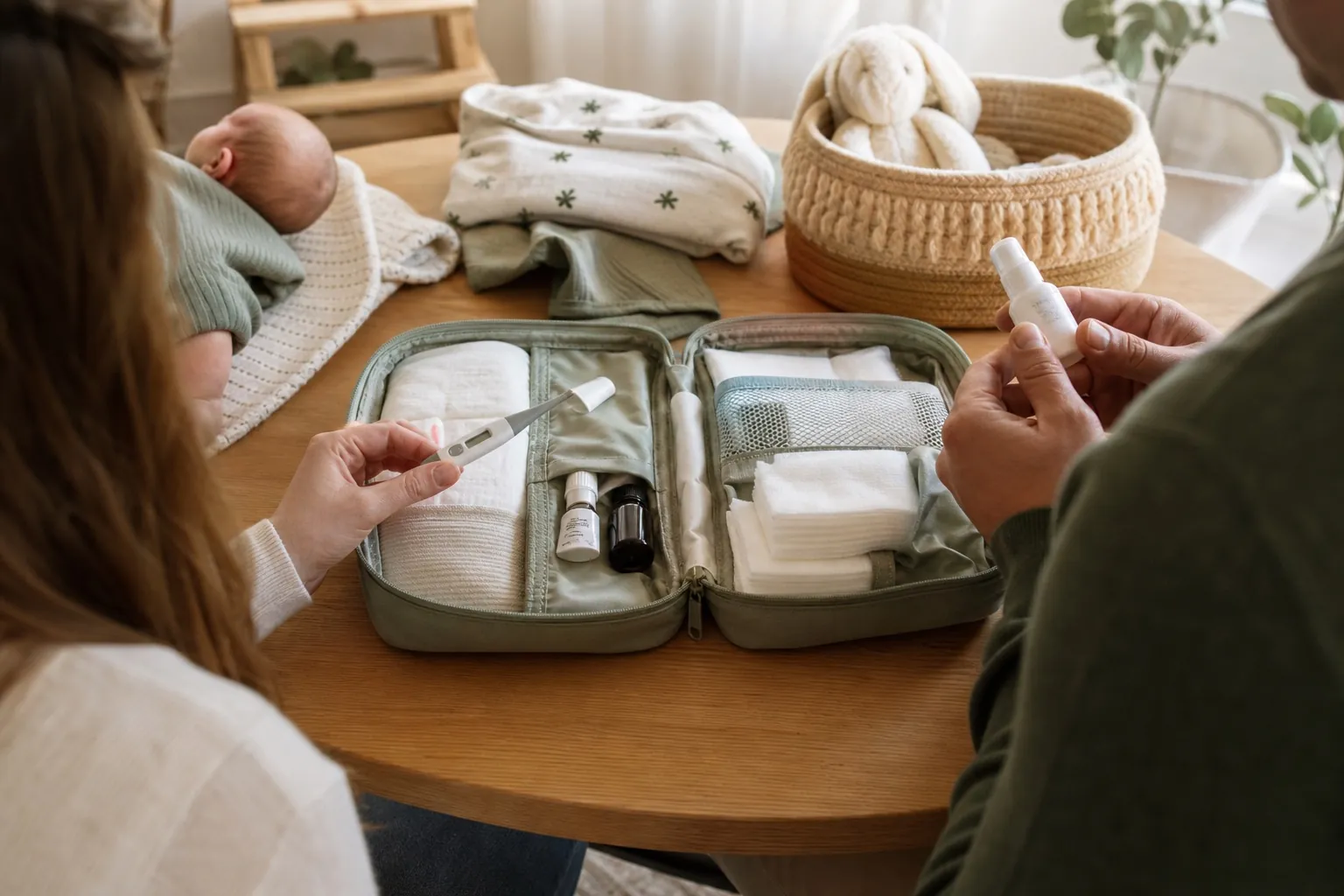
A newborn first aid kit should make daily care, temperature checks and clearing a blocked nose easier. To start with, you mainly need a digital thermometer, saline in single-use ampoules, a nasal aspirator, sterile gauze, a barrier cream and safe nail care tools. Medicines, supplements and treatments for specific problems are chosen later, based on age, weight and the advice you get at discharge or from your paediatrician.
Newborn first aid kit: a ready-made checklist
You can add the items below to a checklist on your phone and tick them off as you put the kit together. The list covers products for everyday care. Medicines and products that need a doctor's advice first are covered later in the article.
Newborn first aid kit: a ready-made checklist
- Nose, eye and cord care
- 0.9% saline in single-use ampoules
- Nasal aspirator
- Sterile gauze
- Cotton pads for babies
- Skin and nappy area
- Barrier cream for the nappy area
- Gentle newborn wash
- Emollient suited to baby's skin
- Temperature and nail care
- Digital thermometer
- Baby scissors or clippers
- Baby nail file
- Supplements and individual advice
- Vitamin D for babies
- Products advised at hospital discharge
- Hospital advice and contact numbers
Add the first aid kit checklist to BuyNest and share it with your partner or someone close to you. You will both see which items are ready and which are still missing.
For everything you need for sleeping, feeding, changing and walks, see Newborn essentials checklist. What mum and baby need during the hospital stay is covered separately in Hospital bag checklist: what to pack.
What a baby first aid kit needs at home
Saline and a nasal aspirator
Single-use saline ampoules are easy to keep clean and can be used to moisten or clear the nose. They are also handy if a midwife or doctor advises cleaning around the eye. Use a separate gauze pad for each eye, and practise the technique with your midwife during the home visit.
An aspirator removes mucus from the nose, especially when it makes breathing or feeding hard for the baby. Choose a model that is easy to take apart, wash and dry thoroughly. Talk to your midwife about how and how often to clear the nose, because suctioning too often or too hard can irritate the lining. Saline and gentle removal of mucus are also mentioned in guidance on respiratory infections in small children. NHS information on RSV and a blocked nose.
Sterile gauze and umbilical cord care
Keep the umbilical stump clean and dry. If it gets dirty, you can wash the area with water and then dry it well. Sterile gauze is useful for exactly that, gentle drying. An antiseptic is used only when medical staff recommend it, and it is not part of routine care for every newborn.
Spreading redness around the navel, swelling, pus, a bad smell or bleeding all need a check by a midwife or doctor. Detailed rules for dry cord care are described by Medycyna Praktyczna.
Barrier cream and newborn skincare
A barrier cream helps protect the nappy area, especially when redness appears. Choose a product made for babies from the first days of life and apply a thin layer, following the manufacturer's instructions or your midwife's advice.
Daily care needs only a few products suited to your baby's skin. A wash should be labelled for your baby's age. An emollient is mainly useful for dry or sensitive skin, so choose a specific product based on how the skin really looks. If skin changes are severe, weeping or not going away, a paediatrician needs to see the baby. More about newborn skincare is available from Medycyna Praktyczna.
Scissors, clippers or a nail file?
A newborn's nails are thin and can have uneven edges. The simplest way to start is with a gentle nail file. Round-ended scissors or small baby clippers work once a nail clearly sticks out past the fingertip. Nails are easier to trim while your baby sleeps, or with a second person holding the hand steady. American Academy of Pediatrics tips on baby nails.
Vitamin D for a newborn: when and how much?
Under Polish recommendations, a healthy baby born at term receives 400 IU of vitamin D a day from the first days of life for the first six months, however they are fed. Between 6 and 12 months the recommended dose is 400 to 600 IU a day, depending also on how much vitamin D comes from food. Recommendations of the National Centre for Nutrition Education (NCEZ).
At discharge, check which day to start supplements, what dose your baby has already had, and whether the product you choose gives that dose in one drop or several. Prematurity, chronic conditions and other individual needs may call for a different approach. A doctor should confirm the dose for your baby.
Baby thermometer: which one to choose?
The most practical choice to start with is a digital thermometer used under the arm. It should have a clear screen, a short measuring time and a tip that is easy to clean according to the manufacturer's instructions. The NHS recommends a digital thermometer under the arm for children under 5, and says forehead strips do not measure body temperature reliably. How to take your baby's temperature, NHS.
A non-contact thermometer is quick, but the result can depend on distance, room temperature and correct use of that particular model. If a reading does not match how your baby looks, repeat it following the device instructions, and contact a doctor if you are unsure.
Fever in a newborn: when do you need urgent advice?
A temperature of 38°C or higher in a baby under 3 months needs urgent contact with a doctor or appropriate medical help. At this age, trying to bring the temperature down is no substitute for finding the cause of the fever. The NHS advises against giving paracetamol to babies under 2 months, and ibuprofen to babies under 3 months or weighing less than 5 kg, unless a doctor says so. NHS guidance on fever in children.
For this reason, suppositories of a given strength or a fever suspension do not belong in a universal kit as something to give on your own. If your paediatrician prescribes a medicine, write down its name, the dose calculated for your baby's current weight, the minimum gap between doses and the situations that call for advice. Babies gain weight quickly, so the dose has to be updated.
Colic drops: should you buy them before the birth?
Crying and fussiness in a baby can come from hunger, a need for closeness, overheating, swallowing air while feeding, an infection or something else. Products with simethicone, herbs or probiotics are not a must-have in a starter kit. The NHS says colic drops and similar supplements are not routinely recommended, because there is no evidence they help with colic. NHS information on colic.
If your baby cries for a long time in an unusual way, or has other symptoms, the first step is to talk to a midwife or paediatrician. That lets you match the approach to the cause and your baby's age, instead of trying one product after another.
Should a nebuliser be in the newborn kit?
A nebuliser becomes necessary when a doctor prescribes a specific inhalation for your baby and explains how to do it. The choice of mask, medicine, dose and treatment time matters, and with babies the procedure may need extra instructions. Medicines given through a nebuliser to children should be used as directed by a doctor or specialist. NHS information on using a spacer or nebuliser with children.
If a nebuliser has been recommended, check before the first use how to assemble it, and how to wash and dry the parts. Saline for rinsing the nose and a product meant for nebulisation can differ in packaging and intended use, so always use the product recommended for the specific purpose.
What to prepare before the birth and what to add after discharge
Before the birth, it helps to have a basic checklist at home: a thermometer, saline, an aspirator, sterile gauze, a barrier cream and nail care tools. That way, your first shopping trip after leaving hospital will not be for everyday care items.
After discharge, complete the list using the information card and the staff's advice. This mainly concerns vitamin D, skincare, cord care and products related to prematurity or your baby's health.
After the birth you will also want a separate list of official and practical matters. You will find it in Paperwork after the birth: what to do and when.
How to store a newborn's first aid kit
Keep baby products in one easy-to-find place, out of your baby's reach. Keep medicines and supplements in their original packaging together with the leaflets. You can note the opening date on the pack if a shorter shelf life applies once opened. Always check storage conditions on the label, as some products need a certain temperature or protection from light.
Once a month, check expiry dates, how clean the aspirator is, the condition of the thermometer and your stock of single-use ampoules. Keep other household members' medicines separate, so that when you are tired you do not mix up a product or a dose. Broader rules for organising medicines and dressings are in Home first aid kit: checklist.
Download BuyNest and keep the first aid kit, hospital bag and other lists for before the birth in one app. You can share a checklist with someone else, split the shopping by store and save it as a template. On your next shop you both see the current state of the list, without hunting for notes in several places. BuyNest has no ads, even in the free version.
Frequently asked questions about a newborn first aid kit
Should a newborn first aid kit include a fever medicine?
It is worth having one when a paediatrician names the right product and the dose for your baby's age and current weight. A temperature of 38°C or higher in a baby under 3 months needs urgent contact with a doctor, even if you have a medicine at home.
Do I need an antiseptic for the umbilical cord?
The basics are keeping the stump clean and dry. An antiseptic is used on the advice of medical staff, for example in a specific clinical situation, and not routinely for every newborn.
Can nasal saline be used in a nebuliser?
Only a product meant for nebulisation and recommended for your baby should go in a nebuliser. An ampoule used for nose care should not automatically be treated as an inhalation product. What matters is its intended use, sterility, volume and the manufacturer's instructions.
How often should I check what is in the baby's first aid kit?
A monthly check lets you review expiry dates, opening dates, your stock of ampoules and the condition of the equipment. It is also worth going through the list after your baby has been ill, after a change of dose or when you get new advice from a doctor.
Does the kit need changing after the baby is 3 months old?
As your baby grows and gains weight, the doses of recommended medicines and care needs can change. Even after 3 months, products are still not chosen on the age printed on the pack alone. Go through the current list at a check-up or vaccination visit.
Important medical information
This article is for information only and does not replace individual medical advice. Talk to a paediatrician, neonatologist, midwife or pharmacist about the choice of medicines, supplements, care products and medical devices, and about their dosage and use. If your baby is under 3 months and has a temperature of 38°C or higher, has trouble breathing, is clearly weak, refuses feeds or suddenly gets worse, contact a doctor or appropriate medical help urgently.
Sources
- Informacje NHS o RSV i zatkanym nosie
- Medycyna Praktyczna
- Medycyna Praktyczna
- Wskazówki American Academy of Pediatrics dotyczące paznokci niemowlęcia
- Zalecenia Narodowego Centrum Edukacji Żywieniowej
- Instrukcja pomiaru temperatury u dziecka — NHS
- Zalecenia NHS dotyczące gorączki u dzieci
- Informacje NHS dotyczące kolki
- Informacje NHS o stosowaniu nebulizatora u dzieci
Take the shopping into BuyNest
BuyNest is on iPhone and Android. The app has no ads, including on the free plan.

