
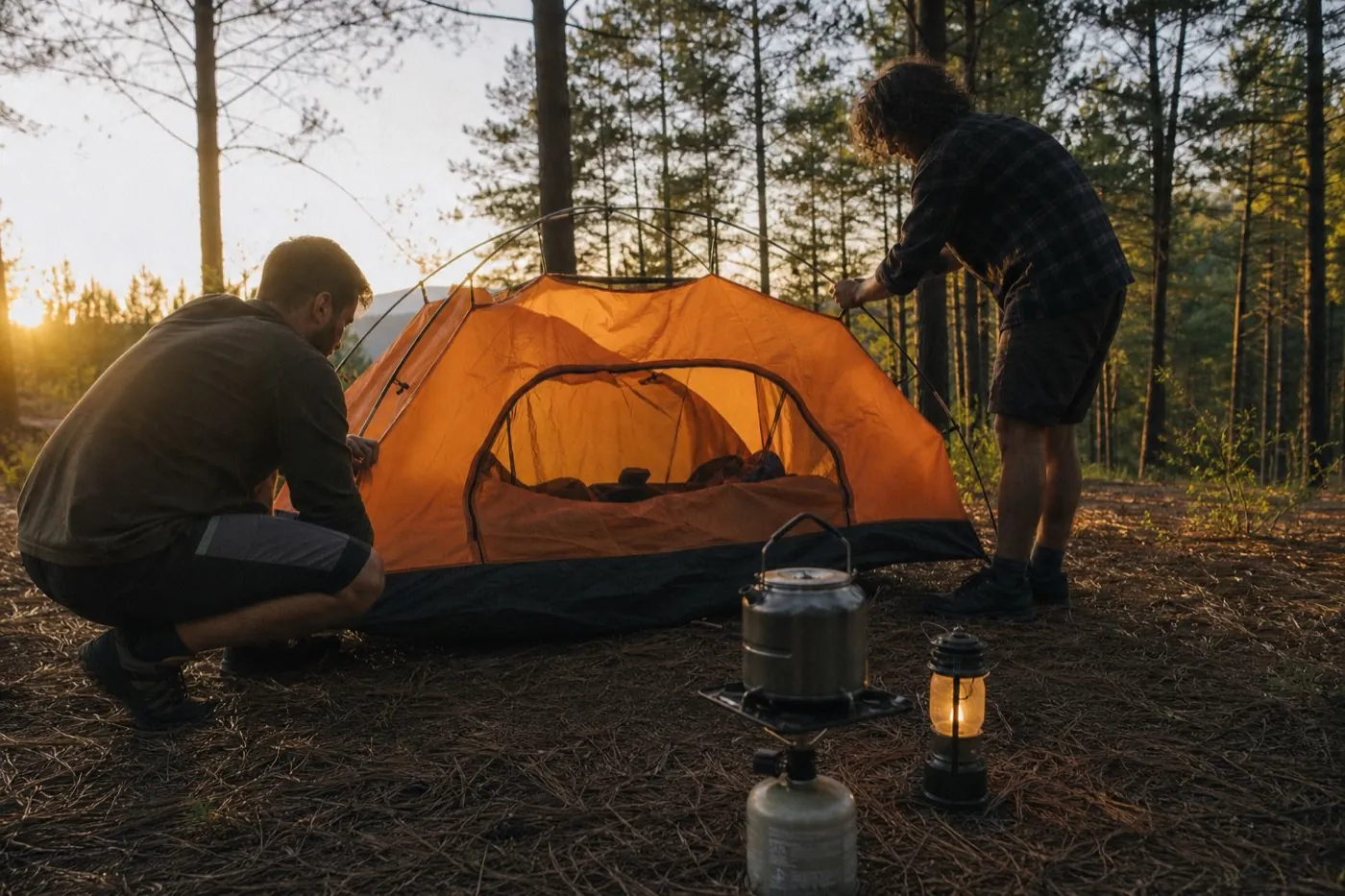
Camping packing list: where do you start?
A camping packing list starts with four groups: sleeping (tent, sleeping bags, mats), kitchen (stove, pan, dishes), food with water, and warm clothes for a cold night. Add a first aid kit, bin bags and head torches. For a weekend for two or three people it all fits in a car, and the list below has 36 items.
Before you load the boot, pitch the tent once at home, check the rules of the place you will stay and read the forecast. Most campsite problems come from a missing peg, a damp sleeping bag or a cool box that warmed up on day one.
This guide is for car camping on a campsite or in a forest. If you carry everything on your back and follow a trail, read the mountain packing list, and for winter slopes see the ski trip packing list.
What to take camping for a weekend
The kit below is for two or three people for two nights, arriving by car. For a bigger group, multiply sleeping bags, mats and dishes, but one tent and one stove per group is plenty.
What do you need for sleeping?
A good night decides the mood of the whole weekend. A night in a tent is colder than the daytime temperature suggests, even in summer, so choose your sleeping bag for the night, not the day.
- tent with all pegs, poles and a bag
- a sleeping bag for each person
- a mat or air bed for everyone, because the cold comes up from the ground
- camping pillow or a rolled-up jumper
- a head torch for each person with spare batteries
- tarp over the tent entrance
What do you need for the kitchen and the camp?
A camp kitchen is a handful of simple items that you can wash with one bowl of water. Pack them in one crate, so after pitching you know straight away where the pan is.
- gas stove with a spare cartridge
- lighter or matches
- saucepan, frying pan and a lid
- mugs, bowls and cutlery
- knife and a small chopping board
- washing-up liquid, sponge and a cloth
- folding chairs and a small table
- bin bags, tape and cord
What to sort out before you set off
These steps take one evening before the trip. On a campsite in high season, book your pitch early; for camping in a forest, check whether the area falls under the Polish State Forests programme.
- Book the campsite, or read the rules of the forest where you want to stay.
- Check the rules on fires and stoves for the place you are going.
- Read the forecast for the whole weekend, paying attention to wind and storms.
- Pitch the tent once in the garden or living room.
- Freeze the cool box ice packs the day before.
- Charge your phone and power bank, and save 112.
- Tell someone where you are staying and when you plan to be back.
A trial pitch shows whether you have all the pegs and poles and how long it takes. In the dark or in the rain that knowledge is worth a lot.
What are the rules for camping in a Polish forest?
Under the Polish State Forests programme "Zanocuj w lesie" ("Sleep in the forest"), at most nine people may stay in one place for no more than two nights in a row without notifying anyone. A larger group or longer stay must be reported to the local forest district by email at least two working days beforehand. You can check the programme areas in the mBDL app.
Fires are allowed only in places designated by the forest manager, and you should bring your own wood unless the site provides it. Taking wood from the forest for fires or camp structures is forbidden.
Gas stoves are allowed under conditions: check the forest district's website and the current fire danger, and at the highest, third (red) level stoves are banned. A stove must always be supervised.
Bring a bag for rubbish and take it away with you, because there are no bins in the forest. If there are warnings of strong wind and storms, the rules ask you to give up the stay.
A campsite has its own rules. In England and Wales, the Countryside Code sets the basics for visitors: take your litter home, do not light fires, only use barbecues where signs say you can, and leave gates as you find them.
Lasy Państwowe: Regulamin programu „Zanocuj w lesie”GOV.UK: The Countryside Code, advice for countryside visitorsWhat food should you take camping, and how do you keep it safe?
Simple one-pot meals work best: pasta with sauce from a jar, couscous or groats with vegetables, porridge for breakfast. You can buy bread and fresh items on the way. The list below assumes two nights for two or three people.
Plan water with a margin. If there is no tap on site, take a container for the whole stay; how much depends on the number of people and whether you cook with it. With children, it is better to overpack than to look for a spring after dark.
Keep chilled food in a cool box with frozen ice packs. The US FDA advises keeping the box at or below 4°C and leaving perishable food out of the cold for no longer than two hours, or one hour above 32°C. Keep drinks in a separate bag, since a cool box opened constantly warms up quickly.
Pack meat and dairy in sealed containers so juices do not drip onto other food. Wash dishes away from streams and lakes and take food scraps with you. Need more meal ideas? Our road trip food list helps with the journey.
FDA: Handling Food Safely While Eating OutdoorsLasy Państwowe: Regulamin programu „Zanocuj w lesie”How to dress and what to do when it turns cold or wet
For the night take a warm layer, a hat and dry socks that you wear only to sleep. Even in summer mornings and evenings can be surprisingly cold, and damp from the grass soaks through thin clothing quickly.
A tarp over the tent entrance gives you a dry place for boots and cooking in the rain. Never use a gas stove inside a tent: the NHS warns that a camping stove used inside can build up carbon monoxide. For rain, pack a waterproof jacket and a bag for wet clothes.
Check the forecast before you leave and again on site. If strong wind or storms are forecast, it is better to go home than to spend the night in a draughty tent under trees.
NHS: Carbon monoxide poisoningHow to avoid ticks and what goes in the first aid kit
After a walk in woods or meadows, check your skin, including behind the ears, behind the knees and on the scalp, especially on children. The Polish sanitary inspectorate advises long sleeves, long trousers and closed shoes, and repellent used as the label directs.
Remove a tick straight away with tweezers or a tick tool: grip it as close to the skin as possible, pull steadily upwards, then disinfect the wound. The NHS advises seeing a GP if a rash, fever or feeling unwell appears after a tick bite.
A camping first aid kit holds plasters, dressings, a bandage, antiseptic, tweezers for ticks, bite cream, a painkiller and regular medication. Our travel first aid kit guide covers the contents. If someone has a long-term condition, ask their doctor what to carry.
WSSE Bydgoszcz (gov.pl): Kleszcze, jak się chronić i jak usunąć kleszczaNHS: Lyme diseaseHow to call for help while camping in a forest
Keep track of where you are. The programme rules advise that in an emergency you find the nearest forest marker post and give the dispatcher the numbers displayed on it. The general emergency number is 112.
Mobile signal in a forest can be poor, so download an offline map and note where the nearest access road is. In the mountains separate rescue numbers apply, which you will find in the mountain packing list.
Lasy Państwowe: Regulamin programu „Zanocuj w lesie”How to set up camp so it stays comfortable and clean
Pitch the tent on flat, dry ground, away from hollows where water collects, with the door facing away from the wind. Clear stones and pine cones before laying out the mats, because you feel them all night.
Set up the kitchen a few steps from the tent, never inside it and not under branches. Keep food, rubbish and toiletries in sealed containers away from where you sleep, so you do not attract insects or animals.
The State Forests rule is simple: do not damage trees, shrubs or the forest floor with your kit. Tie the tarp cord so it does not scar the bark, and leave the spot as you found it.
- Choose flat, dry ground and clear stones and pine cones.
- Pitch the tent door away from the wind and hammer in every peg.
- Hang the tarp over the entrance or over the table.
- Set up the kitchen a safe distance from the tent.
- Keep a torch or head torch in a fixed place by the door.
- Before leaving, collect your rubbish and check nothing is left behind.
How to split the camping packing in BuyNest
The ready-made list sits below this guide. Open the camping list with the QR code or the button and share it with your group. Changes show for everyone at once.
Assign groups to people: one takes "Sleeping", another "Kitchen", a third "Food". That way you do not bring three saucepans and nobody forgets the gas cartridge.
Tag anything you buy on the way with a shop. A reminder for the evening before you leave will prompt you to freeze the ice packs.
Camping trip
- To do
- Book a campsite or pitch
- Check the fire rules
- Check the weather forecast
- Test-pitch the tent
- Freeze the ice packs
- Sleeping
- Tent with pegs
- Sleeping bags per person1 pcs
- Sleeping mats per person1 pcs
- Camping pillow
- Head torches per person1 pcs
- Kitchen
- Gas stove and cartridge
- Lighter or matches
- Pot and pan
- Mugs, bowls, cutlery
- Knife and board
- Washing-up liquid and sponge
- Cool box
- Food
- Drinking water per day5 l
- Pasta or grains500 g
- Jar of sauce2 pcs
- Bread1 loaf
- Porridge oats500 g
- Coffee or tea1 pack
- Clothes
- Warm layer for the night
- Waterproof jacket
- Warm hat
- Spare socks pairs3 pcs
- Camp and tidying
- Rubbish bags4 pcs
- Tarp
- Tape and cord
- Folding chairs
- First aid and hygiene
- First aid kit
- Insect and tick repellent
- Sunscreen
- Toilet roll2 pcs
- Quick-dry towel
Frequently asked questions
Can I light a campfire when camping in a Polish forest?
Only in places designated by the forest manager and with wood you bring yourself unless the site provides it. That is what the "Zanocuj w lesie" programme rules say. On a campsite, ask the owner about their fire rules.
How many people can camp in a forest without notifying anyone?
Under the programme rules, up to nine people in one place for no more than two nights in a row. A larger group or longer stay must be reported to the local forest district by email at least two working days earlier.
Can I cook on a gas stove in the forest?
Yes, under conditions. Check the forest district's website, do not use the stove at the third level of fire danger and never leave it unattended.
How long can food stay out of the cool box?
The FDA says perishable food should not be out of the cold for more than two hours, or one hour above 32°C. Keep it in a cool box with frozen ice packs.
What should I do if a tick bites me?
Remove it straight away with tweezers or a tick tool, gripping close to the skin, and clean the wound. See a GP if a rash, fever or feeling unwell develops.
Open the list and split the groups between your group before you shop. A camping packing list saved as a template will serve every later trip under canvas, so the second time you pack in minutes.
Open the ready list in BuyNestSources
Take the shopping into BuyNest
BuyNest is on iPhone and Android. The app has no ads, including on the free plan.

