
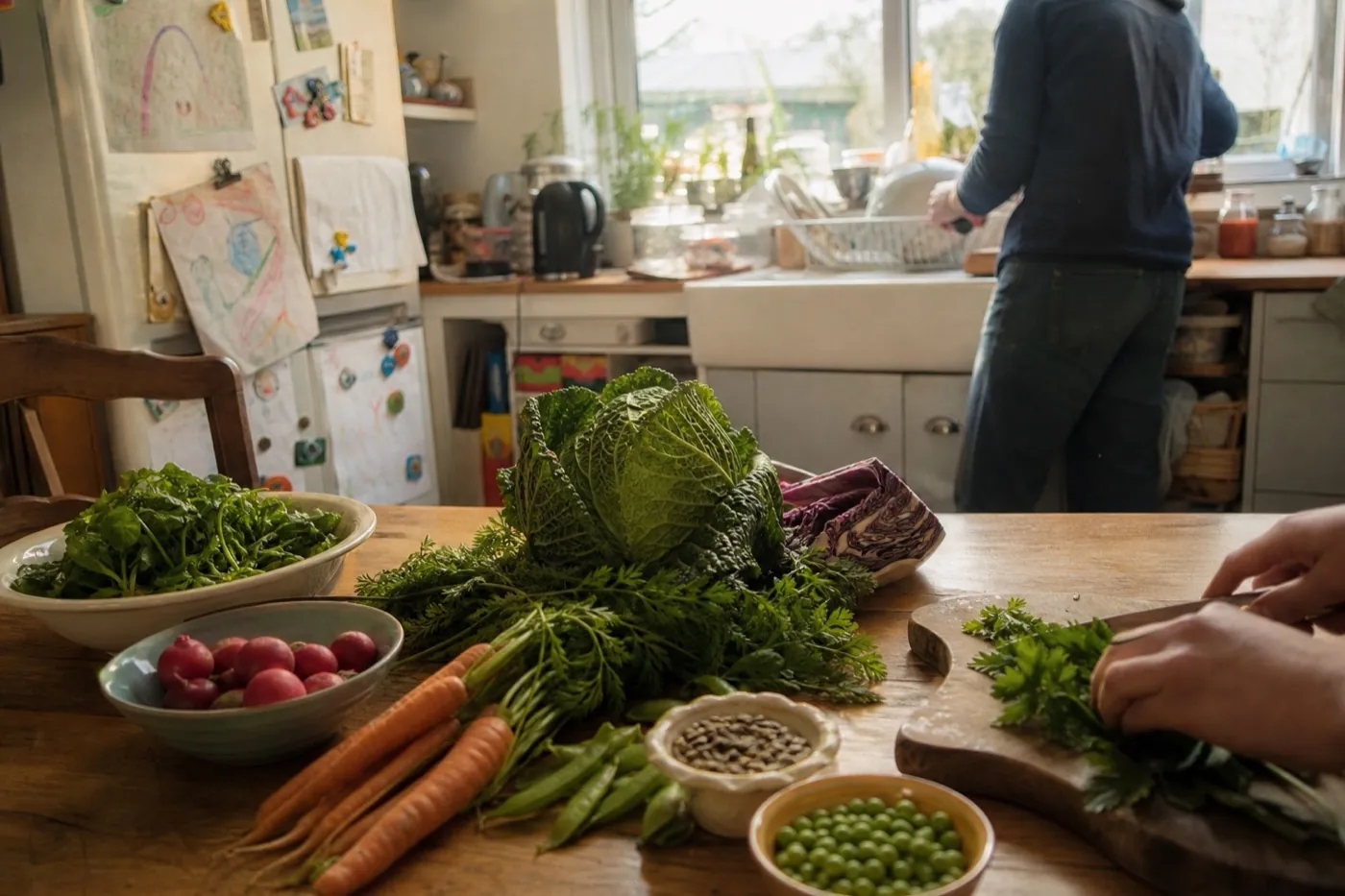
How can you add variety to meals without replacing what is in your cupboard?
To add variety to meals, bring in one new item a week and put it into a dish your household already likes. Then swap foods inside the same group, such as bulgur for rice. You keep using up what you have, so nothing is wasted and no one has to learn a new menu.
Below you will find a simple rhythm for a month, a table of swaps, ways to use open packets and notes for households with picky eaters or allergies.
WHO: Healthy diet (fact sheet)Tomato and lentil pasta sauce
An ordinary tomato sauce with one new ingredient. Red lentils break down in the sauce, so they change it less than you might expect.
Ingredients
- Rapeseed or olive oil1 tbsp
- Onion1
- Garlic2 cloves
- Tomato passata700 g
- Red lentils100 g
- Water250 ml
- Dried basil or oregano1 tsp
- Pasta whatever you have320 g
Method
- Soften the finely chopped onion in the oil for about 5 minutes. Add the chopped garlic and cook for another minute.
- Add the rinsed lentils, passata, water and herbs. Simmer gently for 20 minutes, stirring every few minutes, until the lentils are completely soft.
- Meanwhile cook the pasta. Season the sauce with salt and pepper. If someone at home prefers a smooth sauce, blend it.
- Toss with the pasta. Freeze any extra sauce or keep it in the fridge for up to 3 days.
Frittata with frozen vegetables and leftovers
A way to use up odds and ends from the fridge and add vegetables to supper. The filling changes every week depending on what is left.
Ingredients
- Eggs6
- Frozen mixed vegetables300 g
- Cooked potatoes leftover2
- Hard cheese or feta50 g
- Rapeseed oil1 tbsp
- Chives or parsley½ bunch
Method
- Heat the grill. Heat the oil in an ovenproof frying pan.
- Add the frozen vegetables and chopped potatoes and fry for 5–6 minutes until the vegetables have thawed and the water has evaporated.
- Beat the eggs with salt, pepper and the chopped chives. Pour into the pan, scatter over the cheese and cook over low heat for 5 minutes until the base is set.
- Put the pan under the grill for 3–5 minutes until the top is set and golden. Cut into wedges.
Tip No grill: cover the pan with a lid for the last 5 minutes.
What does one new thing a week look like in practice?
Small steps are easier to keep up than a plan for a ‘healthier week’. Pick one product you do not buy yet and add it to a familiar dish. You buy one item instead of ten, so the cost is low and the risk that the whole dinner flops is small.
Here is a sequence that works over a month, one step per week:
- Week 1: stir red lentils into your usual tomato pasta sauce; they usually break down in about a quarter of an hour (check the packet).
- Week 2: cook bulgur wheat instead of rice in a dish where rice is the side.
- Week 3: add a handful of frozen spinach to soup instead of another carrot.
- Week 4: buy a seasonal fruit that has not been in your basket for a while and serve it with porridge or yoghurt.
- After a month, decide what becomes a regular and what was a one-off.
You do not have to follow this order. What matters is the rhythm: one change, a few days to judge it, then the next one.
What can you swap for the food you buy every week?
The second method is rotation within one food group. The dish stays close to what people expect, so nobody has to relearn dinner, but taste and texture shift. The table gives example pairs for a family of four; they are editorial suggestions, not rules.
| What you usually buy | What to try once a week | Where to use it |
|---|---|---|
| White rice | bulgur, buckwheat or pearl barley | side dishes, bakes, salads |
| White pasta | wholewheat or lentil pasta | tomato sauce, pasta with vegetables |
| Carrot and cucumber | Chinese leaf, beetroot or peppers | slaws, sandwiches, roasted vegetables |
| Kidney beans | chickpeas or cannellini beans | chilli, spreads for bread, soups |
| Apples and bananas | a seasonal fruit such as pears or plums | porridge, yoghurt, snacks |
| Plain yoghurt | kefir or buttermilk | dressings, smoothies, cold soups |
Pulses are the easiest to swap, because red lentils, chickpeas and tinned white beans suit most simple recipes. For fruit and vegetables, buying what is in season lets your choice change through the year on its own.
How do you use up what you already have?
Before you add anything to the list, look in the cupboard and fridge. An open packet of grains, a tin of beans or half a jar of pesto is the base of a dinner that needs no shopping. Buying a better version of something that is already open usually means both go past their date.
How can frozen and tinned food help?
Frozen mixed vegetables, spinach, peas and berries keep for months, so you can add a little to several dishes. Tinned beans and tomatoes let you make something new even when the plan for the week has changed.
Many people see frozen food as a weaker version of fresh. In practice it makes it easier to reach the amount of fruit and vegetables the WHO gives as at least 400 g a day, because there is always something to add to the plate.
What can you do with fridge leftovers?
Vegetable ends, a piece of cheese and a few eggs make a frittata or omelette. Yesterday’s rice can be fried with vegetables, and leftover roast vegetables go well in a sandwich with hummus. Two meals like this a week add variety without adding to the shopping.
WHO: Healthy diet (fact sheet)How do you introduce new foods with a picky eater or an allergy at home?
If someone dislikes novelty, serve the new food next to the familiar dish, not instead of it. A small bowl of roasted chickpeas beside the pasta offers a choice without pressure. Children often need several meetings with a new taste, so do not judge it after the first try.
With food allergies the rule is different: always check a new product for allergens, even if it looks similar to one you already buy. Manufacturers change recipes, and similar packs can contain quite different ingredients. We explain how to read this information in our guide to checking allergen information on shared shopping trips.
This text gives general tips for healthy adults and families and is not a meal plan. People with long-term conditions, who are pregnant or breastfeeding, and families with very young children may need different rules, so agree them with a doctor or dietitian.
How can a plate guide keep variety useful?
Variety is easier when you have a reference point. The Polish Healthy Eating Plate from the National Centre for Nutrition Education (NCEZ) splits a meal into vegetables and fruit, grain foods, protein foods and healthy fats. Instead of counting grams, you check that the plate has something from each group.
If one group always arrives in the same form, that is the place for your first change. Always pasta? Try a grain. Always the same vegetable? Swap it for another in a different colour or season. The NHS gives similar advice: choose a range of fruit and vegetables, because they differ in what they contain, and eat at least five portions a day (a portion of fresh, frozen or tinned is 80 g).
NCEZ / NIZP PZH-PIB: Talerz Zdrowego ŻywieniaNHS: Eight tips for healthy eatingWhat does a week of dinners with one change look like?
An example helps show how little changes. The plan below is an editorial suggestion for a family that cooks five dinners a week and tends to repeat the same few dishes. Only one item is new; the rest are familiar flavours.
Day by day it looks like this:
| Day | Dish | What is new |
|---|---|---|
| Monday | pasta with tomato sauce | red lentils in the sauce |
| Tuesday | chicken tray bake with potatoes | no change |
| Wednesday | vegetable soup | a handful of frozen spinach |
| Thursday | frittata with fridge leftovers | no change, you use up stock |
| Friday | grain bowl with vegetables and yoghurt | bulgur wheat instead of rice |
Notice that two days need no change at all. That keeps the week from feeling like hard work and leaves room to judge the new dishes calmly. If all went well, swap a different item next week.
How do you know a new food has caught on?
No surveys are needed. A few simple signs after dinner will do, and you can jot them down as a note next to the item on your list.
- Plates came back empty or nearly empty.
- Someone asked for seconds or whether it will appear again.
- There were leftovers you are happy to eat the next day.
- The item was enough for two different dishes, not just one.
If at least two of these hold, add the item to your regular template. If none do, give it one more try in a different form or let it go.
Which mistakes most often spoil attempts at more varied meals?
Most failures share one cause: too much at once. Here are four traps that show up after a few weeks of trying, each with a fix.
- You buy five new things in one week and half of them sit in the cupboard. Limit yourself to one item and keep the rest for later.
- The new food goes into an entirely new recipe, so nobody knows what to expect. Put it into a dish your household already likes.
- You do not check how long a product lasts once opened. Grains and pulses usually keep well, but fresh herbs or kefir need using up quickly.
- You forget to record what worked. A month later you buy something that has already failed once.
One habit fixes all four: a short note next to the item on your list. A single word such as ‘liked’ or ‘needs more spice’ means you do not start from zero next time.
How do you write ‘new this week’ on a shopping list?
The biggest trap is forgetting the new item when the list is long. So on the ready list, items to try sit in their own group called ‘Nowe w tym tygodniu’ (new this week). The list with three newcomers has three such items, and the rest are things you probably already buy.
In BuyNest you can save your regular list as your own template and add one new item each week with a note such as ‘new ingredient’. When a product catches on, move it into the template for good; when it does not, leave it out next time. The list is shared, so everyone at home sees changes at once.
Two recipes sit further down, above the list. The tomato and lentil pasta sauce shows one new ingredient in a familiar dish, and the frittata with frozen vegetables and leftovers helps you use up fridge ends and add vegetables to supper.
A familiar list with three new items
- New this week
- Red lentils new ingredient500 g
- Bulgur wheat instead of rice once500 g
- A seasonal fruit you rarely buy500 g
- Vegetables
- Onions3 pcs
- Garlic bulb1 pcs
- Frozen mixed vegetables750 g
- Frozen spinach450 g
- Carrots1 kg
- Chinese leaf cabbage1 pcs
- Potatoes2 kg
- Chives bunch1 pcs
- Fruit
- Apples1 kg
- Bananas5 pcs
- Cupboard
- Tomato passata700 g
- Tinned white beans tins2 pcs
- Sunflower seeds100 g
- Dairy
- Eggs10 pcs
- Plain yoghurt400 g
- Hard cheese150 g
Frequently asked questions
How many new foods a week is sensible?
One, or two at most. With more it is hard to tell what people liked, and some of what you bought sits unused in the cupboard. If one item catches on, add the next one the following week.
How can I add variety to dinners when I am short of time?
Choose swaps that do not lengthen cooking: frozen vegetables stirred into a sauce, red lentils that usually cook in about 15 minutes, and tinned beans. Changing one ingredient in a familiar recipe takes the same time as usual.
Do frozen and tinned foods count towards variety?
Yes. Pick plain versions, meaning just vegetables, fruit or pulses, and drain the liquid from tins. Check the label, because some ready-made mixes come with sauces or a lot of salt.
What if nobody likes the new food?
Offer it once more in a different form, for example roasted rather than boiled. If it still does not catch on, skip it next time. One miss costs little, and you have learned something about your household’s tastes.
Does this approach suit a restricted diet or an allergy?
Small steps suit most households, but the choice of foods has to follow advice from your doctor or dietitian. With an allergy, check every new product for allergens on the label, even if it looks like one you know.
Adding variety to meals starts with one new item in the basket, not a review of your whole kitchen. Open the ready list in BuyNest, pick what you will try this week and add the rest to your own template.
Open the ready list in BuyNestSources
Take the shopping into BuyNest
BuyNest is on iPhone and Android. The app has no ads, including on the free plan.