
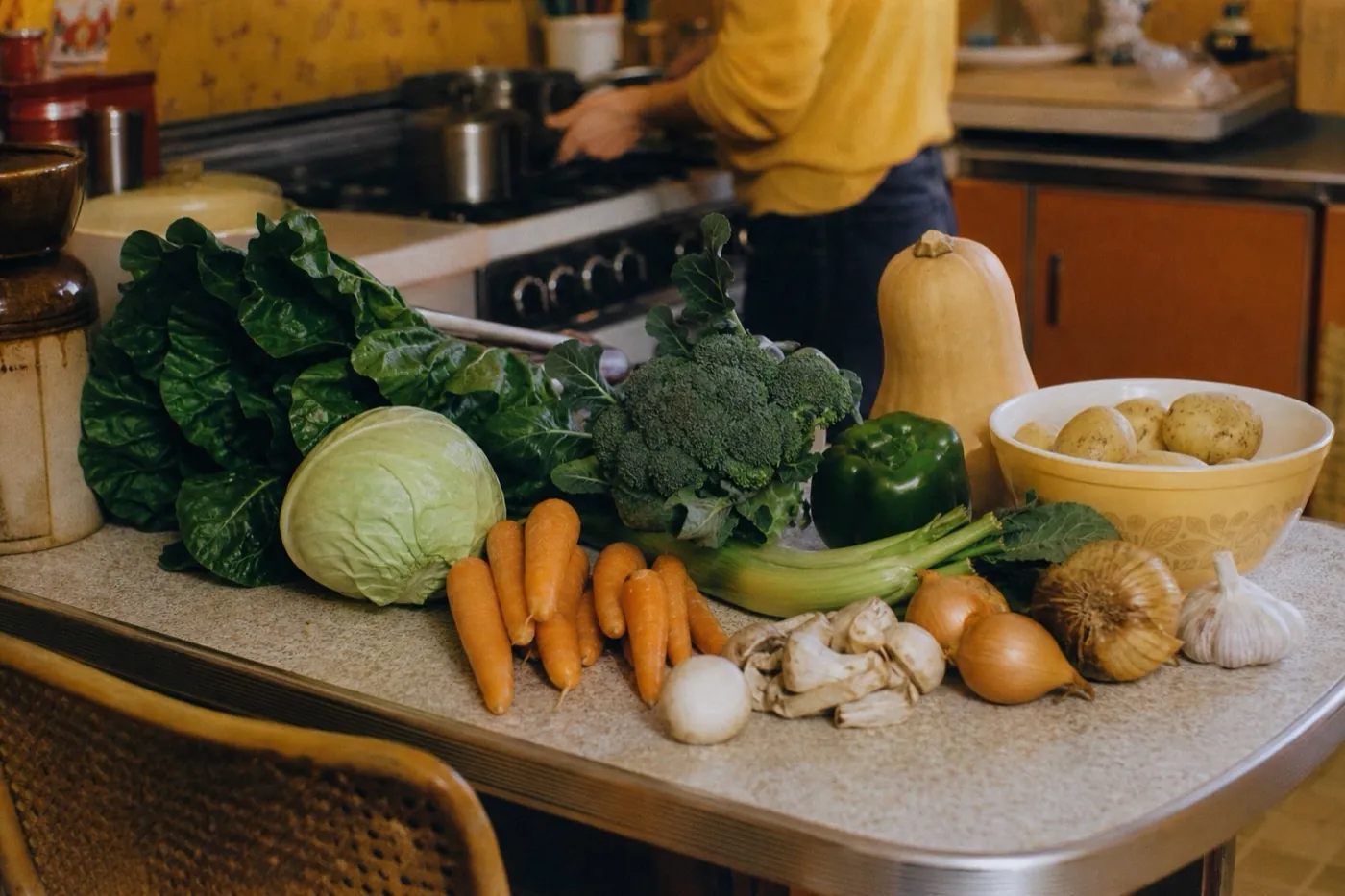
What are the best vegetables to buy for the week?
The best vegetables to buy for the week are the ones you can eat raw and cooked with little waste: carrots, onions, white cabbage, courgettes and red peppers. Each goes into at least two dishes, crunchy in a slaw one night, soft in a stew or pan the next.
Below are the picking rules, ten uses for these five vegetables, a plan for five dinners and storage advice. Two recipes sit further down, above the shopping list.
Courgette and pepper lecsó
Vegetables stewed in tomato and served with rice. Enough for two dinners, or a dinner and a lunch.
Ingredients
- Courgette1
- Red peppers2
- Brown onion1
- Garlic2 cloves
- Chopped tomatoes 400 g1 tin
- Sweet paprika2 tsp
- Rapeseed oil2 tbsp
- Long-grain rice180 g
- Feta to serve100 g
- Flat-leaf parsley a handful
Method
- Slice the onion into thin wedges, the peppers into strips and the courgette into half-moons about 1 cm thick.
- Soften the onion in the oil for 5 minutes. Add the peppers and cook for 5 more minutes until soft.
- Add the courgette, garlic and paprika. Stir for a minute, then add the tomatoes and season with salt.
- Cover and simmer on low heat for 15 minutes. The courgette should be tender but not falling apart.
- Meanwhile cook the rice as the packet says.
- Serve the lecsó with the rice, crumbled feta and chopped parsley. Put the third portion in the fridge straight away.
Tip If you eat meat, fry 150 g of sliced sausage at the start.
Fried cabbage with noodles and egg
Cabbage and carrot fried hard with soy sauce. It uses half the cabbage; the other half becomes slaw.
Ingredients
- White cabbage about ½ head500 g
- Carrots2
- Brown onion1
- Garlic1 cloves
- Ribbon noodles200 g
- Eggs2
- Soy sauce2 tbsp
- Rapeseed oil2 tbsp
Method
- Shred the cabbage into thin strips, coarsely grate the carrots and slice the onion into thin wedges.
- Cook the noodles as the packet says, drain and set aside.
- Heat the oil in a large frying pan. Fry the onion and cabbage over high heat for 8 minutes, stirring often, until the cabbage softens and catches a little colour.
- Add the carrot and garlic and fry for 2 minutes.
- Push the vegetables to one side, crack the eggs into the space and stir until fully set.
- Add the noodles and soy sauce, toss everything together and heat for one more minute.
Which rules decide which vegetables work across several meals?
The choice is our editorial judgement, based on how everyday dinners with vegetables usually work. We asked the same question of every item: does one piece get boring after two dinners?
- Raw and cooked. The vegetable should taste good both ways, so one piece gives two different dishes.
- Fits different cuisines. It has to work in a Polish-style slaw, in a lecsó stew and in a dish with soy sauce.
- Available all year. It should be in an ordinary shop at a similar price and quality whatever the month.
Next to the five main vegetables we added potatoes, leek, garlic and parsley. They are the background: they thicken soup, add aroma and let you use up leftovers from the whole week in one pot.
Five vegetables, ten uses: what can you cook from each?
The table shows how each vegetable works raw and cooked. Quantities assume two people and five dinners, and a kilogram of carrots covers every dish mentioned.
| Vegetable | Raw | Cooked |
|---|---|---|
| Carrots | Grated into a slaw with cabbage and apple | Fried with cabbage and noodles or in soup |
| White cabbage | Slaw with carrot, apple and yoghurt | Fried with noodles and egg |
| Courgettes | Thin ribbons with feta and lemon | Lecsó or fritters with carrot |
| Red peppers | Sticks for lunch, salad with red onion | Lecsó; cooking makes them sweet |
| Onions | Red in slaws, because it is milder | Brown as the base of almost every hot dish |
Young courgettes do not need peeling. Cabbage is dense, so a small head gives a lot of vegetable from one line on the list: half goes into fried cabbage and the other half into slaw.
What plan for five dinners can you build from this list?
The list is built for five dinners for two. The order is deliberate: delicate vegetables such as courgettes and peppers go first, while hard ones, cabbage, carrots and potatoes, wait for the second half of the week.
- Day one: lecsó with courgette and pepper over rice, with a portion kept for lunch.
- Day two: fried cabbage with noodles and egg.
- Day three: courgette and carrot fritters with yoghurt and a red onion slaw.
- Day four: potatoes with a fried egg and a slaw of cabbage, carrot and apple with yoghurt.
- Day five: vegetable soup with leek, potatoes, carrot and leftover cabbage and pepper, topped with parsley.
We do not say how many days a particular vegetable will last, because it depends on its condition in the shop and on your fridge. Look at them every time you cook and swap the order of dishes if something starts to wilt.
For three or four people, increase the carrots, potatoes and peppers by half and buy one larger cabbage instead of two small ones. You do not need to buy more onions or garlic, because a kilogram leaves a margin.
How do you pick vegetables in the shop so they last until the end of the week?
With cabbage, carrots and onions, go by weight and firmness. A good cabbage is tight and heavy for its size, carrots are stiff with no soft tips and onions are dry with a papery skin. Soft or damp patches show the vegetable will spoil sooner than the rest.
Courgettes and peppers are more delicate, so buy them for the first days of the plan. The skin should be smooth and taut, with no wrinkles or marks. If you shop once a week, choose medium sizes, because very large courgettes can be watery and very small peppers take two to fill a dish.
- Cabbage: tight and heavy, with no loose leaves.
- Carrots: stiff, with no soft tips or cracks.
- Courgettes and peppers: smooth, taut skin without marks.
- Onions and garlic: dry, with no mould or damp at the neck.
At a market, ask for loose pieces rather than ready-made trays, because it is easier to choose exactly the amount you need.
What else on the list besides vegetables?
Vegetables alone do not make dinner. For five dishes you also need protein, grains and a few cupboard items. You can load the ready vegetable list into BuyNest and tick off what you already have.
- Dairy and eggs: eggs, plain yoghurt and feta add protein to dishes without meat.
- Dry goods and tins: long-grain rice, ribbon noodles, chopped tomatoes and vegetable stock.
- Fruit: apples for the slaw and a lemon for the courgette salad.
- Check your cupboard: rapeseed oil, soy sauce, plain flour for the fritters and sweet paprika.
For a wider set of staples that does not repeat this list, see our basic grocery staples list.
How should you store vegetables so they last the week?
Keep carrots, peppers, courgettes and leek in the fridge salad drawer. Store potatoes and onions outside the fridge, somewhere dark and airy, and apart from each other, so one does not speed up spoilage of the other.
Wrap a cut cabbage tightly and come back to it within a few days. If the outer leaves have changed colour, peel them off and use the ones underneath.
What should you do with cooked leftovers?
Put cooked dishes, meaning lecsó, cabbage with noodles and soup, into the fridge in flat, lidded containers within two hours of cooking. USDA FSIS advises eating such leftovers within 3–4 days and freezing whatever you will not eat in that time.
If one dinner drops out of the plan, its vegetables move to the Friday soup, so nothing needs throwing away. Soup, lecsó and cabbage all freeze well in single-meal portions.
USDA FSIS: Leftovers and Food SafetyWhat if the planned vegetables do not match your week?
The plan is not rigid. If you eat out on Wednesday, move that dinner by a day and reorder the dishes so delicate vegetables come first. If half a cabbage is left, add it to Friday’s soup or make a quick slaw for sandwiches.
If someone at home dislikes peppers or courgettes, replace them with a double portion of carrots and cabbage. Both cope well with frying and roasting, and in a salad only the extras change. If you cook for one, buy half the quantities and read our guide to cupboard basics for one person, which shows how to plan portions.
Packed lunches from leftovers have their own guide on ingredients for a quick packed lunch, so we do not repeat box packing here. It is worth knowing, though, that pepper sticks and carrots from this list suit a lunch box well.
Is this a good proportion of vegetables on the plate?
The five dinners from this list have plenty of vegetables on the plate. That fits the healthy eating plate from Poland’s National Centre for Nutrition Education, where vegetables and fruit fill half the plate.
Yoghurt, eggs and feta add protein to the meat-free dishes. If you follow a restricted diet or have advice from a doctor or dietitian, adapt the list to it, because this is a general set and not a menu.
NCEZ: Talerz zdrowego żywieniaHow do you set the list up in BuyNest?
Add the list to BuyNest and assign it to the shop where you usually buy vegetables. Items are in groups, so at the vegetable aisle or market stall you have everything in one place, with dairy and dry goods in later groups.
If you shop with someone else, share the list. One of you takes the vegetables at the market, the other the rest at the supermarket, and ticked items show up at once on both phones. After a week, save the list as a template: if the plan worked, next time you only load it and untick what is still in the fridge.
Vegetables for several meals
- Vegetables
- Carrots1 kg
- Brown onions1 kg
- Red onions2 pcs
- White cabbage small head1 pcs
- Courgettes2 pcs
- Red peppers3 pcs
- Potatoes1 kg
- Leek1 pcs
- Garlic bulb1 pcs
- Flat-leaf parsley bunch1 pcs
- Fruit
- Apples for the slaw2 pcs
- Lemon1 pcs
- Dairy and eggs
- Eggs6 pcs
- Plain yoghurt400 g
- Feta200 g
- Dry and tinned
- Long-grain rice500 g
- Ribbon noodles250 g
- Chopped tomatoes 400 g tin1 pcs
- Vegetable stock for 1 l1 pack
- Check the cupboard
- Rapeseed oil1 pcs
- Soy sauce1 pcs
- Plain flour1 pack
- Sweet paprika1 pack
Frequently asked questions
How many vegetables should you buy for two people for a week?
For five dinners for two, a kilogram of carrots, a kilogram of onions, a small cabbage, two courgettes, three peppers and a kilogram of potatoes is enough. This is our editorial estimate based on the five dishes in this plan, not a nutritional norm.
Which vegetables keep the longest?
Usually the hard ones: cabbage, carrots, potatoes and onions. The exact time depends on the vegetable’s condition in the shop and on your fridge, so look at them each time you cook.
Can you freeze cooked lecsó and soup?
Yes, ideally in single-meal portions that went into the fridge within two hours of cooking. USDA FSIS advises eating leftovers within 3–4 days and freezing the rest.
Do courgettes need peeling?
Young ones do not, a wash is enough. Older courgettes with thick skin are better peeled.
What can replace feta in the salad?
Another firm, ripe cheese in cubes works, or yoghurt with lemon. If you avoid dairy, add a tin of chickpeas.
Load the ready list into BuyNest, assign it to your vegetable shop and tick off what is already in your fridge. On Thursday check which vegetables need using and shuffle the order of dishes. If the plan works, save it as a template and you will know the best vegetables to buy for the week without thinking.
Open the ready list in BuyNestMethod and criteria
Criterion: the vegetable can be used raw and cooked in the dishes in this piece. No freshness-in-days score and no vitamin ranking.
Sources
Take the shopping into BuyNest
BuyNest is on iPhone and Android. The app has no ads, including on the free plan.