How do you set up a pantry for one person?
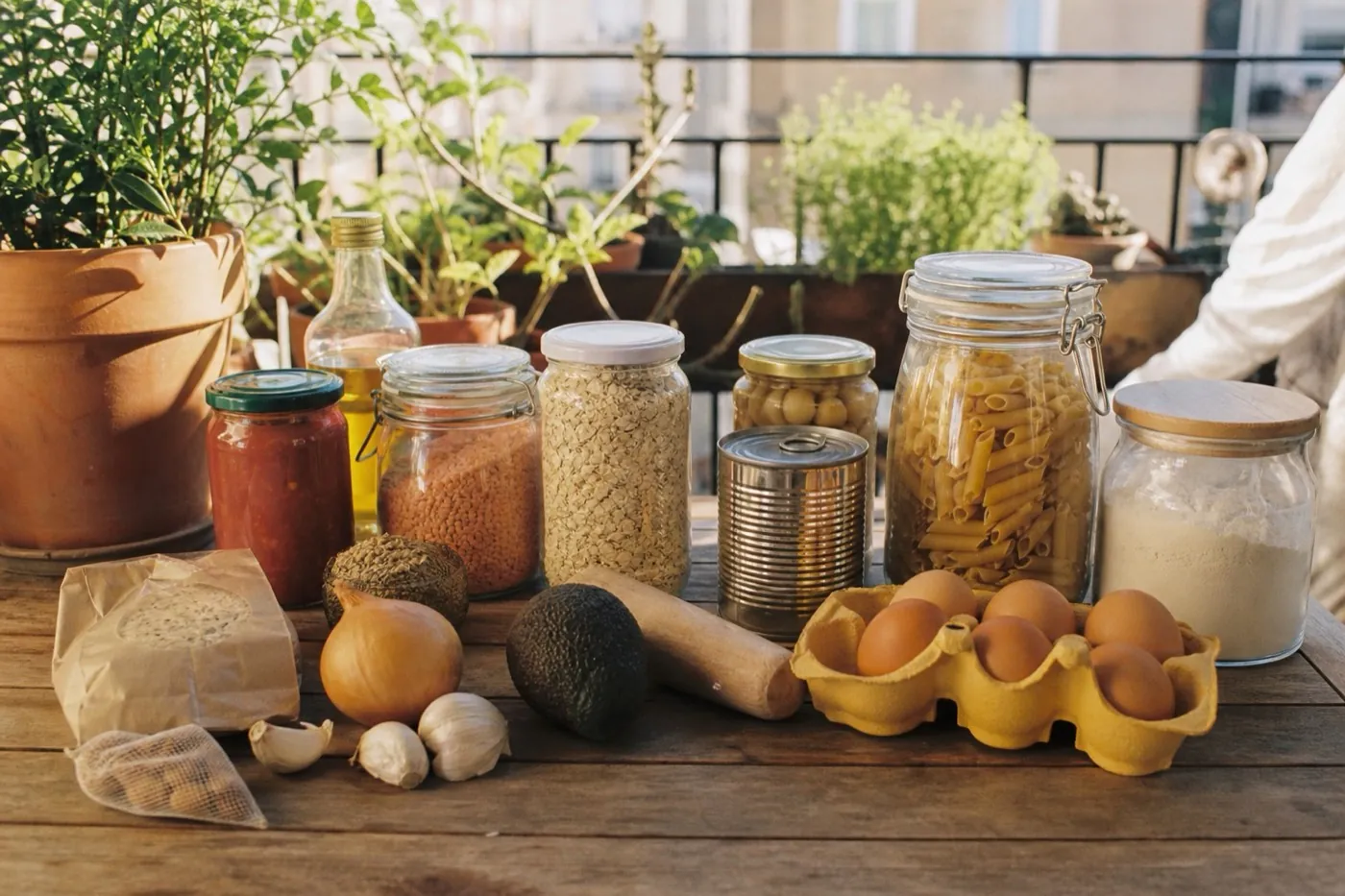
Pantry staples for one person rest on small or divisible packs that you will use up before they lose quality, and on giving every item a dish to go into. A few dry grains, pulses, flavour items, two frozen vegetables and a short list of long-keeping fresh items are enough.
Below are the picking rules, a list of 22 items, a two-week plan for using them and a way to deal with second portions. Two recipes sit further down, above the shopping list.
Egg fried rice with peas
Dinner from one bag of rice, two eggs and a handful of frozen peas. It works best with rice cooked the day before.
Ingredients
- Boil-in-bag rice 100 g1
- Eggs2
- Frozen peas80 g
- Onion½
- Garlic1 cloves
- Soy sauce1 tbsp
- Olive oil1 tbsp
Method
- If you have no cooked rice, cook one bag as the packet says, spread the rice on a plate and leave it for 10 minutes to steam off.
- Chop the onion and soften it in the oil for 3 minutes. Add the garlic and the peas straight from the freezer and fry for 2 minutes.
- Add the rice and fry over high heat for 3–4 minutes, stirring, until the grains start to colour.
- Push the rice aside, crack in the eggs and stir until fully set. Mix everything together.
- Season with soy sauce and serve straight away.
Pasta with chickpeas, garlic and lemon
A small tin of chickpeas and 100 g of pasta is dinner for one. Mashing some of the chickpeas makes the sauce creamy.
Ingredients
- Short pasta100 g
- Chickpeas small tin1 tin
- Frozen spinach portions2
- Garlic2 cloves
- Tomato purée in a tube1 tsp
- Lemon zest and juice½
- Olive oil2 tbsp
- Hard aged cheese20 g
Method
- Cook the pasta as the packet says. Keep half a cup of the cooking water before draining.
- Warm the sliced garlic in the olive oil for a minute until fragrant. Add the tomato purée and stir for 30 seconds.
- Add the drained chickpeas and the frozen spinach. Once the spinach has melted, mash about a third of the chickpeas with a fork.
- Add the pasta and a little cooking water and stir until you have a thick sauce.
- Season with lemon zest and juice, salt and pepper. Finish with grated cheese.
Which rules decide what goes into a one-person pantry?
When you cook only for yourself, a family bag of flour, a kilo of lentils or a big jar of sauce tempts with the price, but once opened it sits for months and part of it ends up in the bin. Our rules are editorial judgement, not the result of a study.
- Pack size. The product should come small or divisible, such as rice in portion bags, purée in a tube or spices in small sachets.
- Use. Every item suits at least two dishes for one person.
- Plan for using it. You know when you will open the pack and what you will do with the rest.
A pantry for one person does not have to be small. It only needs fewer things open at once. That is why the list has a few dry goods, two frozen items you take out by the portion and a short list of fresh items that keep well.
What should you buy for a one-person pantry?
The list has 22 items in five groups. You can load the ready one-person pantry list into BuyNest and tick off what is already on your shelf. The table shows what each group is for.
| Group | Examples | What it is for |
|---|---|---|
| Grains | Rice in portion bags, short pasta, rolled oats, buckwheat in portion bags | The base of dinner and breakfast |
| Pulses and tins | Red lentils, chickpeas, tuna | Protein that keeps for months |
| Flavour | Tomato purée in a tube, passata, olive oil, stock, soy sauce, paprika, curry powder | Turn a base into a dish |
| Frozen | Peas, spinach in portions | Vegetables with no risk of wilting |
| Fridge and fresh | Eggs, UHT milk, hard aged cheese | Quick protein and a flavour topping |
For a wider set of staples for a whole household, see the basic grocery staples list, and for how to arrange stock on the shelf, our guide to cupboard staples for an evening without shopping.
When is a smaller pack worth it?
A small pack usually costs more per kilogram. Comparing is easy, because the EU price indication directive requires a unit price, meaning the price per kilogram or litre, next to the product. Look at the shelf label before reaching for a bigger pack.
A bigger pack pays off only if you use all of it. Rolled oats, pasta and rice keep well, so a 500 g pack is a sensible choice. Spices, soy sauce and passata lose flavour or need a fridge once opened, so smaller is better.
A tube of purée is more convenient than a jar, because you squeeze out a teaspoon and the rest has no contact with air. Buy onions singly rather than in a net, unless you know you will use a kilo.
Dyrektywa 98/6/WE w sprawie ochrony konsumenta przez podawanie cen produktówWhat size of chickpea tin makes sense for one?
Chickpeas are on the list in small tins, because a large tin is two or three portions for one person. If you buy a large one, plan a second dish for the next day.
One tin gives pasta with chickpeas, garlic and lemon, and the other half goes next day into curry rice or a salad. Red lentils need no soaking and cook quickly, so they wait in the cupboard until you fancy them.
What two-week plan will use up the list?
The list lasts roughly two weeks of dinners for one person if you eat some meals out. The rule is simple: cook two portions, eat one now and the other the next day or freeze it. The example below reuses the same few products, so nothing is left lonely on the shelf.
- Egg fried rice with peas.
- Pasta with chickpeas, garlic and lemon.
- Red lentil dal, with a second portion to freeze.
- Buckwheat with a fried egg and spinach.
- Pasta with tuna and passata.
- Porridge for breakfast throughout.
The plan is a sketch, not a timetable. If you go out on Thursday, move the dish to Friday and swap the order.
How should you store opened tins and dry goods?
Treat an open tin like a fresh product. USDA FSIS says leftovers from low-acid tins, such as pulses, can stay in the fridge for 3–4 days, and from high-acid tins, such as tomatoes, for 5–7 days. Move them into a lidded container and write the opening date on it.
Dry rice and pasta in a sealed pack keep their quality for about two years. After opening, tip them into an airtight container and keep it somewhere dry and cool.
USDA FSIS: Shelf-Stable Food SafetyWhat should you do with the second portion?
Put the second portion in the fridge in a flat, lidded container straight after dinner. USDA FSIS advises that leftovers go into the fridge within two hours of cooking and are eaten within 3–4 days.
If you know you will not eat it in that time, freeze it at once, not after three days. Write the freezing date on the container and eat the portion within a few months, as an editorial estimate. Freezing in single-meal portions makes sense, because you take out exactly what you will eat.
Frozen peas and spinach in portions do the same job on the shopping side: they give vegetables for dinner with no risk of fresh spinach wilting in the fridge. More on what and how to freeze is in our guide to a small freezer.
USDA FSIS: Leftovers and Food SafetyUSDA FSIS: Freezing and Food SafetyWhat if open packs start to multiply?
The most common problem for one person is three open packs of the same product. Before you buy another, open the cupboard and take a quick look. If something has been open for a long time, plan the next dish around it.
A simple rule helps: open a new pack only when the previous one is empty. Tip loose goods into one jar and write the opening date on it. You will also see what you really use and what sits there out of good intentions.
- Write down on paper or in a note the three dishes you cook most often.
- Buy only products that suit at least two of them.
- Add small missing items to the list as soon as a pack runs low.
How do you buy fresh food when you eat alone?
Fresh food is where one person wastes the most. Instead of big trays, buy singly or in small portions and plan them for the first days after shopping. Spinach, lettuce and herbs wilt faster than onions, carrots or cabbage.
A rule of two fresh vegetables a week works well: one quick one, such as tomato or cucumber, for the first days, and one that lasts, such as carrot or cabbage, for the rest. Frozen items from the list fill the gaps. If you like market shopping, bring your own bag and ask for two or three pieces instead of a kilo.
Eggs are the best ally here. Six cover several dinners and breakfasts, and check the best-before date on the egg box. Hard aged cheese lasts a long time and adds flavour to pasta, rice and soup.
- Buy fresh vegetables singly, not in a net.
- Plan delicate items for the first days after shopping.
- Fill gaps with frozen items from the list.
- Herbs in a pot last longer than a bunch.
How can you adapt the list to a diet or an allergy?
The list is general and does not replace a menu from a dietitian. If you avoid dairy, swap the cheese and UHT milk for a plant drink and the eggs for a second portion of chickpeas. Without gluten, swap pasta and oats for rice, buckwheat and oats labelled gluten-free, checking the label.
With medical conditions or food allergies, check your shopping with a doctor or dietitian. The list gives no health advice, only an idea for a stock you can rearrange to suit you.
How do you run a one-person pantry in BuyNest?
Save the list in BuyNest as a template and tick items off as they run out. Next time you shop, the list holds only what is really missing, so you will not buy a third jar of the same spice.
In the note next to an item, write the pack size, for example “small tin” or “4 bags of 100 g”. In the shop it is easy to grab a bigger pack, and the note reminds you why you chose the smaller one. If you shop at two places, such as dry goods at a discounter and fresh near home, assign items to shops. The list then shows only what you buy at each one.
Cupboard for one person
- Grains
- Boil-in-bag rice 4 bags of 100 g1 pack
- Short pasta500 g
- Rolled oats500 g
- Buckwheat in cooking bags 4 bags of 100 g1 pack
- Pulses and tins
- Red lentils400 g
- Chickpeas small tins2 pcs
- Tuna in spring water tin1 pcs
- Flavour
- Tomato purée in a tube1 pcs
- Passata small bottle1 pcs
- Olive oil500 ml
- Stock cubes1 pack
- Soy sauce small bottle1 pcs
- Sweet paprika small sachet1 pack
- Curry powder small sachet1 pack
- Frozen
- Frozen peas450 g
- Frozen spinach portions450 g
- Fridge and vegetables
- Eggs6 pcs
- UHT milk500 ml
- Hard aged cheese150 g
- Onions loose, not a net3 pcs
- Garlic bulb1 pcs
- Lemon1 pcs
Frequently asked questions
How much food should you keep in the pantry if you live alone?
As much as you will use in about two weeks. The 22-item list is built for that span of dinners for one person, with some meals eaten out.
Are small packs more expensive?
Usually yes, if you count per kilogram. Check the unit price on the shelf label and pick a bigger pack only if you will use all of it.
How long can you keep an open tin of chickpeas?
According to USDA FSIS, leftover pulses from a tin keep in the fridge for 3–4 days. Move them into a lidded container and write the opening date on it.
What do you do with a second portion you will not eat?
Freeze it right after cooking, in a single-meal portion. Write the freezing date on the container and eat the portion within a few months (editorial estimate).
Is frozen spinach better than fresh for one person?
It is more convenient, because you take out a portion and do not risk fresh spinach wilting in the fridge. Fresh makes sense when you will use it within two or three days.
Load the list into BuyNest, save it as a template and tick off what runs out. Notes on pack size will help you pick the smaller one in the shop. Pantry staples for one person then work without wasting food.
Open the ready list in BuyNestMethod and criteria
Criterion: the pack can be used across a few meals for one person and the food has a dish in this piece. No prices.
Sources
Take the shopping into BuyNest
BuyNest is on iPhone and Android. The app has no ads, including on the free plan.