
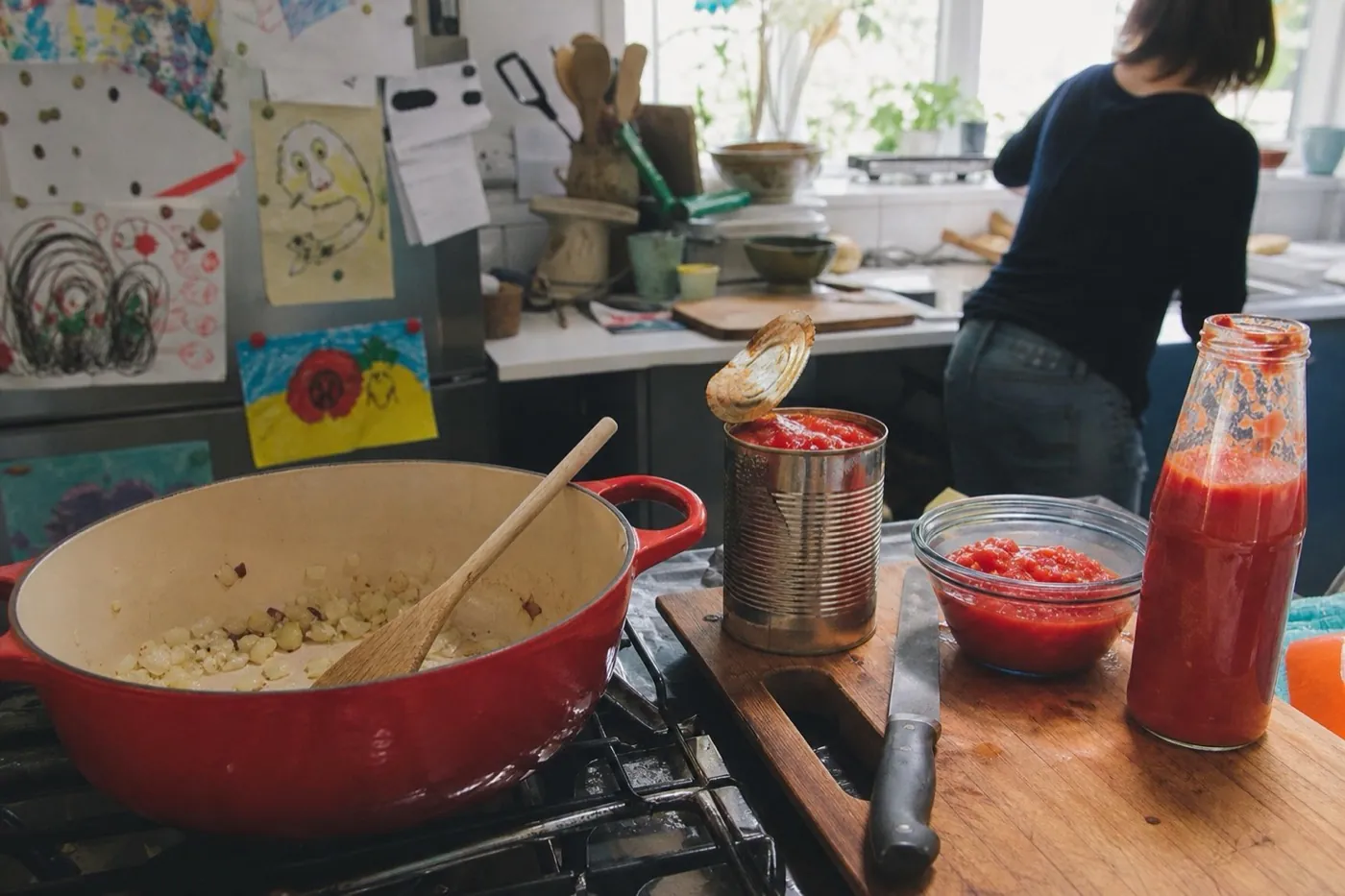
Can you use tinned tomatoes instead of passata?
Tinned tomatoes instead of passata works without trouble: use the same weight, so 400 g of chopped tomatoes for 400 g of passata. Blend them smooth and simmer uncovered for longer than the passata recipe says. Tinned tomatoes hold more water, so the sauce needs time to reduce.
Passata is sieved tomato without skins or seeds, usually thicker than the contents of a tin with its juice. The difference is texture, not taste. The right cooking time and a quick blend close the gap almost completely.
The amounts here are our editorial rule of thumb for typical tins. Always check the weight on your own tin, as it is not always 400 g.
Smooth tomato sauce from two tins
A sauce that stands in for passata in pasta, pizza and bakes. Make the full batch and freeze half.
Ingredients
- Tinned chopped or whole tomatoes 400 g each2 tin
- Olive oil3 tbsp
- Garlic3 cloves
- Onion optional½
- Tomato purée1 tbsp
- Dried oregano1 tsp
- Sugar only if the sauce is sharp½ tsp
- Basil a few leaves
- Salt and pepper to taste
Method
- Blend the tomatoes from both tins until smooth, juice and all. For a sauce as smooth as passata, push it through a sieve to catch the seeds and skins. It takes about 5 minutes.
- Soften the chopped onion in the oil for 4–5 minutes, then add the sliced garlic and cook for a minute, until fragrant. Do not let it brown or it turns bitter.
- Add the tomato purée and fry for a minute, stirring. Pour in the blended tomatoes and add the oregano.
- Simmer uncovered over low heat for 15–20 minutes, stirring every few minutes. The sauce should reduce by about a third and stop running off the spoon like juice.
- Taste before salting. Tinned tomatoes are often salted already, so add salt at the end, a little at a time. If the sauce is very sharp, add a pinch of sugar.
- Finish with torn basil. Cool any sauce you will not eat in a shallow container and freeze it.
Tomato soup from tins, with rice
A homely tomato soup made without passata. The tomatoes simmer in stock and are blended afterwards.
Ingredients
- Tinned chopped tomatoes 400 g each2 tin
- Vegetable or chicken stock1 l
- Carrot1
- Celery stick1
- Onion1
- Butter1 tbsp
- Long-grain rice120 g
- Thick plain yoghurt to serve4 tbsp
- Dill or parsley a handful
Method
- Finely dice the onion, carrot and celery. Soften them in the butter for 6–8 minutes.
- Add the tomatoes with their juice and the stock. Bring to the boil, lower the heat and simmer, covered, for 20 minutes.
- Meanwhile cook the rice separately as the packet says. Cooked in the soup, it would soak up too much liquid.
- Blend the soup smooth. If it is too thick, add a little hot water or stock; if too thin, simmer uncovered for a few minutes.
- Season with salt and pepper only after tasting, as the stock and tomatoes may already be salty.
- Spoon rice into bowls, ladle the soup over, add a spoonful of yoghurt and scatter with dill. Add the yoghurt in the bowl, not to the hot pot, where it can split.
Tip Celery is one of the EU-listed allergens, as is the milk in butter and yoghurt. Ready-made stock often contains celery too.
How do you replace passata? A table of instead of, use, amount and notes
The table covers a sauce for about four portions of pasta where the recipe calls for one bottle of passata of around 500 g. Amounts are relative to the weight of the passata and reflect editorial practice, not a standard.
| Instead of | Use | Amount | Notes |
|---|---|---|---|
| Passata | Chopped tinned tomatoes, blended | 1 to 1 by weight | Simmer 10–15 minutes longer, uncovered. |
| Passata | Whole peeled tinned tomatoes, crushed | 1 to 1 by weight | Usually meatier than chopped, with less juice. |
| Passata | Tomato purée plus water | 1 tablespoon purée per about 100 ml water | Fry the purée in oil first. Add a pinch of sugar. |
| Passata | Fresh tomatoes, scalded and blended | about 1.3 times the weight | They need long cooking. Best in season. |
| Passata | Chopped tomatoes plus a teaspoon of purée | 1 to 1 by weight | A thicker sauce without long reducing. |
| Passata in soup | Tinned tomatoes and stock | about ½ tin per portion of soup | The liquid is needed, so do not reduce for long. |
If you can choose between chopped and whole, pick whole for sauces and chopped for soups and stews. The longer reducing is the price of a quick shop, but it does not spoil the flavour.
How do you blend and reduce so a tinned-tomato sauce turns smooth?
Blend the tomatoes together with the juice from the tin first, for example with a hand blender in the pan. If you leave the pieces, the sauce will be rustic, which is also good, but it will not resemble passata. Then simmer over a medium heat, uncovered.
The sauce is ready when it has reduced by about a third and leaves a clear coat on the spoon. For two tins that is usually 10–15 minutes longer than the passata recipe. That is an editorial estimate, as timing depends on the pan and the hob.
- Open the tin, tip the tomatoes and juice into a pan and blend smooth.
- Fry onion and garlic in olive oil, then pour in the blended tomatoes.
- Simmer over a medium heat, uncovered, stirring from the bottom every few minutes.
- When the sauce is as thick as you like, add salt and herbs.
- Taste and, if needed, balance sharpness with a pinch of sugar or a spoon of butter.
With blended tomatoes, watch out for splashes: part-cover the pan if the sauce bubbles hard.
Which kind of tinned tomato suits which dish?
Not every tin behaves the same way. The dish you are replacing passata in decides what to use. Here is a short guide to the types.
Chopped tomatoes
The handiest, but watery. Best in soups, stews and one-pot dishes where the liquid is welcome. In a pasta sauce they need the longest reduction.
Whole peeled tomatoes
They usually hold less juice relative to flesh. Crush them with a wooden spoon in the pan or blend them. This is the best choice for a sauce when you have no passata and do not want a long wait.
Tomato purée
It will not replace passata alone, but diluted with water as in the table it gives a quick sauce. Fried for a minute in oil, it gains a deeper, sweeter flavour. A tube in the cupboard is a good rescue when the passata runs out.
Fresh tomatoes
In season they can beat tinned, but outside it they are often pale and watery. Scald them, peel, blend and cook for longer than tinned. Use more weight, because fresh tomatoes contain a lot of water.
Which dishes make passata easiest to replace with tinned tomatoes?
The swap is easiest where the sauce is simmered anyway and texture is not the point. It does less well where the passata must be perfectly smooth and light, for example in a delicate fish sauce. Below are dishes from the simplest to those that need more attention.
- Stew, ratatouille-style dishes and goulash: chopped tomatoes are better than passata here, since you need to add liquid anyway. Do not blend, just crush them in the pan.
- Tomato soup: blend the tomatoes with stock and add cream if you like it. Count the tin juice towards the water.
- Pasta sauce and lasagne: blend and reduce as described above. Bakes work best with a slightly thicker sauce.
- Pizza and bakes: reduce the tomatoes hard or drain them, since water will soften the base. Add a spoon of purée for thickness.
- Shakshuka and eggs in tomato: chopped tomatoes crushed with a spoon are enough, as the sauce is meant to be chunky.
If the sauce comes out too thin, do not add flour. Reduce it longer or stir in a spoon of purée, and the flavour stays clean.
How many tins should you buy, and how do you convert them to portions?
When you convert, start from the recipe: if it gives the passata in grams, buy the same weight of tinned tomatoes. One typical tin holds 400 g, so for a recipe asking for 500 g of passata take two tins and expect less sauce after reducing than went into the pan.
The guidance below is editorial practice, not a standard. If you cook a big batch for the freezer, add one more tin, because the sauce shrinks as it reduces.
- Pasta sauce for two: one 400 g tin is enough if you like a thick sauce.
- Sauce for four: two tins, and for generous coating add a spoon of purée.
- Soup for four: two tins plus stock, since soup needs more liquid than sauce.
- Freezer stock: four tins make several portions of sauce that you can freeze in separate containers.
If you are unsure of the amount, buy one tin extra. An unopened tin lasts in the cupboard until the date on the label.
How do you fix a sauce that came out sharp or flat?
A sharp sauce is a common result of swapping, especially with cheaper chopped tomatoes. Longer, gentler cooking helps, as does a spoon of butter at the end or a pinch of sugar. Avoid bicarbonate of soda: it is easy to spoil the taste with it.
If the sauce is flat, add a pinch of salt and a little olive oil at the end. A teaspoon of purée fried with garlic helps too. Add dried herbs such as oregano at the start, and fresh ones only after taking the pan off the heat.
How do you check salt and ingredients on the tin?
Tinned tomatoes can be salted and often contain citric acid as an acidity regulator. Regulation 1169/2011 requires a nutrition table, including salt, on most packaged food, so you can compare it with the passata you normally use.
Salt at the end, after reducing, because cooking concentrates the taste. If you buy tomatoes with added herbs or garlic, read the ingredients, especially when you cook for someone with an allergy.
Rozporządzenie (UE) nr 1169/2011 w sprawie przekazywania konsumentom informacji na temat żywnościWhat should you do with an open tin and spare sauce?
Move leftover tomatoes from the tin into a sealed container and keep it in the fridge. See what to move an open tin into, and look for a use-within date on the label if the maker gives one.
You can portion finished sauce and freeze it. Use flat containers or bags and leave a little space, as sauce expands. Label the container with the date so you know what to use first. For more on choosing between types, read our guide to passata or chopped tomatoes for a sauce.
How do you shop for a sauce and a soup from tinned tomatoes?
When you plan to cook from tins, shop once and with a list. The shopping list for sauce and soup from tinned tomatoes covers tomatoes, purée, rice, stock, vegetables and herbs. The items are grouped by shop section.
Two recipes sit just below, above the list: a smooth tomato sauce from two tins and a tomato soup from tins with rice. Both come from what is in the cupboard and need no passata. Find more ideas in the recipes.
Sauce and soup from tinned tomatoes
- Tins and dry goods
- Chopped tomatoes 400 g tins4 pcs
- Tomato purée1 pcs
- Long-grain rice500 g
- Vegetable stock for 1 l1 pack
- Pasta for the sauce500 g
- Vegetables
- Onions2 pcs
- Garlic bulb1 pcs
- Carrot1 pcs
- Celery head1 pcs
- Basil pot1 pcs
- Dill bunch1 pcs
- Dairy
- Thick plain yoghurt about 180 g1 pcs
- Butter1 pack
- Check the cupboard
- Olive oil1 pcs
- Dried oregano1 pcs
- Sugar1 pack
Frequently asked questions
Can chopped tomatoes replace passata?
Yes. Use the same weight, blend them, and simmer uncovered for longer than the recipe says. Chopped tomatoes are more watery, so the sauce needs to reduce.
Can tomato purée replace passata?
Yes, once diluted. Fry a spoon of purée in oil and loosen it with water in the amount from the table. Add a pinch of sugar and taste.
Why is a sauce from tinned tomatoes sharp?
Tinned tomatoes can be more acidic, especially cheaper chopped ones. Longer cooking over a low heat, a spoon of butter at the end or a pinch of sugar will help.
Do you need to peel or seed tinned tomatoes?
No. Blend them with the juice. If you want a perfectly smooth sauce, pass it through a sieve.
How long does it take to reduce a tinned-tomato sauce?
Usually 10–15 minutes longer than a passata recipe, for two tins. The sauce is ready when it leaves a clear coat on the spoon. That is an editorial estimate, as timing depends on the pan.
Tinned tomatoes instead of passata work well when you blend them and let the sauce reduce. Open the ready list in BuyNest and add any missing tins, so next time you will not need passata.
Open the ready list in BuyNestSources
Take the shopping into BuyNest
BuyNest is on iPhone and Android. The app has no ads, including on the free plan.