
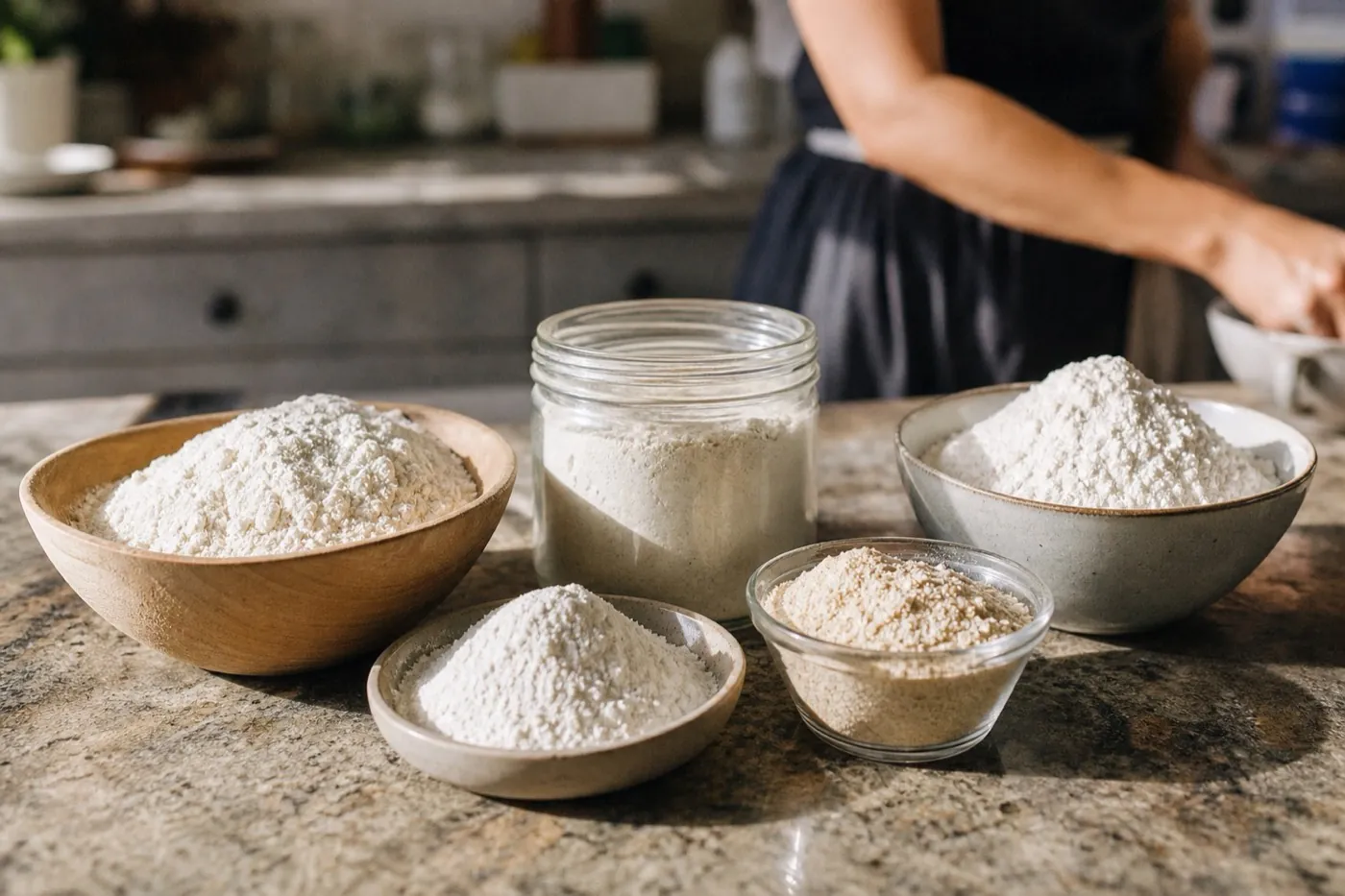
Polish flour types explained: what does the number mean?
Polish flour types explained simply: the number shows how thoroughly the grain was cleaned of bran. The higher the number, the more ash, meaning minerals, it holds, because Polish flour is graded by ash content. It is not a quality score. For pierogi use 450 or 500, for pizza and bread 650 or 750, for wholemeal bread a flour labelled wholemeal (razowa).
The number does not state the gluten level outright, but in kitchen practice higher numbers absorb more water. Below you will find a table of types, rules for matching flour to a dish, a comparison with British flour and the label.
This guide covers wheat flour. Rye, spelt and gluten-free flours follow other rules, so we do not cover them here.
Wikipedia: Mąka (typy mąki według PN-A-74022:2003)Potato and cheese pierogi with type 450 or 500 flour
Fine, white flour gives a thin, stretchy dough that does not crack when you fold it. This makes about 40 pierogi.
Ingredients
- Wheat flour type 450 or 500 (plain flour)500 g
- Warm water250 ml
- Rapeseed oil2 tbsp
- Potatoes600 g
- Twaróg or curd cheese250 g
- Onion2
- Butter30 g
- Salt1 tsp
- Black pepper½ tsp
Method
- Boil the peeled potatoes in salted water until soft, drain and press through a ricer. Dice one onion and soften it in half the butter. Mix the potatoes with the cheese, onion, salt and plenty of pepper. Let the filling cool.
- Put the flour in a bowl, add a pinch of salt and the oil, and gradually the warm water. Knead into a smooth, stretchy dough, about 8 minutes. Cover and rest for 20 minutes so it rolls out easily.
- Roll the dough out in batches to 1–2 mm and cut 7–8 cm rounds with a glass. Put a teaspoon of filling on each, fold and seal the edges firmly.
- Cook the pierogi in batches in a large pan of salted water. Once they float, cook for 2–3 minutes and lift out with a slotted spoon.
- Slice the second onion and brown it in the rest of the butter. Spoon it over the pierogi. Do not taste the raw dough: flour is not a ready-to-eat food.
Tip Freeze extra pierogi uncooked on a tray, then tip them into a bag. Cook from frozen, one minute longer.
Pizza with type 650 or 750 flour
A yeast dough needs a flour with more protein. Look for at least 12 g of protein per 100 g on the pack.
Ingredients
- Wheat flour type 650 or 750 (strong white flour)300 g
- Dried yeast4 g
- Lukewarm water190 ml
- Olive oil1 tbsp
- Salt1 tsp
- Passata150 g
- Mozzarella 2 balls250 g
- Fresh basil1 bunch
Method
- Mix the flour with the yeast and salt. Add the water and oil and knead into a smooth dough, about 10 minutes. It should be slightly sticky; do not add too much extra flour.
- Cover and leave somewhere warm for 1–1.5 hours until doubled. Or put it in the fridge overnight for a fuller flavour.
- Heat the oven to its maximum, usually 250–275°C, with a baking tray inside, for at least 30 minutes.
- Divide the dough in two and stretch each piece by hand to about 28 cm across. Spread with passata seasoned with salt and top with torn mozzarella.
- Slide onto the hot tray on baking paper and bake for 8–12 minutes until the edges are browned and the cheese has melted. Scatter with basil.
Which types of wheat flour are in the shop?
You will most often meet a handful of types. The table shows their usual nicknames and uses. Everyday names such as “tortowa” or “wrocławska” differ between producers, so trust the number on the pack.
| Type | Common name | Used for | Notes |
|---|---|---|---|
| 450 | Tortowa (cake flour) | Sponges, shortcrust, creamed cakes, roux sauces | Finely milled, very pale |
| 500 | Wrocławska | Pierogi, pancakes, dumplings, fritters, yeast and shortcrust cakes | All-purpose, the most common |
| 550 | Luksusowa | Rolls, wheat bread, yeast dough, pizza | A little stronger than 500 |
| 650 and 750 | Chlebowa (bread flour) | Wheat bread, baguettes, pizza, focaccia | Copes better with a long rise |
| Above 750 | Graham | Semi-wholemeal bread, a bread blend, biscuits | Fuller flavour, darker colour |
| Highest | Razowa (wholemeal) | Wholemeal bread, flatbreads | Needs more water than pale types |
The common names and uses in the table are an editorial simplification. Flours with the same number from different mills may behave a little differently, so read the description on the pack.
Wikipedia: Mąka (typy mąki według PN-A-74022:2003)Stolarska i in.: Ocena zawartości metali ciężkich i cech jakościowych ziarna pszenicy (Folia Pomeranae Univ. Technol. Stetin. 278), o gatunkowaniu mąki według popiołuWhich flour type suits which dish?
The simplest way to think about it is whether the dough should be tender or elastic. Tender bakes, such as sponges and shortcrust, like low numbers. Doughs that must rise and stretch, such as pizza and bread, need higher ones.
Which flour for pierogi and fresh pasta?
For pierogi, dumplings and pancakes pick type 450 or 500. The dough is elastic but not rubbery, and rolls out well. Type 500 is popular in Polish homes because it suits most everyday dishes.
Two recipes sit below, above the list: potato and cheese pierogi with type 450 or 500, and pizza with type 650 or 750. Both flours are on the list, so you can make either from one shop.
Which flour for pizza and bread?
For pizza and bread take type 650 or 750, or 550 if you want a fluffier dough. Higher types are chosen for bread and pizza from baking practice, not from the standard.
If you keep only one flour at home, types 500 and 550 are the most versatile. For bread and pizza it is still worth adding a stronger bread flour.
What about wholemeal and graham?
Flour with a higher type absorbs more water, so when you swap types in a recipe you usually need to add a little liquid. At first replace no more than a third of the pale flour with wholemeal, so the dough does not turn heavy.
What do you use instead of Polish flour abroad?
Flour types are not uniform across Europe. Germany, France and Italy have their own grades, which you cannot convert directly into Polish types. Do not copy number for number, look for flour with a similar purpose.
In Britain and the USA flour has no type numbers. It is sorted by protein content and use. Plain flour is the everyday flour for cakes and sauces. Strong white flour or bread flour has more protein and is used for bread. Wholemeal flour is made from the whole grain. These are rough equivalents, because there is no conversion table to Polish types.
What should you watch for with self-raising flour?
Self-raising flour has baking powder added, so in Polish recipes it does not replace plain flour unchanged. If you shop in Britain for a Polish recipe, compare the protein in the nutrition table and read the ingredients.
How do you swap one flour type for another in a recipe?
When the flour in the recipe is missing from your cupboard, you can often use a neighbouring type, but the dough will behave a little differently. The further apart the numbers, the more you must change the liquid and the kneading time. The rules below help you judge whether a swap makes sense.
The safest swaps are types next to each other in the table, such as 450 for 500 or 650 for 750. For bigger jumps, start by changing half the flour and see how the dough looks.
| Swap | What changes | What to do |
|---|---|---|
| 450 for 500 | More elastic, less crumbly dough | Usually no change to the recipe |
| 500 for 650 or 750 | Stronger dough that stretches more slowly | Knead longer and let the dough rest |
| 650 for 500 | Weaker, less fluffy dough | Shorten the rise and watch for spreading |
| White for wholemeal | More water, heavier bake | Start with a third and add liquid |
For delicate bakes such as sponge, swapping to a higher type goes wrong faster than in bread or pizza. If you are not sure, buy the right flour instead of risking the whole bake.
When you swap, note what you did in the recipe margin. After two tries you will know how your favourite mill's flour behaves in your oven, which is worth more than general rules.
Do you have to sift flour?
Sifting adds air and breaks up lumps, which makes sense for sponges and delicate cakes. For pierogi, bread and pizza it is usually unnecessary. If the flour has sat for a long time, sift it to remove lumps and to check there are no insects in it.
What should you check on a flour label?
A flour label is short, but a few details decide how a bake turns out. The rules for what must appear come from EU Regulation 1169/2011 on food information, which also applies in Poland. Here is a checklist.
Read from the name to the date.
- Type: the number in the name or on the front, for example “mąka pszenna typ 500”.
- Ingredients: wheat flour contains only flour. Extras mean a mix for a specific dough, not a flour for any recipe.
- Allergens: wheat contains gluten, which the rules require to be highlighted in the ingredients. People with coeliac disease or an allergy should avoid it.
- Date: flour usually carries a best-before date, and wholemeal flour has a shorter one because the fat in the germ and bran turns rancid over time.
- Nutrition table: it shows protein, fat and fibre, which helps compare flours of different types.
How do you store flour and handle it safely?
Flour is a shelf-stable product and can sit in a dry, cool cupboard. After opening, pour it into an airtight container so it does not take up damp or smells and pantry moths cannot get in. Write the type and the date from the pack on the container, because once poured out, 450 and 550 look almost alike.
Flour is a raw agricultural product. The US FDA reminds us that milling does not kill bacteria such as Salmonella or harmful strains of E. coli that can be present in the grain. So do not taste raw dough or raw batter, even without eggs, and wash your hands, worktop and equipment after handling flour.
How much flour should you buy at once?
Buy what you will use before the date on the pack, especially wholemeal. One 1 kg pack of each type you actually use is a good starting point (an editorial estimate), while big stocks take up space and age. Labelled containers save you from mix-ups when baking.
FDA: Handling Flour Safely: What You Need to KnowUSDA FSIS: Shelf-Stable Food SafetyHow do you put flour on a BuyNest list?
Write the type and pack size, for example “wheat flour type 500, 1 kg” and “wheat flour type 650, 1 kg”, not just “flour”. That way you will not pick up the wrong number in the shop. You can open the ready pierogi and pizza list in BuyNest and tick items off at the dry goods aisle.
The list holds both flours, dried yeast and the ingredients for the pierogi filling and the pizza, grouped by shop section, so you do not walk back to the same shelves. The amounts are the editors' estimate, based on typical portions in recipes.
If you bake together, a shared list shows at once that the flour is already in the basket. A standing cupboard template helps you remember flour, yeast and oil, which run out quickly.
Flour: pierogi and pizza
- Flour
- Plain flour (type 450/500)1 kg
- Strong white flour (650/750)1 kg
- Dried yeast1 pack
- Vegetables
- Potatoes1 kg
- Onions3 pcs
- Fresh basil pot1 pcs
- Dairy
- Twaróg or curd cheese250 g
- Mozzarella 125 g balls2 pcs
- Butter200 g
- Pantry
- Passata500 g
- Olive oil500 ml
- Rapeseed oil1 l
Frequently asked questions
What does the type number on Polish flour mean?
It describes how thoroughly the grain was milled: the higher the number, the more minerals (ash) in the flour, and the colour is usually darker. It does not mean quality. Low types are pale and tender, high types darker and more filling.
Which flour for pierogi, type 450 or 500?
Both work. Type 500 is chosen more often because it is all-purpose and gives elastic dough. Type 450 is more delicate, so the dough can turn out more crumbly. Use whichever you have in the cupboard.
Can you swap tortowa for wrocławska flour?
In most recipes yes, but the bake will be a little less tender. For sponges use 450 where you can. When swapping, follow the recipe and watch the consistency of the dough.
What is the British equivalent of Polish type 500 flour?
Plain flour is the closest. For bread and pizza look for strong white flour or bread flour. Self-raising flour is not an equivalent, because it has baking powder added.
How long does opened flour keep?
In an airtight container, in a dry, cool place, until the date on the pack. Wholemeal flour ages faster than white. Check the date on the pack and the smell, and throw it away if it smells musty or rancid.
Before you choose, decide whether you are making pierogi and cakes or pizza and bread. You can open the ready shopping list in BuyNest with one tap, with the types written into the names. Then the number on a Polish flour pack stops being a puzzle.
Open the ready list in BuyNestSources
- Wikipedia: Mąka (typy mąki według PN-A-74022:2003)
- Rozporządzenie (UE) nr 1169/2011 w sprawie przekazywania informacji na temat żywności
- FDA: Handling Flour Safely: What You Need to Know
- USDA FSIS: Shelf-Stable Food Safety
- Stolarska i in.: Ocena zawartości metali ciężkich i cech jakościowych ziarna pszenicy (Folia Pomeranae Univ. Technol. Stetin. 278), o gatunkowaniu mąki według popiołu
Take the shopping into BuyNest
BuyNest is on iPhone and Android. The app has no ads, including on the free plan.