
Buying a new build in Poland: where does the handover start?
A snagging checklist for a new-build flat in Poland takes you room by room: size, walls, floors, windows, doors, services, balcony and storage. Every defect goes into the handover record. From the day you sign it, the developer has 14 days to say which defects it accepts and 30 days to fix them.
The rules come from the Polish act on protecting buyers of flats and houses, usually called the developer act. It covers developer agreements and a few similar contracts with a developer. If you are buying a resale flat from a private owner, these rules do not apply.
When can the developer schedule the handover?
The handover, called odbiór in Polish, happens once the occupancy permit for the building has become final, and always before the deed that transfers ownership. You inspect and accept the flat first, then sign at the notary.
Your developer agreement must state how and when you will be notified of the handover, and its date. Read that clause early so you know how much notice to expect and whether it will arrive by email or post.
Should you go alone or with a professional?
The act says the handover takes place in the buyer's presence. Nothing stops you bringing someone along: a builder friend, a professional snagging inspector or simply someone to take photos and notes. Tell the developer how many people are coming.
A professional is most useful for services and measurements, because they own kit you would not buy for one day. If you go alone, book a calm morning and keep the rest of the day free. Rushing is how rooms get skipped.
If your Polish is limited, bring someone who reads it well or ask for the record in advance. You will be signing a Polish document, so you need to understand every line.
ISAP: Ustawa o ochronie praw nabywcy lokalu mieszkalnego lub domu jednorodzinnego oraz Deweloperskim Funduszu Gwarancyjnym (tekst jednolity Dz.U. 2026 poz. 880)ISAP: Ustawa o ochronie praw nabywcy lokalu mieszkalnego (pierwotny tekst Dz.U. 2021 poz. 1177)What should you prepare before the handover?
Paperwork comes first, because you are checking the flat against what was promised. The developer agreement has to state the usable floor area, the size and layout of rooms, the scope and standard of finishing work and how the floor area is measured. Print those pages and bring the floor plan with dimensions.
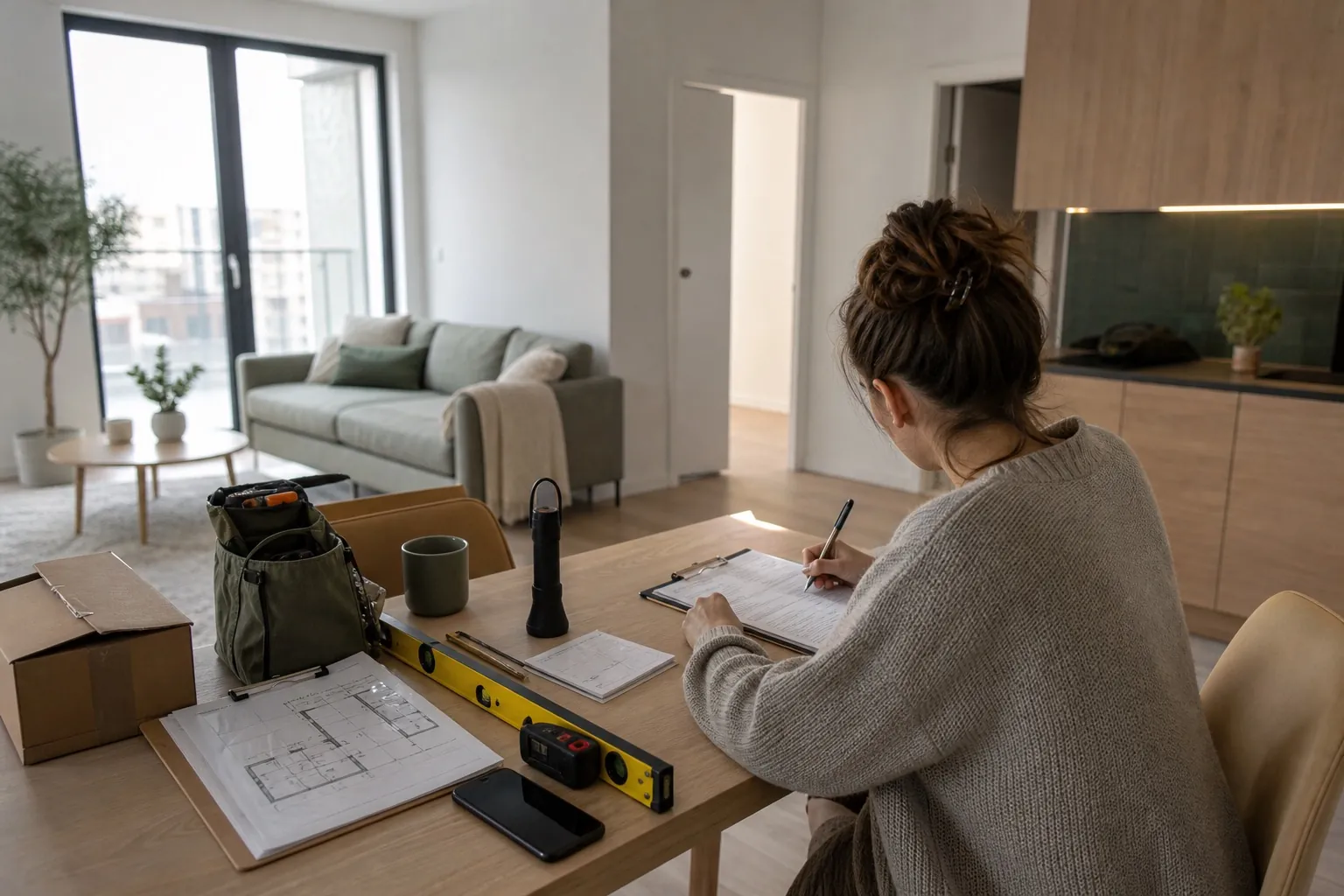
Here is what to bring if one or two of you are doing the inspection without a hired inspector:
- developer agreement, the information prospectus and the finish specification,
- floor plan with dimensions, printed so you can write on it,
- tape measure or laser measure for room sizes and ceiling height,
- long spirit level and a builder's square for walls, corners and the floor screed,
- torch, because new flats often have no light fittings yet and side light shows uneven plaster,
- socket tester or an ordinary phone charger to plug into every socket,
- sticky notes or masking tape to mark defects on walls and windows,
- charged phone for photos, plus a pen and notebook.
The full list is also ready to tick off: the new-build snagging list in BuyNest has 40 checks grouped from paperwork to the handover record. You tick as you go, and the person with you sees on their phone what is already done.
ISAP: Ustawa o ochronie praw nabywcy lokalu mieszkalnego lub domu jednorodzinnego oraz Deweloperskim Funduszu Gwarancyjnym (tekst jednolity Dz.U. 2026 poz. 880)What should you check during the handover?
Work in a fixed order: measurements first, then walls and floors, windows and doors, and finally services and anything outside the flat. Mark each defect with a sticky note and photograph it with the note in shot. Writing it up later is much easier.
Do the size and layout match the agreement?
Measure every room and compare it with the plan. Check where partition walls, doors, windows, sockets and water points are. A kitchen water point in the wrong place or a missing socket shown on the plan are typical snags.
The agreement states how usable floor area is measured. If your figures differ noticeably, read what the agreement says about area differences and price adjustment, and add a note to the record. An accurate area survey is a job for someone with professional equipment.
How do you check walls, ceilings and floors?
Hold the level against each wall in several places, vertically and horizontally. Use the square on corners, especially where kitchen units and fitted furniture will go. Shine the torch along the wall: low side light shows waves and holes in the plaster.
Lay the level on the floor in different directions and look for humps or cracks in the screed. Check ceilings and the corners around windows for cracks, stains and damp marks.
What matters in windows and doors?
Open, tilt and close every window. The handle should turn smoothly and the frame should not rub. Look at the glass against the light, then at the seals, sills and outside trims if you can reach them from the balcony.
Check the front door the same way: locks, cylinders, spyhole, threshold and seal. Count the keys and have the number of sets written into the record.
How do you test the services?
Test as much as the state of the flat allows. If the power is connected, try every switch and socket:
- sockets with a tester or charger, switches and light points,
- the fuse box: are the circuits labelled and do the labels match the rooms,
- water and waste points: position, caps and no leaks,
- radiators: all fitted as designed, with valves and no scratches,
- air vents: hold a sheet of paper up and see whether it is drawn in,
- entry phone, doorbell, TV and internet points if they are in the spec.
Finally, photograph the water, electricity and heat meters with their serial numbers and write the readings into the record. You will need them for the first bills.
What should you look at outside the flat?
A balcony, terrace or garden, a storage unit and a parking space are often part of the same agreement. Check their numbers, size, floor surface, railings and the balcony drain. If any of them has a separate handover, fix the date there and then.
How do you fill in the handover record?
The handover produces a record, the protokół odbioru, where you list the flat's defects. It also notes a refusal to accept the flat because of a material defect, or the developer accepting or rejecting such a defect. Every later deadline depends on it, so write it carefully:
- List each defect separately: room, wall or element and a description, for example „street-side bedroom, wall by the window, crack from ceiling to sill”.
- Add the photo number to each defect or attach the photos.
- Write down the meter readings and the number of keys handed over.
- Read the whole record before signing. If the developer disputes a defect, ask for its position to be written in as well.
- Take your signed copy and put the signing date in your calendar.
Signing a record that lists defects does not mean you accept them. The entry in the record is what triggers the developer's duties described below.
ISAP: Ustawa o ochronie praw nabywcy lokalu mieszkalnego lub domu jednorodzinnego oraz Deweloperskim Funduszu Gwarancyjnym (tekst jednolity Dz.U. 2026 poz. 880)How long does the developer have to fix defects?
Deadlines run from the day the record is signed. The developer's reply must come on paper or another durable medium, such as email. The table follows article 41 of the act:
| When | What happens | What you do |
|---|---|---|
| Within 14 days of signing | Developer confirms which defects it accepts or explains a refusal | Check which defects were accepted |
| No reply within 14 days | The developer is treated as having accepted the defects | Keep the record and the date |
| Within 30 days of signing | Developer fixes the accepted defects | Arrange a visit to check the repairs |
| Delay despite due care | Developer sets another date and explains the delay | Judge whether the new date is unreasonably inconvenient |
| Not fixed by the new date | You set the developer a further deadline | After it passes, you may have the defects fixed at the developer's cost |
If the developer rejects a defect you still believe is there, keep all the correspondence and photos. An opinion from a building surveyor or legal advice will help in a dispute.
ISAP: Ustawa o ochronie praw nabywcy lokalu mieszkalnego lub domu jednorodzinnego oraz Deweloperskim Funduszu Gwarancyjnym (tekst jednolity Dz.U. 2026 poz. 880)When can you refuse to accept the flat?
You can refuse the handover only if the flat has a material defect and the developer refuses to acknowledge it in the record. Ordinary snags, such as a scratched sill or a crooked socket, go into the record and you accept the flat.
After a refusal, both sides agree a new handover date so the developer can fix the defect. The same rules apply at the second handover. To refuse a second time you need an opinion from a building surveyor, which you must request within a month of the refusal.
- the surveyor confirms a material defect: you may withdraw from the agreement and the developer pays for the opinion,
- the surveyor finds no material defect: you pay for the opinion,
- the developer acknowledges a material defect in the record but does not fix it within the deadlines above: you may withdraw from the agreement.
Withdrawing from the agreement has serious financial and legal consequences. Before you do it, talk to a Polish property lawyer or the local consumer ombudsman (rzecznik konsumentów).
ISAP: Ustawa o ochronie praw nabywcy lokalu mieszkalnego lub domu jednorodzinnego oraz Deweloperskim Funduszu Gwarancyjnym (tekst jednolity Dz.U. 2026 poz. 880)What about defects you find after the handover?
Defects you spot between signing the record and the deed transferring ownership can also be reported to the developer. The same rules and the same 14 and 30 day deadlines apply, counted from the day you report them. Report in writing or by email and keep proof.
After ownership passes, anything the developer act does not cover falls under the Polish Civil Code rules on warranty for defects in a sale (rękojmia). For property, the seller is liable for physical defects found within five years of handing it over. Keep the handover date with your record.
ISAP: Ustawa o ochronie praw nabywcy lokalu mieszkalnego lub domu jednorodzinnego oraz Deweloperskim Funduszu Gwarancyjnym (tekst jednolity Dz.U. 2026 poz. 880)ISAP: Kodeks cywilny (tekst jednolity Dz.U. 2026 poz. 795), art. 568 o rękojmiHow do you plan the first days after getting the keys?
Once the keys are yours, a second list starts: utilities, cleaning, furniture and the move itself. Send the meter readings to your suppliers and ask the building manager about rules for carrying in furniture and removing rubble after fitting-out work.
The rest has its own guides: a moving house checklist, a new home checklist and a deep cleaning checklist for before you move in. If you are fitting out the flat, see the bathroom renovation checklist and other home lists.
Keep the snagging list in the app until every defect is fixed. Tick the items in the „After the handover” group when the reply arrives and when you have checked the repairs.
New-build handover: 40 checks
- Before the day
- Developer agreement
- Prospectus and finish spec
- Floor plan with dimensions
- ID card or passport
- Decide who comes with you
- Tools
- Tape measure or laser measure
- Long spirit level
- Builder's square
- Torch
- Socket tester or phone charger
- Sticky notes and masking tape
- Pen and notebook
- Size and layout
- Measure every room
- Compare layout with the plan
- Check ceiling height
- Walls and floors
- Walls plumb and free of cracks
- Corners between walls
- Floor screed level
- Ceilings and damp marks
- Windows and doors
- Windows open and tilt
- Seals and glass unscratched
- Sills and trims
- Front door and locks
- Full set of keys
- Services
- Every socket and switch
- Fuse box and circuit labels
- Water and waste points
- Radiators and valves
- Draw in the air vents
- Entry phone and doorbell
- Meter readings photos for the record
- Outside the flat
- Balcony, terrace or garden
- Storage unit
- Parking space
- Handover record
- Log each defect and where
- Photos of each defect
- Signed copy of the record
- After the handover
- Note the signing date deadlines run from it
- Developer's reply on defects
- Recheck the repairs
Frequently asked questions
Can I sign the handover record if there are snags?
Yes, and for ordinary snags that is exactly what you should do. List them in the record and sign it, and the developer's deadlines for replying and repairing start from that date. Refusing the handover is only possible for a material defect the developer will not acknowledge.
What if the developer does not reply about the defects?
If the developer does not confirm or reject the defects within 14 days of signing the record, the law treats them as accepted. It then has to fix them within 30 days of signing.
What is the difference between a snag and a material defect?
The act does not list material defects. In practice they are faults that seriously get in the way of using the flat as a home, not cosmetic issues. If you disagree at the second handover, a building surveyor's opinion decides.
How long does a handover inspection take?
It depends on the size of the flat and whether you bring a professional. Plan a few unhurried hours with nothing booked straight afterwards. Finishing early is better than skipping rooms.
Can I still report defects after the notary deed?
Yes. The Civil Code warranty then applies, and for property the seller is liable for physical defects found within five years of handing it over. Report them in writing and keep copies.
Print the finish specification pages and pack your tools the day before the handover. A snagging checklist on your phone keeps the inspection moving, because you tick each point and see straight away what is still left.
Open the ready list in BuyNestSources
- ISAP: Ustawa o ochronie praw nabywcy lokalu mieszkalnego lub domu jednorodzinnego oraz Deweloperskim Funduszu Gwarancyjnym (tekst jednolity Dz.U. 2026 poz. 880)
- ISAP: Ustawa o ochronie praw nabywcy lokalu mieszkalnego (pierwotny tekst Dz.U. 2021 poz. 1177)
- ISAP: Kodeks cywilny (tekst jednolity Dz.U. 2026 poz. 795), art. 568 o rękojmi
Take the shopping into BuyNest
BuyNest is on iPhone and Android. The app has no ads, including on the free plan.

