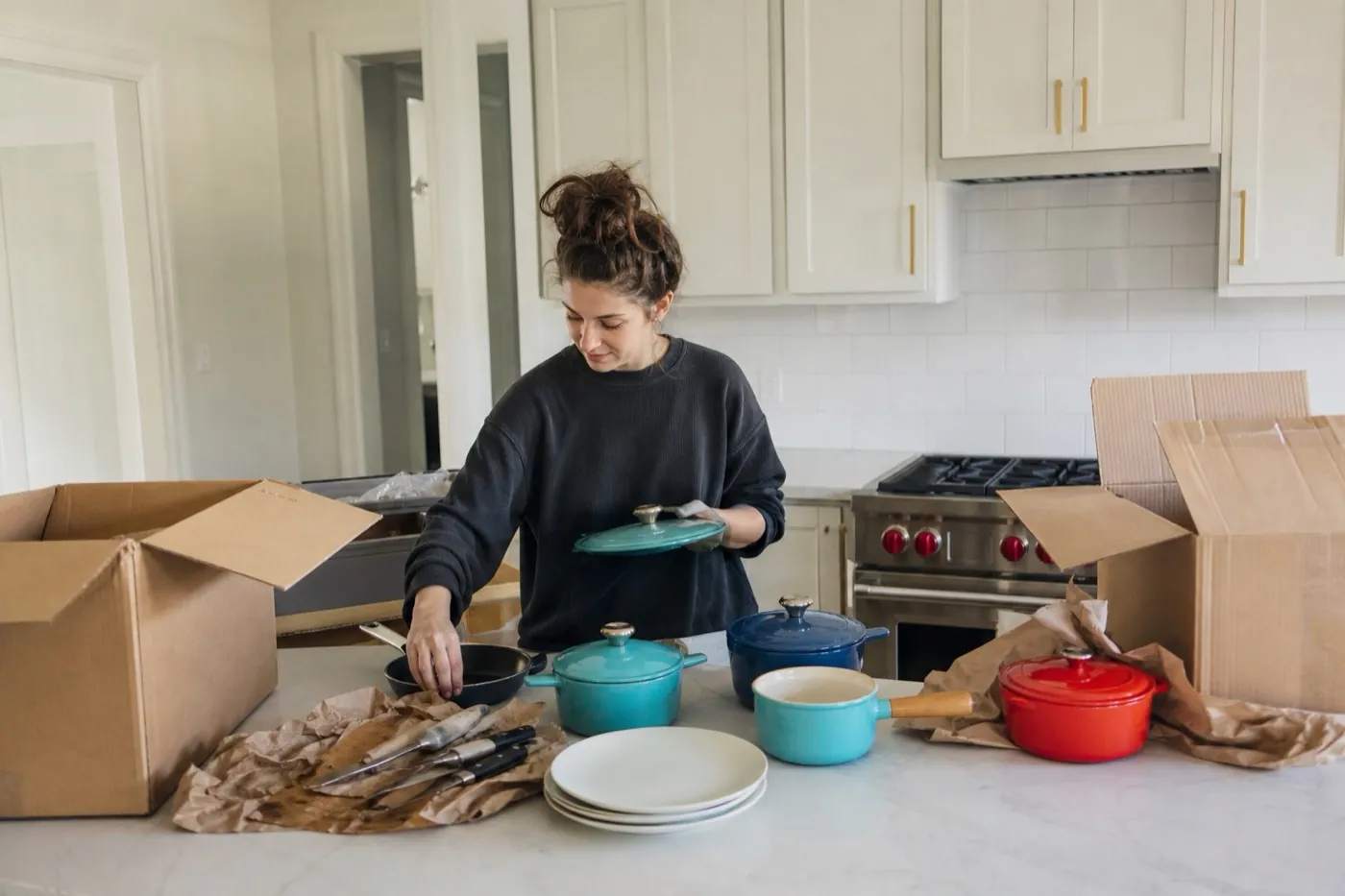
A basic kitchen should let you cook a daily meal, prepare ingredients, serve the food and store leftovers safely. To start, you mainly need pots that suit your hob, a frying pan, a few knives, chopping boards, dishes, cutlery and basic kitchen tools. Match the number of items to how many people live with you, how often you cook and how much cupboard space you have. The list below separates what you need from the start from the appliances worth adding after a few weeks of using the kitchen.
Kitchen essentials: a checklist to tick off
Kitchen essentials checklist (part 1 of 2)
- Pots, pans and baking
- Smaller saucepan for sauces, porridge and small portions
- Medium pot for pasta, potatoes, grains and everyday dinners
- Large pot
- Lids that fit the pots
- Frying pan
- A second frying pan, if you fry ingredients at the same time that need different temperatures or surfaces
- Ovenproof dish or baking dish
- Baking tray or tin to suit the dishes you make
- Knives and boards
- Chef's knife or all-purpose knife for most foods
- Small knife for peeling and precise cutting
- Serrated knife for slicing bread
- Sharpener suited to your knives
- Board for vegetables, bread and ready-to-eat foods
- Separate board for raw meat or fish
- Kitchen tools for preparing food
- Vegetable peeler
- Grater
- Colander
- Sieve
- Two bowls for mixing and preparing ingredients
- Measuring jug with markings
- Kitchen scales
- Whisk
- Spatula suited to your pan's coating
- Mixing spoon
- Soup ladle
- Kitchen tongs
- Trivet for a hot pot or baking dish
- Tin opener
- Bottle opener and corkscrew
- Kitchen scissors
- Oven gloves or pot holders for hot dishes
- Two or three tea towels for drying dishes and hands
- Dishes and cutlery
- Dinner plates
- Deep plates or soup bowls
- Smaller plates or small bowls
- Mugs
- Glasses
- Forks
- Table knives
- Spoons
- Teaspoons
- Platter, larger bowl or dish for serving a shared meal
- Serving spoon or tongs
Kitchen essentials checklist (part 2 of 2)
- Food storage
- Lidded containers in sizes that match typical portions
- Lunch box for work or school
- Airtight containers or jars for flour, rice and grains
- A glass dish with a lid, if it is to serve both for baking and for storing food
- Clips for closing opened packets
- Freezer bags or containers
- Labels or a marker for contents and date
- Basic appliances
- Fridge
- Hob or cooker
- Oven or another appliance for baking and heating food
- Kettle
- Cooker hood or extractor to suit your kitchen design
- Dishwasher
If you wash up every day, prepare one set of dishes for each person in the household, plus a small reserve for a guest or a second use during the day. If you run the dishwasher less often, you need more plates, mugs and cutlery.
Add a blender if you regularly make cream soups, smoothies or pastes. A mixer is useful if you bake often, a coffee machine if you drink coffee every day, and a toaster if breakfast is built around bread. Before you buy, check the appliance's dimensions and plan where it will sit on the worktop or in a cupboard.
Before you shop, put the products you have agreed on into a shared BuyNest list, ideally with a specific model, size or capacity. Split the list by the shops where you plan to buy them. After each purchase, tick items off, so everyone using the list can see which kitchen essentials are complete and which are still to buy.
What to buy for your kitchen first
Start with the set you need from day one. Add further tools to match the dishes you actually cook.
| Stage | What it includes | When to buy |
|---|---|---|
| Getting the kitchen running | A pot, frying pan, basic knives, chopping boards, spatula, dishes, cutlery and containers | Before the move or on the first day |
| Comfortable everyday cooking | Colander, grater, bowls, sieve, measuring jug, scales, an extra baking dish | Once you know which meals you cook most |
| Appliances for specific uses | Blender, mixer, coffee machine, food processor, specialist tins and extra pans | When a regular need appears |
Before you shop, write down five to seven meals you really make in an ordinary week. Scrambled eggs, pasta, soup, roasted vegetables and pancakes need a different set than a diet built on smoothies, baking and cooking big batches. A list like this also shows which appliances would do several jobs and which would serve one rare task.
Kitchen utensils: which are the most useful?
To start, choose a peeler, grater, colander, sieve, whisk, spatula, ladle, tongs, measuring jug and scales. This set is enough to prepare vegetables, pasta, soup, sauce, dough and most everyday dinners.
When choosing, check three things:
- whether the material of the utensil is safe for the coating of your pot or pan;
- whether the handle sits comfortably in your hand and lets you control the tool;
- whether you can wash it the way you do every day, for example in the dishwasher.
A silicone or wooden spatula suits a pan with a delicate coating. Keep metal tongs and spatulas for cookware whose manufacturer allows such tools. Add a mandoline if you often slice a lot of vegetables, a juicer if you make juice regularly, and a rolling pin, pastry brush and tins if you bake. For occasional baking, one baking dish is enough; a springform tin and a muffin tin can wait until a specific recipe calls for them.
Kitchen knives: how many and which to choose
A basic set can consist of a large all-purpose knife, a small paring knife and a bread knife. The first two cover most daily jobs. The bread knife also helps with foods that have a hard crust and a soft middle.
Before you buy, check that the handle is comfortable and that the blade length lets you control the knife on the board you use. Add a sharpening solution that suits the blade material. A sharp knife needs less pressure and gives you more control when cutting.
Store knives in a block, in guards or on a suitable magnetic strip. Loose blades in a drawer get damaged faster and make it harder to reach for other utensils safely.
Pots for your kitchen: how to build a starter set
Instead of starting with a big set, choose sizes to match the number of portions. For one or two people who cook most meals at home, a practical starting point is a smaller saucepan, a medium pot and a frying pan. Add a larger pot if you often cook soups, stocks or meals for several people.
Check:
- that the base is compatible with your hob;
- the diameter of the rings on your hob;
- the usable capacity;
- that the handles are stable;
- the maximum temperature and whether it can go in the oven;
- how it should be washed;
- that the lids fit.
Choose a frying pan for the dishes you make most often. Pancakes, braising, quick frying and baking need different shapes or materials. Check the manufacturer's instructions for temperature, use of fat and utensils suitable for the coating.
How many plates, cutlery items and containers to buy
Decide how many dishes you need by how many meals pass between washing-up sessions. For one or two people, a set of six dinner plates, six bowls or deep plates and six small plates usually covers several meals, so you can run the dishwasher only when it is full. For a family of four, that set may cover only one full meal and breakfast, so count the dishes needed for a typical day before you buy.
| Situation | What to count before buying |
|---|---|
| Washing up by hand after every meal | One full place setting per person, plus 1–2 spare sets for a guest or a breakage |
| Dishwasher run once a day | The plates, mugs and cutlery needed from breakfast to supper, plus a small reserve |
| Dinners prepared for 2–3 days | One larger container for the whole dish, or separate containers for each planned portion |
| Meals taken to work or school | A separate airtight container for each person, and a second one if the first may stay out of the house until the next day |
| Frequent guests | Place settings for the typical number of guests; check that the pattern can be bought again later |
With pots, capacity matters more than the number of pieces. A 1–1.5 l saucepan is enough for a sauce or porridge, a 2–3 l pot for side dishes and smaller portions, and a 4–6 l model will serve soup or dinner for several people. Treat these capacities as a starting point and adjust them to the number of portions you cook at home.
You will find groceries for your first shop in the guide Basic grocery staples: a list for your home. Detergents, bin bags and cleaning accessories are covered in a separate household supplies checklist.
How to plan your kitchen equipment in BuyNest
A kitchen is usually put together over several shopping trips. Once you have chosen together, add specific products to the list, such as “28 cm frying pan for induction”, “1 l glass container with a lid” or “5 l pot”. Then split them by the shops where you plan to buy them.
After each shop visit, tick off what you bought. Before the next trip, everyone using the list sees where things stand: the equipment already complete and the things still to buy. After a few weeks of using the kitchen, you can add any gaps you notice, such as a second lunch container or a larger sieve.
Frequently asked questions about kitchen equipment
How many pots do I need to start?
A smaller saucepan, a medium pot and a frying pan are enough for many everyday meals for one or two people. Choose a large pot and another frying pan according to the number of portions and how you cook.
Which kitchen utensils should I buy first?
Start with chopping boards, knives, a peeler, grater, colander, bowls, spatula, spoon, ladle, tongs, measuring jug and oven gloves.
Is it worth buying a ready-made utensil set?
Write down the items you need and compare their total price with the price of the set. If the set contains several similar spatulas or tools unsuitable for your pan's coating, it is better to put your utensils together one by one.
Which small appliances should I buy to start?
Buy appliances that match your daily meals. A hand blender handles cream soups, sauces and some pastes, a mixer is needed for regular baking, and a coffee machine for daily coffee. Before choosing, write down the width, height and depth of the space set aside for the appliance.
Sources
- EUR-Lex: Rozporządzenie (WE) nr 1935/2004 w sprawie materiałów i wyrobów przeznaczonych do kontaktu z żywnością / Regulation (EC) No 1935/2004 on food contact materials
- Food Standards Agency (GOV.UK): How to chill, freeze and defrost food safely
- Legislation.gov.uk: Regulation (EC) No 1935/2004 (UK version)
Take the shopping into BuyNest
BuyNest is on iPhone and Android. The app has no ads, including on the free plan.