
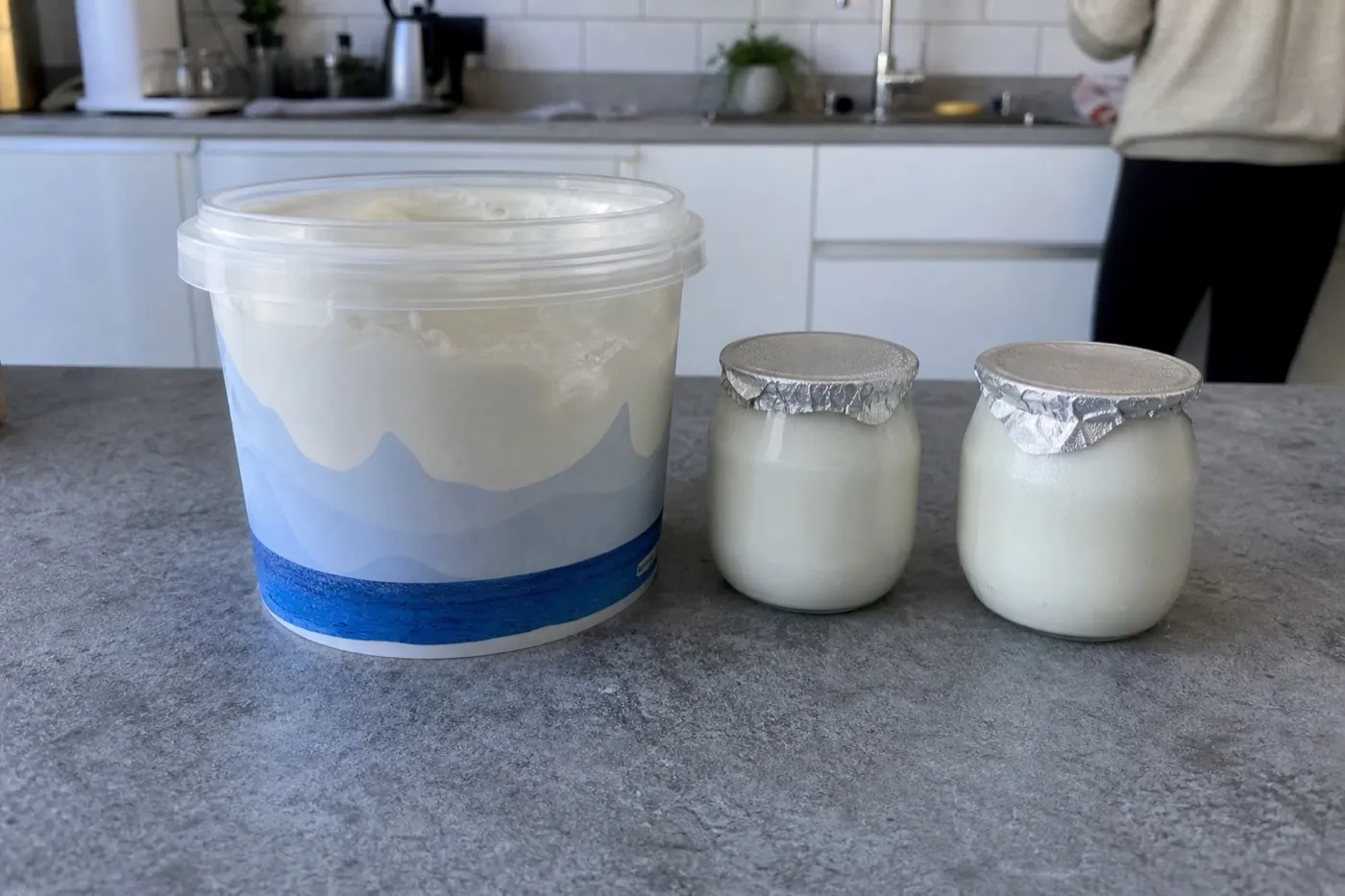
A large tub or small pots of yoghurt: which pays off?
A large tub or small pots of yoghurt? A big tub, say 1 kg, usually costs less per kilo, but only pays off if you finish it in time once opened. If one person eats it, or only now and then, small pots work out cheaper because nothing is wasted.
Compare the price per kilo you eat, not the price per kilo on the shelf. If the rest of a large tub passes its time limit once opened and goes in the bin, its real price rises. The sum below shows how quickly that happens.
The two recipes below the first section use about 450 g of yoghurt between them: yoghurt-marinated chicken for three and tzatziki for four. For label basics, see what to check on a plain yoghurt label.
Yoghurt-marinated chicken
Yoghurt tenderises the meat and helps the spices stick. It uses 250 g from a large tub.
Ingredients
- Boneless chicken thighs600 g
- Plain yoghurt250 g
- Garlic3 cloves
- Sweet paprika2 tsp
- Ground cumin1 tsp
- Lemon1
- Rapeseed oil1 tbsp
Method
- In a bowl, mix the yoghurt, crushed garlic, spices, the juice of half the lemon, the oil and a teaspoon of salt.
- Add the chicken, coat it well, cover and refrigerate for at least an hour, ideally overnight.
- Heat the oven to 220°C. Lay the chicken on a lined tray, shaking off the excess marinade. Throw away marinade that has touched raw meat.
- Roast for 20–25 minutes until cooked through and browned at the edges. Serve with lemon wedges and tzatziki.
Tzatziki with plain yoghurt
A sauce for chicken, vegetables and bread. Make it while the chicken roasts.
Ingredients
- Thick plain yoghurt200 g
- Cucumber1
- Garlic1 cloves
- Dill a few sprigs
- Olive oil1 tbsp
Method
- Coarsely grate the cucumber, sprinkle with a pinch of salt and leave for 5 minutes.
- Squeeze the cucumber in your hands or press it in a sieve to remove the water. Otherwise the sauce will be runny.
- Mix the cucumber with the yoghurt, crushed garlic, chopped dill and olive oil. Season with pepper.
- Keep in a closed container in the fridge and eat within 2 days.
How do a large tub and small pots compare in a table?
The table sets the two forms against the points that matter at home. It is about plain yoghurt eaten by two to four people.
| Criterion | Large tub (e.g. 1 kg) | Small pots (e.g. 150 g) |
|---|---|---|
| Price per kilo | Usually lower on the shelf | Usually higher on the shelf |
| Price per kilo eaten | Rises if part is wasted after opening | Same as the shelf price if you eat it all |
| Portion | You spoon out what you like; easy to take too much | A fixed portion, easier to keep track of |
| Keeping once opened | One opened tub, a few days to use it up | You open one pot at a time, the rest stay sealed |
| Best uses | Marinade, tzatziki, sauces, porridge for the family | Breakfast, snack, packed lunch, travelling |
| Storage | Fridge, closed tightly, clean spoon | Fridge, easy to carry in a bag |
Two 500 g tubs are a middle route: the unit price is usually lower than for pots, and the second tub stays sealed until you finish the first.
How do you work out the price per kilo of the yoghurt you actually eat?
EU Directive 98/6/EC requires shops to show a unit price per kilo, and UK shelf labels show one too. It is a good starting point but does not count what you throw away. So do your own sum: the pack price divided by the weight you eat.
The example below uses made-up prices, only to show the method.
- Turn the weight into kilos: 150 g is 0.15 kg.
- Divide the pack price by the weight in kilos.
- For a large tub, subtract what you will waste and divide the price by the weight eaten.
- Compare the result with the price of the pots.
Example: 1 kg of plain yoghurt costs £1.40, so £1.40 a kilo. Four 150 g pots cost £0.40 each, which is 600 g for £1.60, or 1.60 ÷ 0.6 = £2.67 per kilo. If your household eats 700 g of the kilo and the rest passes its time limit once opened, the eaten kilo costs 1.40 ÷ 0.7 = £2.00.
If you eat only 500 g, the price rises to £2.80 per kilo, more than for the pots. So the break-even sits around 600 g eaten from the kilo: above it the large tub wins, below it the pots win. There are more sums like this in our guide to price per kilo across pack sizes.
Dyrektywa 98/6/WE w sprawie ochrony konsumenta przez podawanie cen produktów (cena jednostkowa)How much yoghurt will your household use in a few days?
Before reaching for a large tub, estimate how much yoghurt you eat in a week. The easiest way is to count portions: who eats yoghurt for breakfast, how often you cook with it and whether it is the base of a sauce or marinade.
The usage below for a household of two is an editorial estimate, not a norm. Write down your own numbers for one week and the choice becomes obvious.
- Breakfasts: a 150 g portion per person, two breakfasts a week is 600 g for two people.
- Marinade: the recipe on this page uses 250 g of yoghurt for three portions of chicken.
- Tzatziki: 200 g of thick plain yoghurt for four portions.
- Porridge or smoothie: a few spoonfuls a day, if it is on your menu.
If the total is above 600 g a week, a large tub makes sense. If it is lower, choose pots or two smaller tubs. The result also helps you decide whether to buy a big tub of Greek-style yoghurt for marinades and sauces.
How do you split a large tub of yoghurt across a week?
A large tub loses its advantage when nobody knows what to use it for. The simplest approach is to plan it in advance: a kilo is about 1000 g, the recipes on this page take about 450 g, and you eat the rest at breakfast. A plan written at the start of the week also helps you decide whether to buy a kilo at all.
The split below is an example for two people and an editorial estimate. Change it to match your own habits and the number of people at the table.
A good habit is to move some of the yoghurt into a separate jar as soon as you open the tub. That way you do not dip into the large tub several times a day, and it stays cleaner for longer.
- Day one: 250 g for the chicken marinade, from the recipe on this page.
- Day two: 200 g for tzatziki with pitta or roasted vegetables.
- Days three and four: 150 g each for breakfast with oats and fruit.
- Day five: the rest into pancake batter or a banana smoothie.
If you know you will not eat that much in a given week, buy a smaller tub or pots. A plan that does not fit into the week usually ends with a leftover at the back of the fridge.
When should you buy a large tub and when small pots?
The number of people, the type of dishes and whether yoghurt is for cooking or eating cold all matter. Here are short pointers.
When does a large tub of yoghurt pay off?
Choose a large tub when at least three people in the house eat it or when you cook with yoghurt several times a week.
- marinade for chicken, as in the recipe on this page,
- tzatziki and sauces for kebabs and wraps,
- porridge or muesli for the whole family,
- cakes and pancakes with yoghurt in the batter,
- a household where yoghurt disappears in a few days.
When are small pots of yoghurt enough?
Choose pots when one person eats it, when you take it to work or when you rarely cook with it.
- breakfast for one,
- a packed lunch or snack,
- trips where there is nowhere to keep an opened tub,
- a household where yoghurt is a side, not the base of dishes.
How do you store opened yoghurt and avoid wasting the rest?
The European Food Safety Authority (EFSA) explains that foods marked use by, including dairy products, should not be eaten after that date, even if they look and smell fine. Storage advice from the maker, such as keeping it below 5°C, must then be taken literally. Our guide to finding storage instructions for opened yoghurt covers what to look for.
Once you open a large tub, close it tightly, use a clean spoon and keep it in the fridge. Write the opening date on the lid so you do not have to guess. When the maker gives a time after opening, it overrules what you remember.
- use the rest in a marinade or tzatziki the next day,
- stir it into pancake or flatbread dough,
- blend it with fruit into a smoothie,
- serve it as a sauce over roasted vegetables,
- freeze small portions for cooking only, as it changes texture once thawed.
EFSA also encourages planning meals and writing a shopping list, which is the best defence against thrown-away yoghurt.
EFSA: Food date labelling (use by, best before)EFSA: Reducing consumer food wasteHow do you add yoghurt to your BuyNest shopping list?
Write the weight or the number of pots: plain yoghurt 1 kg or plain yoghurt, 4 pots. Whoever is at the shelf does not have to guess, and everyone in the household sees a shared list in the app.
We put the ingredients for both recipes and the breakfasts on one list: the ready shopping list with a kilo of yoghurt. You can import it in a few steps.
- Open the ready list on this page.
- Scan the QR code, or tap the import button on your phone.
- Remove what you already have in the fridge and adjust amounts.
- Assign items to shops and share the list with the people you live with.
More side-by-side guides are in food comparisons, and dinner ideas in BuyNest recipes.
A kilo of yoghurt: dinner and breakfasts
- Dairy
- Plain yoghurt large tub1 kg
- Plain yoghurt pots for work4 pcs
- Meat
- Boneless chicken thighs600 g
- Vegetables and herbs
- Cucumber1 pcs
- Garlic bulb1 pcs
- Dill bunch1 pcs
- Lemon2 pcs
- Breakfasts
- Rolled oats500 g
- Frozen berries450 g
- Bananas4 pcs
- Honey jar1 pcs
- Spices and oils
- Sweet paprika1 pack
- Ground cumin1 pack
- Olive oil500 ml
- Bread
- Pitta bread for dipping1 pack
Frequently asked questions
Is a large tub of yoghurt always cheaper?
Not always. The price per kilo on the shelf is usually lower, but what counts is the price per kilo eaten. If you eat only part and bin the rest, pots can work out cheaper. The numbers in the sum on this page are examples.
How long does plain yoghurt keep once opened?
It depends on the product, so check the label. If the maker gives a time after opening, follow it. EFSA reminds us that foods with a use by date should not be eaten after it.
Can you freeze yoghurt?
You can, but it changes texture and separates once thawed. Then it suits cooking, baking and sauces, not eating cold. Freeze small portions and label them with the date.
Is yoghurt in pots less healthy than yoghurt in a large tub?
It depends on the ingredients, not the size of the pack. Check that it is plain yoghurt with no added sugar. For dietary questions, ask your doctor or a dietitian.
Is plain yoghurt a good protein for dinner?
The Polish National Centre for Nutrition Education (NCEZ PZH) places dairy in the protein quarter of the plate but does not name plain yoghurt. As the base of a marinade or sauce it suits chicken and vegetable dishes.
A large tub or small pots of yoghurt: let the amount you really eat before the time limit once opened decide. Write the weight and the number of pots on your list. Import the ready list into BuyNest and work out the price per kilo eaten in the shop.
Open the ready list in BuyNestSources
Take the shopping into BuyNest
BuyNest is on iPhone and Android. The app has no ads, including on the free plan.