
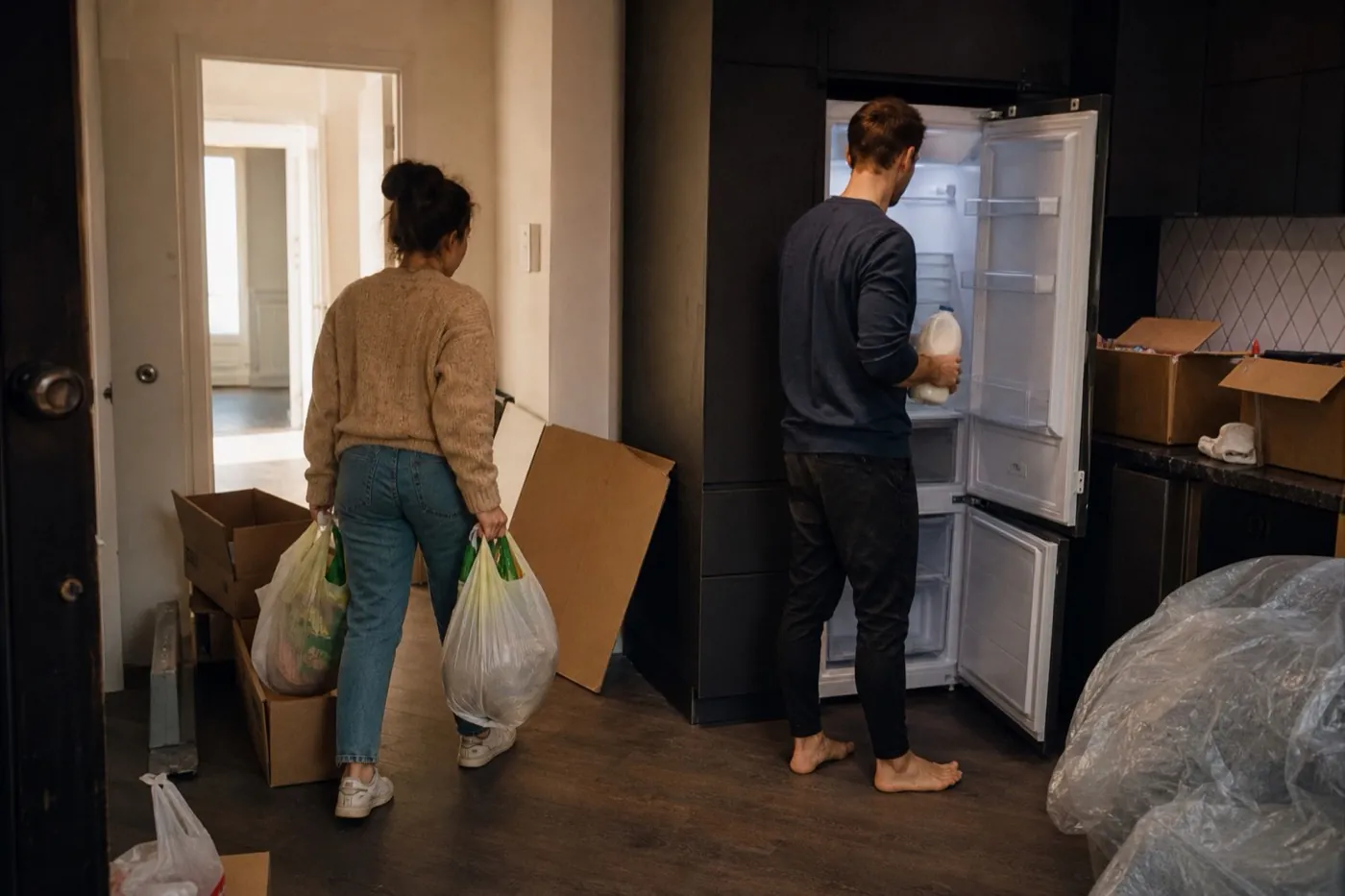
In BuyNest you can split these products by shop and tick them off with your household.
What should a new home grocery list include for the first three days?
A new home grocery list only needs to cover three days of simple meals and the washing-up that follows. Buy pasta, rice, eggs, bread, butter, milk, a few vegetables, washing-up liquid and toilet roll. You can fill the cupboards later, once you see what you actually cook in the new place.
On moving day the kitchen is usually empty, and nobody has the energy for a big shop after carrying boxes. So the list is short: around 30 items, split into food, cleaning and the bathroom.
Quantities are for one or two people. They are our editorial estimate, based on typical portions in home recipes for two. If three or four of you are moving in, double the eggs, bread, milk and pasta. Salt, oil and cleaning products stay the same.
FoodSafety.gov: Cold Food Storage ChartPasta with tomatoes, chickpeas and spinach
A first-evening dish for a kitchen with one pot, one pan and a knife. It makes two dinners for one person or one dinner for two.
Ingredients
- Pasta200 g
- Chopped tomatoes 400 g1 tin
- Chickpeas drained1 tin
- Frozen spinach150 g
- Onion1
- Garlic2 cloves
- Rapeseed oil1 tbsp
- Hard cheese grated40 g
- Salt and pepper to taste
Method
- Bring a pot of salted water to the boil and cook the pasta as the packet says. Before draining, save half a cup of the cooking water.
- Meanwhile chop the onion and fry it in the oil over a medium heat for about 5 minutes. Add the crushed or finely chopped garlic and cook for one more minute.
- Pour in the tomatoes, add the drained chickpeas and the frozen spinach. Simmer for 10 minutes, until the spinach has thawed and the sauce has thickened. Season with salt and pepper.
- Toss the pasta with the sauce. If it is too thick, loosen it with a little of the saved water. Serve with grated cheese.
- Put the second portion in a closed container and into the fridge as soon as it has cooled.
Tip No grater yet? Slice the cheese thinly with a knife or crumble it by hand.
What should you check in the flat before you go shopping?
Five minutes looking around the kitchen can save you a second trip. Without a pan and a saucepan, a food list is not much use, so kit matters more than a third packet of pasta. If something is missing, add it to the top of your list.
Walk through with your phone and check a few things in turn.
- a saucepan, frying pan, knife, chopping board and wooden spoon: buy any that are missing before you buy food
- the fridge: switch it on and make sure it is cooling before you put dairy in
- the cupboards after the last occupants: check dates and packaging, and do not count an open bag of flour of unknown age as a stock
- the bathroom and under the sink: there is often half a bottle of washing-up liquid or a toilet roll left
- the kettle and sockets: tea and coffee do not taste of much if you cannot boil water
The US cold food storage chart says a fridge should be at 4°C (40°F) or below and a freezer at -18°C (0°F). If the appliance has been switched off, wipe it out and give it time to cool, as its manual says, before you put milk and butter inside.
FoodSafety.gov: Cold Food Storage ChartWhat food do you need for three days after moving in?
A good starter list is built from products that make several different meals without special spices. The table below shows what each item is for, so it is easy to decide whether you need it this week.
| Day | Meal | What you make it from |
|---|---|---|
| Day 1 | Supper: pasta with tomatoes and chickpeas | pasta, tinned tomatoes, chickpeas, onion, garlic, spinach, oil |
| Day 2 | Breakfast: porridge with an apple | porridge oats, milk, apples or bananas |
| Day 2 | Lunch: leftover pasta | the portion left from the night before |
| Day 2 | Supper: eggs and bread | eggs, butter, bread, cheese |
| Day 3 | Lunch: rice with vegetables and an egg | rice, carrots, onion, leftover spinach, an egg |
| Day 3 | A simple rice soup if you want something hot | a stock cube, carrots, onion, rice |
Around that sit the things that hold it together: salt, pepper, rapeseed oil, and coffee or tea. Without them even good pasta tastes like canteen food.
What should you cook on the first evening?
Pasta with tomatoes, chickpeas and spinach is the safest choice, because it needs one pan and one saucepan. The recipe is further down, above the list. Make two portions: the second becomes lunch the next day without extra washing-up.
Frozen spinach and tinned tomatoes keep for weeks, so nothing spoils if your plans slip by a day.
What can you buy for moving day itself when you cannot face cooking?
On moving day, things that need neither a fridge nor a pan are enough. Water, bread, apples and bananas from this list do the job. Add something hot from a nearby bakery or takeaway if you like, and do the proper shop the next day.
Which cleaning products should you buy at the start?
For the first week you need a handful of things, not a whole shelf at the chemist. Everything below can be bought in one place, together with toilet roll and soap. Leave oven cleaner, descaler and grout products until you can see they are needed.
- washing-up liquid and two sponges
- microfibre cloths for worktops and the bathroom
- one all-purpose cleaner
- bin bags that fit the bin that came with the flat
- kitchen roll
- toilet roll and liquid soap for both sinks
Keep cleaning products in their original packaging and away from food. The label carries hazard pictograms and precautionary statements, whose format across the EU is set by the CLP Regulation. Read them before first use and never mix different products.
When you unpack, split the bags straight away. Food goes to the kitchen, chemicals to the bathroom or a cupboard with no food in it.
Rozporządzenie (WE) nr 1272/2008 (CLP) / Regulation (EC) No 1272/2008 (CLP)How do you split the first shop between two people and two shops?
It is quickest if one person goes for food and the other for cleaning products. In BuyNest you can save the ready list of first groceries and share it with whoever is moving in with you. Ticked items show up on both phones at once, so nobody buys a third packet of pasta.
Assign the food to the supermarket, and cleaning and the bathroom to the chemist. In each shop you then see only what you are buying there. If you are on your own, it also helps you plan a route around an area you do not know yet.
How should you pace the first week after moving?
The first week in a new home works best in three stages, so you do not try to do everything at once. Each stage has one job, which makes it easy to see what is done and what can wait. That keeps the shopping list from growing endlessly.
The stages for the first week look like this:
- Moving day: water, bread, fruit and a hot meal from the high street. Unpack only enough of the kitchen to find a saucepan, a knife and a board.
- The day after: the shop from this list in two stores, a first wipe-down of the fridge and cupboards, and a one-pot supper.
- Days three to seven: watch what is missing and add it to the list as you notice, rather than buying in advance.
Note gaps the moment you see them, for example while washing up for the first time or opening a cupboard. Memory after a day of carrying boxes is unreliable, a note or an app is not. A list gathered this way is the right base for your first full shop.
If you live with someone, agree who looks after what. One person takes the kitchen and food, the other the bathroom and cleaning. That avoids double buying and arguments about who was meant to get the bin bags.
When should you do the first full weekly shop?
After three days you will know where the nearest shop, bakery and chemist are, and whether you prefer to cook in the evening or eat out. That is a good moment for a full weekly list. A ready pattern is in the guide to weekly groceries for two.
If you want to build a larder from scratch, see the basic grocery staples list. Bigger things than food, such as bedding, towels, crockery and light bulbs, are set out room by room in the new home checklist. The whole move, from boxes to change of address, is covered by the moving house checklist.
After the first week, save your own list as a template and add what you missed. That becomes your starter list for the following weeks, tailored to your new kitchen.
How do you avoid overbuying at the start?
The most common mistake is shopping as if the kitchen were already set up. A new place tempts you to stock up, yet you do not know how much cupboard space you have or what you like to cook there. A few simple rules help.
Rules to remember before you leave for the shop:
- buy food for three days, not two weeks
- skip spices other than salt and pepper until you know what you will cook
- take one pack of each thing, not a multi-buy
- choose long-life products such as pasta, rice and tins, so nothing spoils while you unpack
- photograph the empty cupboards, then the full ones, so you know how much room you really have
After a week you know more than after two hours of planning. You top up what is missing, and the list gets shorter and sharper.
First groceries for a new home
- Kitchen basics
- Salt1 pack
- Ground black pepper1 pack
- Rapeseed oil1 l
- Pasta500 g
- Rice1 kg
- Tinned chopped tomatoes 400 g each2 pcs
- Tinned chickpeas1 pcs
- Vegetable stock cubes1 pack
- Vegetables and fruit
- Onions4 pcs
- Garlic bulb1 pcs
- Carrots500 g
- Frozen spinach450 g
- Apples1 kg
- Bananas4 pcs
- Dairy and bread
- Eggs10 pcs
- Butter200 g
- Hard cheese for the pasta200 g
- Milk1 l
- Bread1 loaf
- For breakfast
- Rolled oats500 g
- Coffee or tea1 pack
- Cleaning
- Washing-up liquid1 pcs
- Kitchen sponges1 pack
- Microfibre cloths1 pack
- All-purpose cleaner1 pcs
- Bin bags 35 l1 pack
- Kitchen roll2 pcs
- Bathroom
- Toilet paper1 pack
- Liquid hand soap kitchen and bathroom2 pcs
Frequently asked questions
How much food should you buy for the first shop in a new home?
Enough for three or four days of simple meals. For one or two people that is around 30 items, like our list. After that you do a full weekly shop, knowing where your shops are and what you like to cook.
Should you buy spices straight after moving?
No, salt and pepper are enough to begin with. Buy others once you have cooked a few meals and seen what you miss. Also check the cupboards, because previous occupants sometimes leave unopened packs.
When can you put food in the fridge in a new home?
Once the fridge has had time to cool down. Switch it on as soon as you arrive and put dairy in after the time given in the fridge manual. The recommended fridge temperature is 4°C or lower.
Which cleaning products do you need for the first week?
Washing-up liquid, sponges, cloths, one all-purpose cleaner, bin bags and toilet roll. Buy the rest when you can see what is actually needed. Never mix products, and read the labels.
Can the first shop for a new home fit into one trip?
Yes, if you split it into food and chemist items. One person can go for food and the other for cleaning products, and both see the same ticks on a shared list in BuyNest.
A new home grocery list does not have to be perfect, it only has to carry you through the first three days. Open the ready list in BuyNest, tick off what you already have and split the rest between two shops or two people.
Open the ready list in BuyNestSources
Take the shopping into BuyNest
BuyNest is on iPhone and Android. The app has no ads, including on the free plan.