
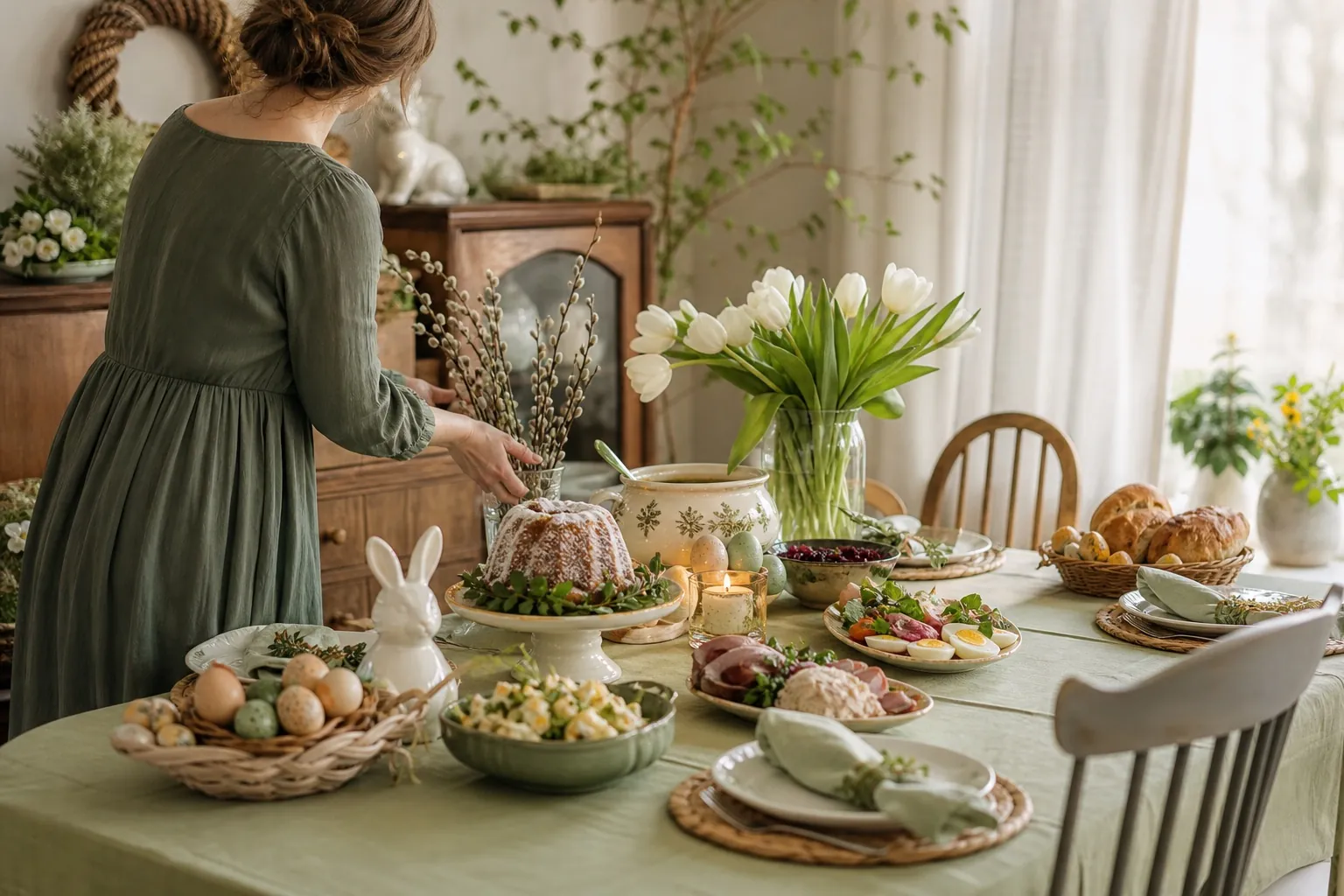
Easter preparation checklist: where do you start?
An Easter preparation checklist starts two weeks out with three decisions: how many guests, what you will serve and who does what. Then spread the work across Holy Week: cleaning early in the week, cakes on Thursday, cooking on Friday, the blessed basket and the table on Saturday. On Sunday morning you only heat things up.
This plan follows the Polish custom, where the main Easter meal is breakfast on Easter Sunday. It covers jobs, not food. For what to buy and how much, see the Easter shopping list for six.
Decide on guests and breakfast time
Confirm who is coming for breakfast, who only for lunch, and whether anyone is staying the night. Ask about allergies and whether anyone does not eat meat.
Set the breakfast time before you plan anything else. It tells you when to get up on Sunday and what must be ready by Saturday evening.
Fix the menu and who brings what
Write down the breakfast and lunch dishes and mark each one: you make it, you order it, or a guest brings it. One dish from each family can save you a whole day of cooking.
Next to a guest's dish, add their arrival time. A cheesecake arriving at 11am will not help a 9am breakfast.
Share out the jobs
List the jobs that are not cooking and hand them out straight away, so Saturday does not land on one person:
- shopping and collecting orders from the butcher or bakery,
- cleaning the kitchen, bathroom and guest room,
- dyeing eggs with the children,
- taking the basket to church to be blessed,
- laying the table and washing up after breakfast.
What to do two weeks before Easter
Two weeks before, deal with anything that needs an order or a decision. The list assumes about six guests:
- confirm the guest list and the menu,
- order meat, cold cuts or cakes if you are not making them,
- buy long-life food: flour, sugar, dried fruit, mayonnaise, horseradish, spices,
- check the tablecloth, napkins, plates, cutlery and number of chairs,
- work out where guests will sleep and whether you have bedding,
- buy egg dye and a basket if last year's has seen better days.
At this stage one shared task list for the whole household is enough. Everyone sees what is done, and nobody rings the butcher twice.
What to do from Palm Sunday to Wednesday of Holy Week
From Palm Sunday to Wednesday you have time for shopping and cleaning before the kitchen gets busy. In Poland, Palm Sunday is a trading Sunday, so it works well for the big shop.
- Sunday: the big shop, dairy, root vegetables, potatoes,
- Monday: start a homemade sour rye starter for the soup, as it needs a few days,
- Monday or Tuesday: sow cress on a saucer or in a small pot,
- Tuesday: clean the fridge and clear space for cakes and meat,
- Tuesday to Wednesday: clean the kitchen, bathroom and guest room,
- Wednesday: wash and iron the tablecloth, get the napkins ready.
You do not have to wash every window before Easter. Do the ones you can see from the table and leave the rest for a warm day afterwards.
MRPiPS (gov.pl): Handel w niedziele, pytania i odpowiedziWhat to do on Maundy Thursday
Maundy Thursday is the day for cakes, because cheesecake and mazurek, a flat Polish Easter tart, taste better after a day or two in the fridge. The oven is free, and on Friday the meat will need it.
A Thursday plan for six:
- In the morning, bake the tart base and make the cheesecake filling while it cools.
- Bake the cheesecake and let it cool in the oven with the door ajar.
- Collect the meat and white sausage and put them straight on the bottom shelf of the fridge.
- In the evening, rub the pork loin with garlic and marjoram and put it back in the fridge.
- Make the beetroot and horseradish relish, or move a shop-bought one into a lidded bowl.
If you go to church on Thursday evening, time the baking so the cheesecake cools while you are out.
What to do on Good Friday
On Good Friday, cook whatever keeps for a day in the fridge: salad vegetables, eggs and the roast pork. Chill hard-boiled eggs within two hours and eat them within a week, which makes Friday the earliest sensible day to boil them.
- boil the potatoes, carrots, parsley root and celeriac for the salad in their skins and chill them unpeeled,
- hard-boil eggs for the salad, the filling, the soup and the basket,
- dye the basket eggs with food-safe colours and put them in the fridge,
- roast the pork, cool it and wrap it tightly,
- buy cold cuts, radishes, chives and apples.
Dyeing a dozen or so eggs with children takes about an hour (our estimate) and rounds off a day of cooking nicely.
USDA FSIS: Shell Eggs from Farm to TableUSDA FSIS: Leftovers and Food SafetyFoodSafety.gov: Cold Food Storage ChartWhat to do on Holy Saturday
Holy Saturday has three parts: shopping in the morning, the food blessing during the day and breakfast prep in the evening. Polish shops may only trade until 2pm, so shop first.
Morning: last shopping before 2pm
Buy bread and whatever ran out on Friday. Trading in shops is banned after 2pm, and on Easter Sunday most shops are closed. Check your shop's hours for Monday.
Go as soon as the shop opens, with the list on your phone. Queues grow by the hour on the Saturday before Easter.
Daytime: the basket and the food blessing
Święconka is the Polish custom of taking a small basket of Easter food to church on Holy Saturday to be blessed. Check the blessing times on your parish website or in Sunday's notices, and pack the basket just before you leave, with eggs straight from the fridge.
What goes in the basket and what each item means is covered in our guide to what to put in a Polish Easter basket. When you get home, put the eggs and cold cuts back in the fridge.
Evening: salad, stock and the table
Peel and dice the vegetables, make the vegetable salad and the devilled eggs, and leave the mayonnaise for the salad until Sunday morning. Cook the soup stock so that in the morning you only add the starter and sausage.
Finally, lay the table without the food. In the morning you just bring out the dishes.
How to lay the Easter table
Lay the table on Saturday evening and add only food and fresh garnishes on Sunday. Six people fit at a table about 1.6 m long (our estimate, allowing about 50 cm each along the sides), but put the cakes on a sideboard rather than the table.
Tablecloth and place settings
White or pale tablecloths are the usual choice, though descriptions of Polish tradition also mention blue and cream ones with embroidery. At each place set a dinner plate, a small plate for the egg, cutlery, a glass and a napkin.
Add small bowls for horseradish and beetroot relish, and one for eggshells. Keep the soup bowls in the kitchen so they do not take up room.
The basket, the lamb and greenery
According to a description of the tradition on Opoka, the basket of decorated eggs and a figure of a lamb stood in the middle of the table, and the lamb symbolises Christ's victory over death. A sugar or chocolate lamb on a bed of cress sits well beside the basket.
Sprigs of box or lingonberry add green without taking plate space. Keep candles away from children and napkins.
In what order should you serve?
From the start the table holds the blessed basket, cold cuts, pâté, devilled eggs, salad, beetroot relish, horseradish and bread. Serve the soup hot after the egg sharing, and the cakes with coffee once the breakfast plates are back in the kitchen.
What to do on Easter Sunday morning
On Sunday morning, finish only what has to be fresh. The list assumes breakfast for six:
- add the starter and white sausage to the stock and simmer the soup,
- stir the mayonnaise into the salad and put it in a serving bowl,
- slice the cold cuts, the cold pork and the bread,
- peel the eggs for the soup,
- take food out of the fridge only when guests sit down,
- get coffee and tea ready for later,
- keep fifteen minutes for yourself to get changed.
Dishes with mayonnaise, eggs and meat should not stand at room temperature for more than two hours. After breakfast, put them back in the fridge before you sit down to coffee.
USDA FSIS: Leftovers and Food SafetyFinal checklist before Easter breakfast
Five minutes before guests arrive, run through this short list. You can tick off each point at a glance:
- the blessed basket is in the middle of the table,
- the soup is ready or warming on a low heat,
- cold dishes are waiting in the fridge,
- there is room in the hall for coats and shoes,
- there is a clean towel in the bathroom,
- leftover containers are within reach,
- everyone knows who serves the soup and who washes up.
The whole plan is available as a ready Easter preparation checklist with jobs grouped by day. Save it in BuyNest, share it with your household, set reminders for the orders and tick jobs off as you go. For more holiday lists, browse lists for occasions.
Easter preparation plan for Holy Week
- Two weeks before
- Confirm guest numbers and breakfast time
- Write the menu and who brings what
- Split the jobs within the household
- Buy the long-life food
- Check tablecloth, plates and chairs
- Order meat, cold cuts or cakes
- Palm Sunday to Wednesday
- Big shop on Palm Sunday
- Start homemade sour rye starter
- Sow the cress
- Clean the fridge and make space
- Clean kitchen, bathroom, guest room
- Wash and iron the tablecloth
- Maundy Thursday
- Bake the cheesecake and tart
- Collect the meat order
- Marinate the pork loin
- Make the beetroot relish
- Good Friday
- Boil the salad vegetables
- Boil and dye the eggs
- Roast the pork loin
- Buy cold cuts and greens
- Holy Saturday
- Buy bread before 2pm
- Check blessing times at the parish
- Pack the Easter basket
- Make the salad and devilled eggs
- Cook the soup stock
- Lay the table
- Easter Sunday morning
- Finish the soup with white sausage
- Slice the cold cuts and bread
- Put the blessed basket on the table
- Take food out of the fridge just before
- Get leftover containers ready
Frequently asked questions
How early should you start preparing for Easter?
Two weeks is enough. That gives you time to fix guests and menu, order the meat and buy long-life food, and all the kitchen work fits into Holy Week. For a smaller breakfast for four, one week will do.
When should you dye Easter eggs?
Friday evening or Saturday morning works best. Hard-boiled eggs must be eaten within a week, and between dyeing and eating they go back in the fridge. Use food-safe dyes for any eggs you plan to eat.
Can you make Polish vegetable salad the day before?
Yes: boil the vegetables on Friday and dice them on Saturday. Add the mayonnaise on Sunday morning so the salad does not go watery. Keep it in the fridge and put it out only while you eat.
What if something runs out after 2pm on Holy Saturday?
Most Polish shops will stay closed until Tuesday. Petrol stations and some bakeries, among others, may open, so bread and small items are usually still possible. That is why you check the list once more on Saturday morning before you go out.
How is this plan different from the Easter shopping list?
The plan tells you what to do on which day, and the shopping list what to buy and how much. Use both: the shopping list in the shop, the checklist at home.
Your Easter preparation checklist works best when you save it on your phone today and hand out the jobs straight away. Everyone ticks off their part, and on Saturday evening all that is left is laying the table.
Open the ready list in BuyNestSources
Take the shopping into BuyNest
BuyNest is on iPhone and Android. The app has no ads, including on the free plan.