
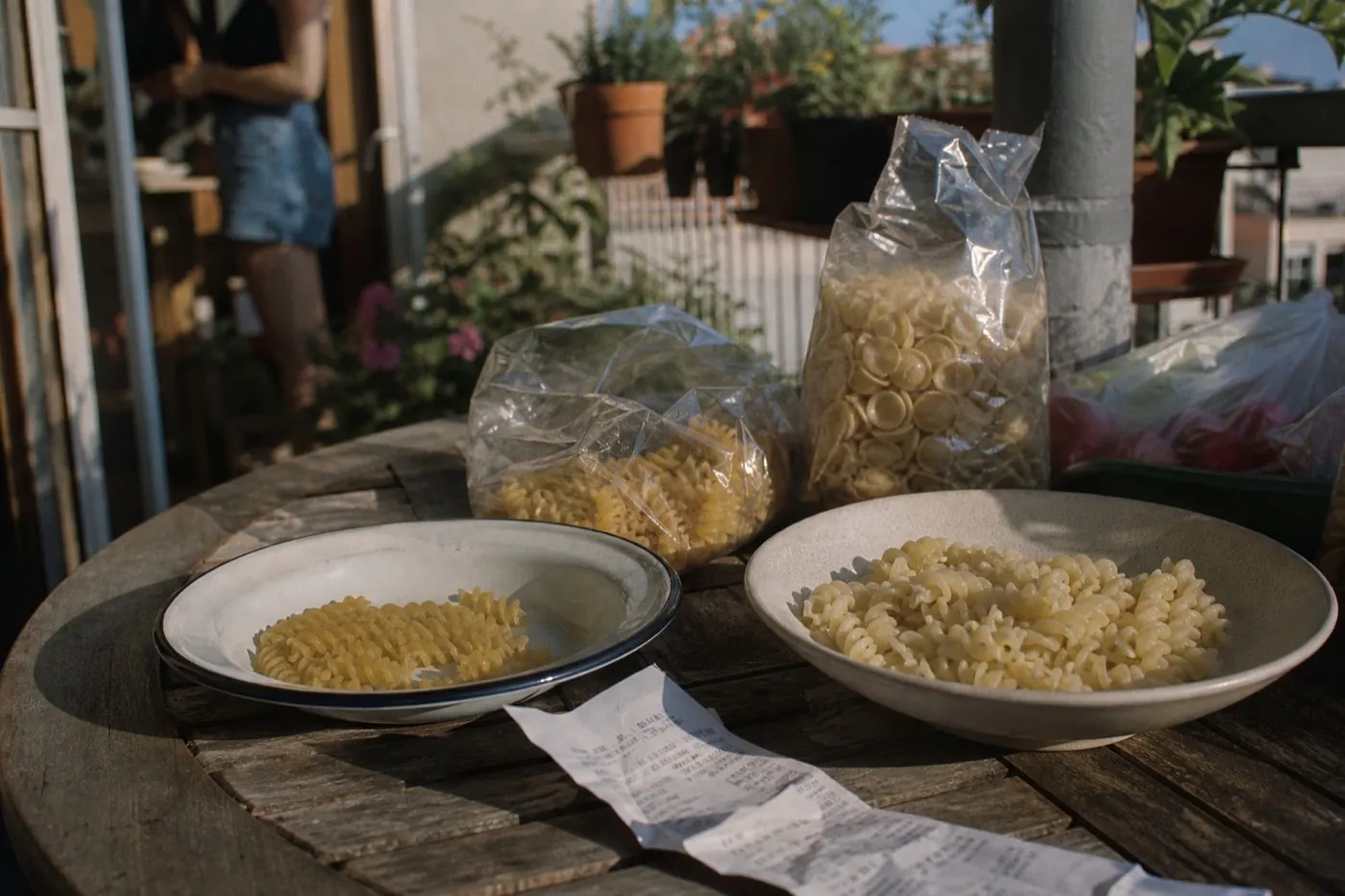
Cost per portion of dried and ready-made food: how do you compare fairly?
You can compare the cost per portion of dried and ready-made food fairly only when you convert both to the same weight of cooked food on the plate. You need the pack price, the weight you will actually eat and the yield of the dried product once cooked. The first two are on the label, and the third you can weigh.
The price per kilogram of dried lentils and the price per kilogram of tinned lentils describe different things. Dried seeds absorb water as they cook and their weight grows several times. A tin already contains that water, and the seeds also sit in liquid.
How do we calculate it, and where do the example numbers come from?
The method: we work out the cost of a portion from the dry weight and the drained weight, with a yield measured in your own kitchen. The rules behind the label information are Regulation (EU) No 1169/2011, and for unit prices Directive 98/6/EC.
The prices and the yield factor in the examples are invented. They do not come from a shelf, and the yield of 2.5 is a value assumed for the calculation, not a laboratory measurement. The period hardly matters because you are costing one portion, but shop prices move, so repeat the sum whenever prices change noticeably.
The sum leaves out cooking energy and time. Those depend on your tariff and your appliances, so we deal with them separately, without made-up amounts.
Rozporządzenie (UE) nr 1169/2011 w sprawie przekazywania informacji na temat żywnościDyrektywa 98/6/WE w sprawie ochrony konsumenta przez podawanie cen produktówWhat does the label say: net weight, drained weight, values as prepared?
For products in liquid, such as tinned pulses, Regulation (EU) No 1169/2011 (Annex IX, point 5) requires the drained net weight to be shown as well. A 400 g tin may therefore carry a second, smaller number telling you how much is seeds alone. If you pour the liquid away, count the price against that number.
Nutrition values are normally given for the product as sold. The regulation (Article 31(3)) allows them to be given for the product after preparation, provided the pack carries sufficiently detailed preparation instructions. So check whether the table on dried grains refers to 100 g dry or 100 g cooked. It matters when you compare protein or calories per portion.
Recipes usually give a dry weight, for example 80 g of lentils per person. If you swap dried for tinned, you must convert that amount to a cooked weight.
Rozporządzenie (UE) nr 1169/2011 w sprawie przekazywania informacji na temat żywnościHow do you work out the cost of a portion step by step?
The sum has five simple steps and works for lentils, rice, grains, pasta or chickpeas. Do it once for the products you buy most often and keep the result in a note.
- Decide on a target portion of cooked food, for example 200 g after cooking.
- Weigh the dried product before cooking and the cooked product after. Divide the cooked weight by the dry weight. That is the yield.
- Work out how much dried product a portion needs: portion weight ÷ yield.
- For the dried product, multiply that weight by the price per gram. For a ready-made tin or pouch, take the price per gram of drained weight or the price per portion on the label.
- Compare the two results, then note separately what the sum leaves out: electricity, gas, time.
A way to use it: you want a 200 g portion of cooked grain, and the grain’s yield is 3. You need about 67 g dry. If a kilogram of dry grain costs an invented £1.20, the portion costs about £0.08. The same method works for any product that changes weight as it cooks.
Note the result once and come back to it when the price changes. You then swap a single number in the sum instead of starting from scratch.
What does a portion of lentils and rice cost at invented prices?
Every number in the table is an example, not a real price or a laboratory measurement. The yield of 2.5 is a value assumed for the sum. Weigh your own lentils before and after cooking to find yours.
| Product | Pack details | Price per kilogram, ready to eat | Cost of a portion |
|---|---|---|---|
| Dried lentils | 500 g for £1.80 | £1.44 (from 1.25 kg cooked) | £0.29 for 200 g, from 80 g dry |
| Tinned lentils | 400 g net, 240 g drained, £1.00 | £4.17 (1.00 ÷ 0.24) | £0.83 for 200 g |
| Dried rice | 1 kg for £1.60 | we count from dry weight here | £0.12 for 75 g dry |
| Rice in a pouch | one portion for £1.25 | portion price from the label | £1.25 per portion |
In this example a portion of tinned lentils costs nearly three times as much as one from dried, and the rice pouch costs about £1.13 more than dried rice. The pouch, though, is ready in minutes.
At invented prices the gaps look clear. In the shop, put in your own numbers. The proportions may differ, especially with promotions and different tin sizes. We cover promotion maths in the guide to multibuy offers.
How do you measure the yield of a dried product in your own kitchen?
Yield depends on the variety, soaking and cooking time, so a figure from the internet may differ from yours. Fortunately a measurement takes one cooking session and very little equipment.
- Weigh a set amount of the dried product, for example 100 g, and write down the exact weight.
- Cook it as you normally would and drain off any excess water.
- Weigh the cooked product. Divide its weight by the dry weight: that is your yield.
- Note the result with the variety and the cooking method, because white and brown rice will give different numbers.
- Repeat the measurement next time you cook, to rule out a chance error.
For tinned products it is enough to weigh the seeds after draining and compare with the figure on the label. If in doubt, trust your own scales.
What does the cost per portion leave out?
The portion price shows the cost of the food, not of the whole meal. Four things worth noting beside the result before you decide that dried always wins.
- Cooking energy. Beans and chickpeas from dried need soaking and long cooking, while red lentils cook quickly. The cost of gas or electricity depends on your tariff and appliances. We do not add a made-up amount, so use the rate from your own bill.
- Time and planning. A ready-made product is quick and needs no remembering to soak the night before. For many people that is real value you cannot see in pounds.
- Leftovers. Cooking from dried makes it easy to make too much. Cooked pulses and grains can be portioned and frozen, but if the surplus goes in the bin, the cost per portion rises. An opened tin that is not finished also pushes up the price of what you eat.
- Ingredients. Ready-made products may contain salt or other additions. The ingredients list shows whether you are comparing like with like.
When is dried the better buy, and when ready-made?
There is no single answer, because your week, your kitchen and your cupboard space count too. The sum gives a simple rule: dried is cheaper per portion when you cook a larger batch and use all of it, and ready-made makes sense when time matters or you cook for one.
Four questions help you pick the version for your basket.
A mixed stock often works best: dried pulses and grains for days when you have time to cook, and a few tins or pouches for quick dinners. That way you do not give up convenience, and you do not pay for it every day.
If you are comparing several packs of the same product, begin with the price per kilogram and only then convert it into a portion.
- You cook for several people. Dried food is cheaper per portion and easy to cook for a few days.
- You have storage space. Dried seeds and grains keep for a long time in a sealed container, while tins take up cupboard space.
- You are short of time. A ready-made product cuts dinner prep to minutes, which can be worth the extra.
- You cook for one. An opened tin may be too big, but portions of a dried product can be frozen.
How do you use this in BuyNest?
On your shopping list, enter dried products in grams and ready-made ones in items, with a note of the drained weight. Then on your next shop you compare portions, not packs. In the note on a dried product, record the yield you measured.
A list for your own dried versus ready-made test lets you run the experiment: buy a few products in both forms, weigh the portions and note the prices. After a week you know what a portion costs in your kitchen.
Save the mixed stock as a template so you can top it up every month in one go. A shared list stops housemates buying the same grains twice.
Dried and ready: a portion test
- Pulses
- Red lentils dried500 g
- Tinned lentils note drained weight1 pcs
- Dried chickpeas500 g
- Tinned chickpeas note drained weight2 pcs
- Dried white beans500 g
- Jarred white beans1 pcs
- Grains
- Rice1 kg
- Ready rice pouch2 pcs
- Buckwheat400 g
- Dried pasta500 g
- Fresh pasta chilled250 g
- For cooking
- Onions500 g
- Garlic1 pcs
- Chopped tomatoes 400 g tins2 pcs
Frequently asked questions
Is cooking from dried pulses always cheaper?
Usually per portion, but not always. At the invented prices in this guide a portion from dried lentils costs less than from a tin. Once you add energy, time and possible leftovers, the gap narrows.
What does drained weight on a tin mean?
It is the weight of the seeds without the liquid. Regulation (EU) No 1169/2011 requires it for products in liquid. If you pour the liquid away, count the price against that figure.
How do I find out how much dried rice or grain makes a portion?
Weigh the dried product before cooking and the cooked product after it, then divide the cooked weight by the dry weight. That is the yield you use in later sums. Treat any figure on the pack as a starting point.
Does the nutrition table refer to the dried or the cooked product?
Usually the dried product as sold, but the regulation allows values after preparation when the pack gives detailed instructions. Check the table heading before comparing protein or calories per portion.
Before you decide whether the cost per portion of dried versus ready-made food favours the tin, weigh your own portion and note the yield. Add the dried and ready-made versions to your BuyNest list so you can compare them in the shop. You work the sum out once and reuse it on later shops.
Open the ready list in BuyNestMethod and criteria
Method: compare dry weight, drained weight and the pack price. No electricity measurement and no shelf prices.
Sources
Take the shopping into BuyNest
BuyNest is on iPhone and Android. The app has no ads, including on the free plan.

