
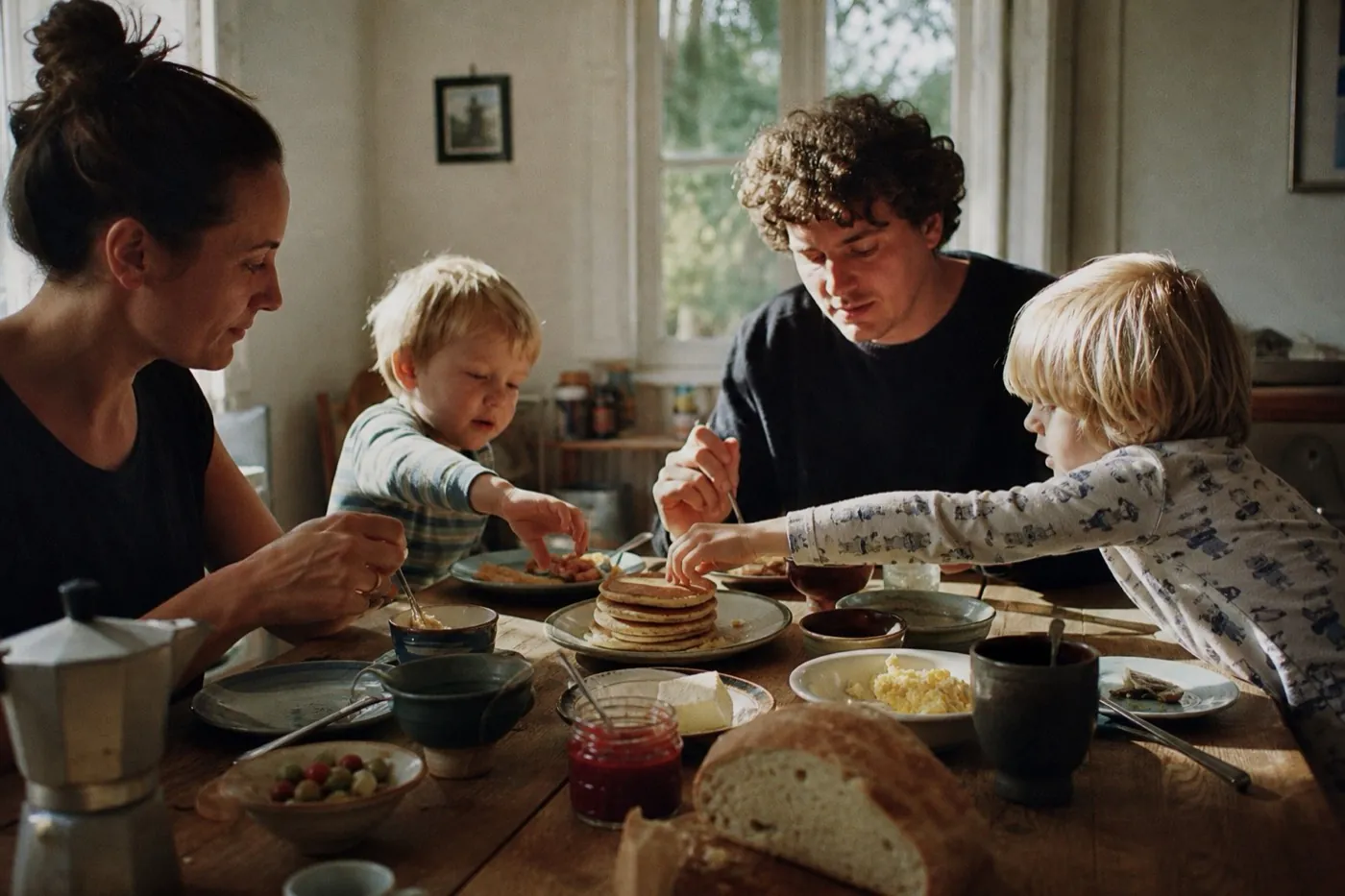
In BuyNest you can split these products by shop and tick them off with your household.
What goes on a weekend brunch shopping list for six people?
A weekend brunch shopping list for six people covers bread, 20 eggs, dairy, vegetables for shakshuka, fruit and ingredients for oat pancakes. In total that is about 28 items. Split the shopping between Friday and Saturday morning so the bread is fresh.
Quantities are for six people and two main dishes: shakshuka and oat pancakes with banana. Both recipes sit below, above the list. The amounts are our editorial estimate, based on typical portions in these recipes, so if you have more or fewer guests, scale the eggs, bread and milk up or down.
The rest of this guide answers the questions that come up just before shopping: who to ask what, what to buy early, what to leave until the last minute and how to avoid ending up with three packs of butter.
Shakshuka for six
Eggs cooked in a tomato and pepper sauce. The sauce can be made the evening before, so in the morning you only warm it and add the eggs.
Ingredients
- Rapeseed oil2 tbsp
- Onions2
- Red peppers2
- Garlic3 cloves
- Sweet paprika2 tsp
- Ground cumin1 tsp
- Chopped tomatoes 400 g each2 tin
- Eggs12
- Feta cheese150 g
- Flat-leaf parsley½ bunch
- Salt and pepper to taste
Method
- Slice the onions and peppers into strips. Fry them in the oil in a large, deep frying pan for about 10 minutes, until soft.
- Add the chopped garlic, paprika and cumin. Stir for a minute so the spices do not burn.
- Pour in the tomatoes and simmer gently for 10 minutes, until the sauce thickens. Season with salt and pepper. At this point you can cool the sauce and keep it in the fridge overnight.
- In the morning, reheat the sauce. Make 12 hollows with a spoon and crack an egg into each. If the pan is too small, split the sauce between two pans with six eggs each.
- Cover and cook over a low heat for 6–8 minutes, until the whites are set. Scatter over the crumbled feta and chopped parsley. Serve from the pan with bread.
Tip For a guest who avoids dairy, leave one corner of the pan without feta.
Oat and banana pancakes
About 18 small pancakes for the sweet side of the table. The batter is mixed in one bowl.
Ingredients
- Rolled oats150 g
- Plain flour100 g
- Baking powder2 tsp
- Bananas ripe2
- Eggs2
- Milk300 ml
- Rapeseed oil for frying1 tbsp
- Greek yoghurt, berries, honey to serve
Method
- Mash the bananas with a fork in a bowl until smooth. Add the eggs and milk and mix.
- Add the oats, flour, baking powder and a pinch of salt. Stir only until combined, then leave for 5 minutes so the oats soften a little.
- Heat a frying pan and brush it lightly with oil. Drop in large spoonfuls of batter and cook over a medium heat for about 2 minutes a side, until golden.
- Keep the cooked pancakes warm in an oven at 80°C (175°F) or under a clean tea towel while you fry the rest.
- Serve with yoghurt, berries and honey or syrup.
Tip You can make the pancakes with oat drink instead of milk. The taste is very close.
What should you ask your guests before you shop?
Two questions avoid most trouble: does anyone avoid certain foods, and what time do you usually eat breakfast. The first changes the whole list, the second changes the hour you shop. Ask a day or two ahead, not on Friday night.
It helps to collect answers in one place, such as a single message to everyone.
- allergies and intolerances: eggs, milk, gluten, nuts, sesame
- vegetarian or vegan guests: add a plant drink and something dairy-free
- breakfast time: if it is late, plan it as a brunch
- drinks: coffee, tea, juice, or someone who only drinks water
- children: whether they eat spicy food and like tomatoes in sauce
EU rules require that allergens and intolerance-causing ingredients are clearly highlighted in the ingredients list on food packaging. If a guest has an allergy, read labels even on products you buy every week, because makers sometimes change recipes.
Rozporządzenie (UE) nr 1169/2011 / Regulation (EU) No 1169/2011What should you buy on Friday and what on Saturday morning?
Splitting the shop in two saves nerves and money. On Friday you buy what keeps and what you need in the house just in case, and on Saturday morning the fresh bread and fruit. The table below shows what goes where.
| When | What to buy | Why then |
|---|---|---|
| Friday | eggs, butter, milk, yoghurt, feta | dairy keeps in the fridge, and on Saturday you skip the queue |
| Friday | tinned tomatoes, peppers, onion, garlic | the base of the shakshuka, and it survives two days |
| Friday | porridge oats, flour, baking powder, honey | dry ingredients for the pancakes, fine to buy ahead |
| Friday | coffee, tea, juice | drinks do not need to be fresh |
| Saturday morning | bread, rolls | bread is best on the day you buy it |
| Saturday morning | avocado, cherry tomatoes, cucumber, parsley, fruit | fresh produce looks best on the day you serve it |
If the flat is already full of guests on Friday and you have no time to shop, ask someone to bring fresh bread on Saturday. One request to one person beats a failed dash at six in the morning.
How do you scale the list for a different number of people?
The list is written for six, yet rarely do exactly six people sit down. The easiest approach is to scale the items that vanish first: bread, eggs, milk and fruit. The others, such as flour, honey or spices, will cover either version.
Hints for scaling by the number of guests:
- three or four people: halve the eggs, bread, milk, fruit and juice, and leave the rest
- eight to ten people: add a third more eggs, a second loaf and a second pack of coffee, and make the pancakes in two batches
- guests with children: add more fruit, yoghurt and juice, and less pepper and spicy extras
- guests after a party or a journey: add more bread and drinks, because hunger is often bigger than you expect
Do not treat these proportions as a rule. They are hints that we give as an editorial estimate. The best test is your own past gatherings: if half a loaf always comes back, buy a smaller one.
What should you check at home and leave off the list?
Before you print the list or open it on your phone, look in the cupboards. The last group on the list is called Check your cupboard, with sweet paprika, cumin and oil, because these usually already sit in the kitchen. Buy only what is truly missing.
Below are the things that often sit at home yet still end up as a second packet in the basket.
- spices for the shakshuka: sweet paprika, cumin, salt and pepper
- oil or olive oil for frying
- flour and baking powder: check the date
- butter or spread already in the fridge
- coffee and tea if you drink them every day
Two minutes at the cupboard usually means a smaller bill and less to carry out afterwards.
What should you add for vegan guests, children and people avoiding gluten?
A shared table looks best when everyone finds something they can eat. You do not need separate dishes, just a few extras that suit all. It helps if you spoke to your guests earlier, because then you buy exactly what is needed.
A few simple solutions that work well at a shared breakfast:
- oat drink and hummus or avocado for people who avoid dairy and eggs
- fruit, yoghurt and porridge oats for children who dislike spicy dishes
- gluten-free bread from its own shelf, served on a separate plate, if someone has coeliac disease
- juice and water with lemon for those who do not drink coffee or tea
With coeliac disease or a severe allergy, ask the guest how they want the meal prepared rather than guessing. Separate boards and spoons are often more important than the product itself.
How do you serve brunch without being tied to the hob?
Shakshuka and pancakes can both be started early and finished in front of your guests. You can make the tomato sauce on Friday evening and reheat it on Saturday, and mix the dry pancake ingredients in the morning. That way you stand at the hob for a quarter of an hour, not an hour.
A Saturday morning running order might look like this:
- Take the eggs, butter and yoghurt out of the fridge half an hour before eating.
- Warm the tomato and pepper sauce and add the eggs for the last few minutes.
- Fry the pancakes in batches in a second pan and keep them covered.
- Slice the bread, cucumber, cherry tomatoes and avocado, and tip the fruit into a bowl.
- Put out coffee, tea, juice and water so guests can help themselves.
When someone asks how they can help, hand them a board and a knife. Chopping vegetables is the best job you can delegate.
How do you keep one list for several people in BuyNest?
A shared breakfast is an ideal time to share the shopping. Save the ready list for a shared breakfast and share it with whoever is buying the bread on Saturday. Everyone sees what is already in the basket, and nobody buys a second yoghurt.
Assign bread and fruit to the bakery or market, and the rest to the supermarket. If there are two of you shopping, split by group: vegetables for them, dairy for you. Ticked items appear for both of you at once.
After the weekend, keep the list as a template. Next time friends visit you only change the number of people.
What should you do with the leftovers?
Leftovers from the weekend table should go into the fridge within two hours. The US cold food storage chart says raw eggs in their shells keep for 3 to 5 weeks in the fridge, hard-cooked eggs for about a week, and cooked leftovers three to four days. Tomato and egg sauce is best eaten the next day.
Fruit and yoghurt left over? Blend them with a banana for a smoothie. Pancakes nobody ate can be frozen in a single layer and taken out for a quick breakfast during the week. More ideas for the following mornings are in the guide to five days of home breakfasts.
FoodSafety.gov: Cold Food Storage ChartUSDA FSIS: Leftovers and Food SafetyWhat if your guests are staying longer?
When breakfast is part of a whole weekend, add supper, lunches and a second morning. A full two-day meal plan is in the guide to a weekend with guests, and the list of things for a sleepover is in the piece on groceries for overnight guests. Here we stay with a single meal.
Frequently asked questions
How many eggs should you buy for brunch for six people?
Our list has 20 eggs, enough for the shakshuka, the pancakes and a spare. The two recipes use 14 eggs (12 for the shakshuka, 2 for the pancakes) and the rest is spare. That is an editorial estimate, so for bigger appetites add another ten.
What if a guest does not eat eggs?
Make a second dish without eggs, such as oat pancakes with yoghurt and fruit. Buy a plant drink in place of milk if someone avoids dairy. Always read labels, because allergens are highlighted on them.
When is the best time to buy bread for a shared breakfast?
On Saturday morning, because bread and rolls are freshest then. Buy dairy, eggs and dry goods on Friday. If you are short of time, ask one guest to call at the bakery on the way.
Can you prepare brunch for guests the day before?
Partly. You can reheat the shakshuka sauce the next day and mix the dry pancake ingredients ahead. Add the eggs only when serving so they do not turn hard.
How do you split the cost of a shared breakfast?
The simplest way is for each person to bring one part, such as bread, fruit or drinks. Agree it on a shared shopping list so nobody buys the same thing. BuyNest has no cost splitting, so settle up your own way.
A weekend brunch shopping list works best when you know who buys what and on which day. Open the ready list in BuyNest, share it with your guests and cross off whatever is already in your cupboards.
Open the ready list in BuyNestSources
Take the shopping into BuyNest
BuyNest is on iPhone and Android. The app has no ads, including on the free plan.