How do you store leftovers after cooking dinner?
How to store leftovers: get them into the fridge within two hours of cooking, in shallow, covered containers, labelled with the date, in a fridge at 4°C or below. Anything you will not eat within 2–3 days goes into the freezer the same day.
Two hours is the limit the US Food and Drug Administration gives for any food that needs refrigeration. It covers leftovers and takeaway food too. On a hot day, with a room above 32°C, the limit drops to one hour.
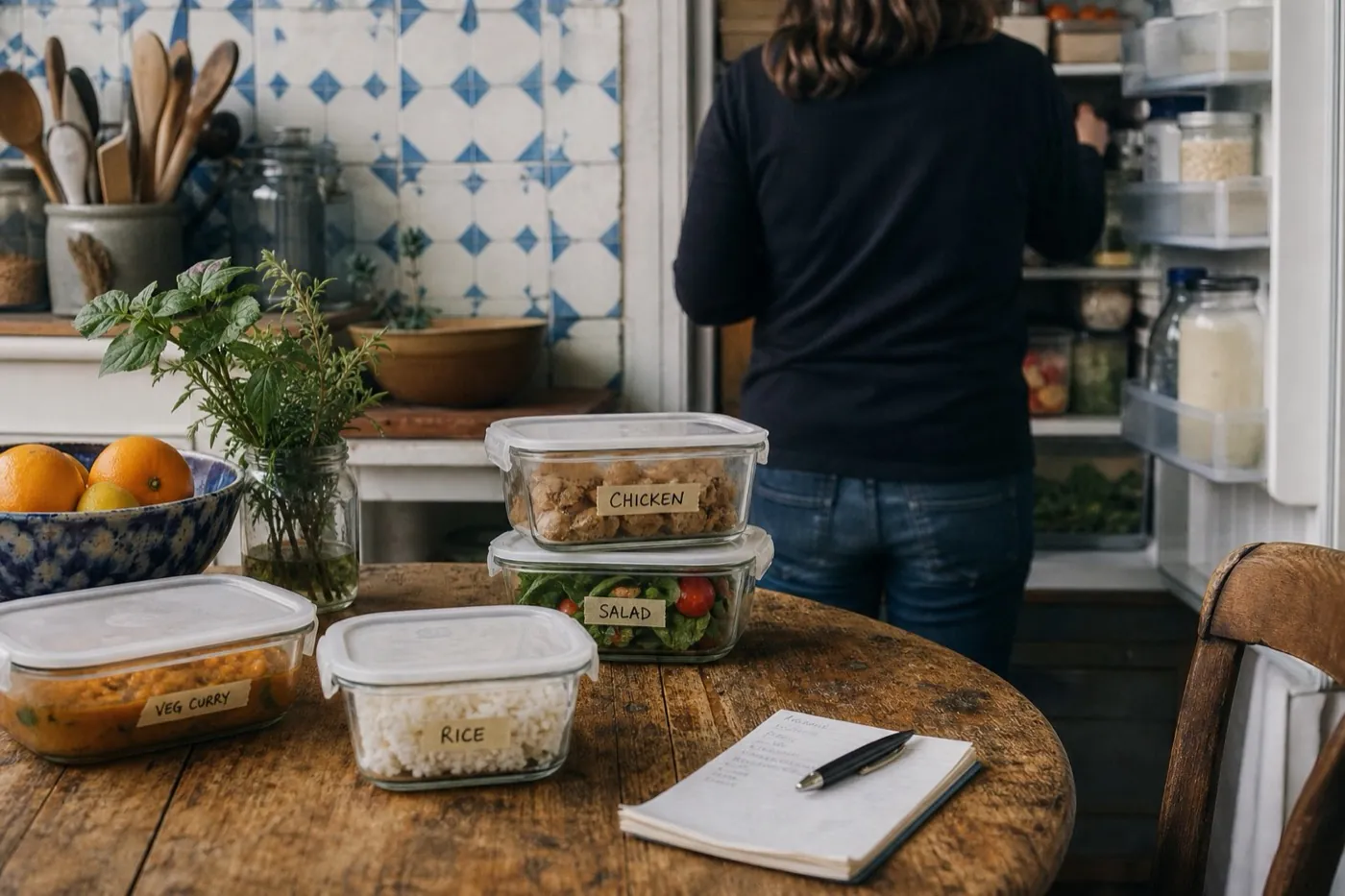
A good plan starts before you cook, not after the meal. If you know you will make too much, get containers and tape ready before you sit down. Then setting leftovers aside takes a few minutes, not half the evening.
FDA: Are You Storing Food Safely?Leftover fried rice
Cooked rice from the fridge, up to 3 to 4 days after cooking, plus leftover vegetables or meat. A quick dinner for two that clears the fridge boxes.
Ingredients
- Cooked rice from the fridge400 g
- Eggs2
- Frozen peas100 g
- Leftover vegetables or meat150 g
- Spring onions3
- Garlic1 cloves
- Grated ginger1 tsp
- Soy sauce2 tbsp
- Rapeseed oil2 tbsp
Method
- Break up the rice with your fingers so there are no clumps. Dice the leftover meat or vegetables and slice the spring onions.
- Heat a tablespoon of oil in a large frying pan or wok. Add the eggs, stir until set and tip onto a plate.
- Add the rest of the oil, then the white part of the spring onions, the garlic and ginger. Fry for 30 seconds.
- Add the rice, peas and leftovers. Fry on high heat for 5 to 6 minutes, stirring often, until everything is piping hot throughout. A thermometer in the middle of the pan should read at least 165°F (74°C).
- Stir in the eggs and soy sauce, scatter over the green spring onion and serve at once. Do not put this portion back in the fridge for another day.
What should you do with leftovers in the first two hours?
The first two hours decide everything that follows. Bacteria can multiply quickly while food sits warm, so it helps to have a routine you know like a recipe. Five steps are enough.
- Put aside the portions you want to keep before anyone goes back to the pot for seconds.
- Spoon the food into clean, shallow containers. Hot food can go in the fridge straight away as long as the containers are not overfilled.
- Leave the lids slightly open for a few minutes so steam does not condense on top, then close them.
- Write the dish and the cooking date on masking tape.
- Put them on a middle shelf and note which one you will eat first.
A shallow container cools faster than a deep pot because it has more surface for its volume. So split soup or stew between two flat boxes rather than putting the whole pot in the fridge. This is a kitchen tip, not a rule, but it shortens the cooling time.
Which containers suit dinner leftovers?
A container should be clean, tight-fitting and sized to the portion. The less air above the food, the less it dries out or picks up smells. The FDA recommends keeping food in the fridge in covered containers or sealed bags.
The table below shows what to use for what when you cook for two to four people. Sizes are approximate and based on typical boxes in shops, not on any regulation.
| Leftover | Container | Why |
|---|---|---|
| Soup, sauce, stew | shallow glass box, 0.8 litre | cools quickly and reheats well in the microwave |
| Rice, grains, pasta | lunch box, 0.5 litre | one-meal portion, easy to take to work |
| Meat in sauce, roast | freezer box, 1 litre | goes straight to the freezer if you will not eat it within days |
| Cooked or roasted vegetables | microwave-safe lidded box | you reheat without transferring |
Glass does not stain from tomato sauce or hold onions’ smell. Plastic is lighter and better in a work bag. A good set is a few containers in two sizes with matching lids.
How many days do dinner leftovers keep in the fridge?
Use a cautious editorial rule: eat leftovers within 2–3 days of cooking. That time is an editorial estimate, not a legal limit. It is more cautious than USDA FSIS, which gives 3–4 days in the fridge, and close to the UK Food Standards Agency, which advises eating leftovers within 48 hours or freezing them. If you will be out, or you are tired of the dish, freeze it at once.
The FDA advises checking leftovers daily and keeping the fridge at 4°C or lower. Risk rises over time, particularly with ready-to-eat food, where Listeria bacteria can grow, especially in a warmer fridge. A fridge thermometer costs little and beats guessing.
If a leftover is clearly off, throw it out. But no smell does not mean safe: the FDA reminds us that harmful bacteria need not change the look, smell or taste of food. That is why the date on the box counts and your nose does not.
When leftovers include items from opened packs, such as cream or part of a tin, respect the time the producer gives. Article 25 of EU Regulation 1169/2011 provides that a label may state a time limit after opening, and that takes priority over the general rule.
FDA: Are You Storing Food Safely?Rozporządzenie (UE) nr 1169/2011 / Regulation (EU) No 1169/2011, art. 24, 25 i zał. XUSDA FSIS: Leftovers and Food SafetyGOV.UK (FSA): How to chill, freeze and defrost food safelyWhen and how should you freeze leftovers?
Freeze on the day you cook if you will not eat the food in 2–3 days. The FDA recommends a freezer at −18°C and notes that quality declines with time, and USDA FSIS adds that continuously frozen food stays safe. Keep leftovers in tight containers to avoid drying out.
Freeze single-meal portions. A small portion freezes and thaws faster, and you are not left wondering what to do with half. Label each box with the name, the cooking date and the number of portions, and add a reheating note if useful.
- soups and sauces: freeze well, leave room for the liquid to expand
- stew and meat in sauce: flat portions in bags, thawed in the fridge
- rice and grains: freeze well in flat bags, use them quickly after thawing
- bread from dinner: slice and freeze by the slice, as in our guide to portioning and freezing bread
We have gathered the labelling basics in our guide to labelling freezer containers. That way, in a month you will not open five boxes to find the soup.
FDA: Are You Storing Food Safely?USDA FSIS: Freezing and Food SafetyHow do you reheat leftovers safely?
Reheat leftovers until they are hot all the way through, not only at the edges. Stir halfway, and in the microwave cover the container with a vented lid so the heat spreads evenly. According to USDA FSIS, leftovers should reach 74°C (165°F), and sauces and soups should be brought to a rolling boil. A kitchen thermometer will confirm that the middle of the portion is hot too.
Heat only what you will eat. Reheating and cooling the same portion again and again lowers quality and raises risk, because each time in the warm gives bacteria another chance. A leftover that has been reheated and not eaten should be thrown away or frozen at once, not left on the worktop.
Thaw frozen meals in the fridge, in the microwave or in cold water in a sealed bag, not on the worktop. Food thawed in the fridge can be kept briefly, but it is best eaten within a day.
USDA FSIS: Leftovers and Food SafetyGOV.UK (FSA): How to chill, freeze and defrost food safelyWhat should you avoid doing with leftovers?
A few habits recur in many homes and are worth dropping. The list below is about storage, not taste.
- leaving the pot on the hob until morning, especially on warm days
- putting a whole deep pot in the fridge without dividing it up
- keeping leftovers uncovered, which dries them and spreads smells
- guessing from memory when something was cooked instead of reading the date on the tape
- eating leftovers that stood in the warm for longer than two hours
When in doubt, throw it out. The FDA advises binning food that was not properly chilled if you are unsure. Losing a portion costs less than a bout of food poisoning.
FDA: Are You Storing Food Safely?How do you plan meals from leftovers for the next few days?
It works best to cook so that leftovers are part of the plan, not an accident. Monday’s rice becomes fried rice on Wednesday, roasted vegetables fill an omelette and a meat sauce is the base for pasta. A recipe for fried rice from leftovers is below, above the list.
The ready list for planning leftovers has containers in several sizes, tape for labels, a food thermometer, a microwave cover and the fried rice ingredients: eggs, frozen peas, spring onions, soy sauce, oil and ginger. Import it into BuyNest with the QR code.
When several people cook at home, a shared list shows everyone what is in the fridge to be used up. Add “Tuesday’s soup” and nobody buys a second dinner for that day. We take a similar approach to part-used tins in our guide to storing food from an opened tin.
Leftovers kit
- Containers
- Shallow glass container 0.8 l up to 5 cm deep4 pcs
- Lunch box 0.5 l one portion4 pcs
- Freezer box 1 l3 pcs
- Masking tape for labels1 pcs
- Equipment
- Food thermometer checks 165°F1 pcs
- Microwave cover1 pcs
- For fried rice
- Eggs6 pcs
- Frozen peas450 g
- Spring onions bunch1 pcs
- Soy sauce150 ml
- Rapeseed oil1 l
- Fresh ginger small piece1 pcs
Frequently asked questions
Can you put hot dinner straight in the fridge?
Yes, if you divide it into shallow containers and do not overload the fridge. Do not wait more than two hours, or one hour in hot weather. An overfull fridge holds its temperature less well, so do not cram in too much at once.
How long can you keep dinner leftovers in the fridge?
Be cautious and allow 2–3 days from cooking, then freeze what you will not eat. This is an editorial estimate, not a rule. If a product's label gives a time after opening, follow that.
Can you freeze leftovers?
Yes, ideally the same day, in tight single-meal portions. The FDA recommends a freezer at −18°C and says quality drops over time, and USDA FSIS says continuously frozen food stays safe. Label the box with the name and date.
Can you reheat leftovers more than once?
Reheat only what you will eat, and only once. Reheating and cooling the same portion repeatedly lowers quality and gives bacteria more chances. Throw away or freeze at once whatever is left after reheating.
How can you tell leftovers have gone off?
Not always by smell. The FDA reminds us that harmful bacteria need not change the look or taste of food. Go by the date on the container, and treat mould or an unpleasant smell as a sign to throw it out.
How to store leftovers comes down to cooling within two hours, a date on the box and the freezer for anything you will not eat in 2–3 days. Open the ready list in BuyNest and buy containers, tape and a thermometer so your next cook-ahead dinner goes without waste.
Open the ready list in BuyNestSources
Take the shopping into BuyNest
BuyNest is on iPhone and Android. The app has no ads, including on the free plan.