
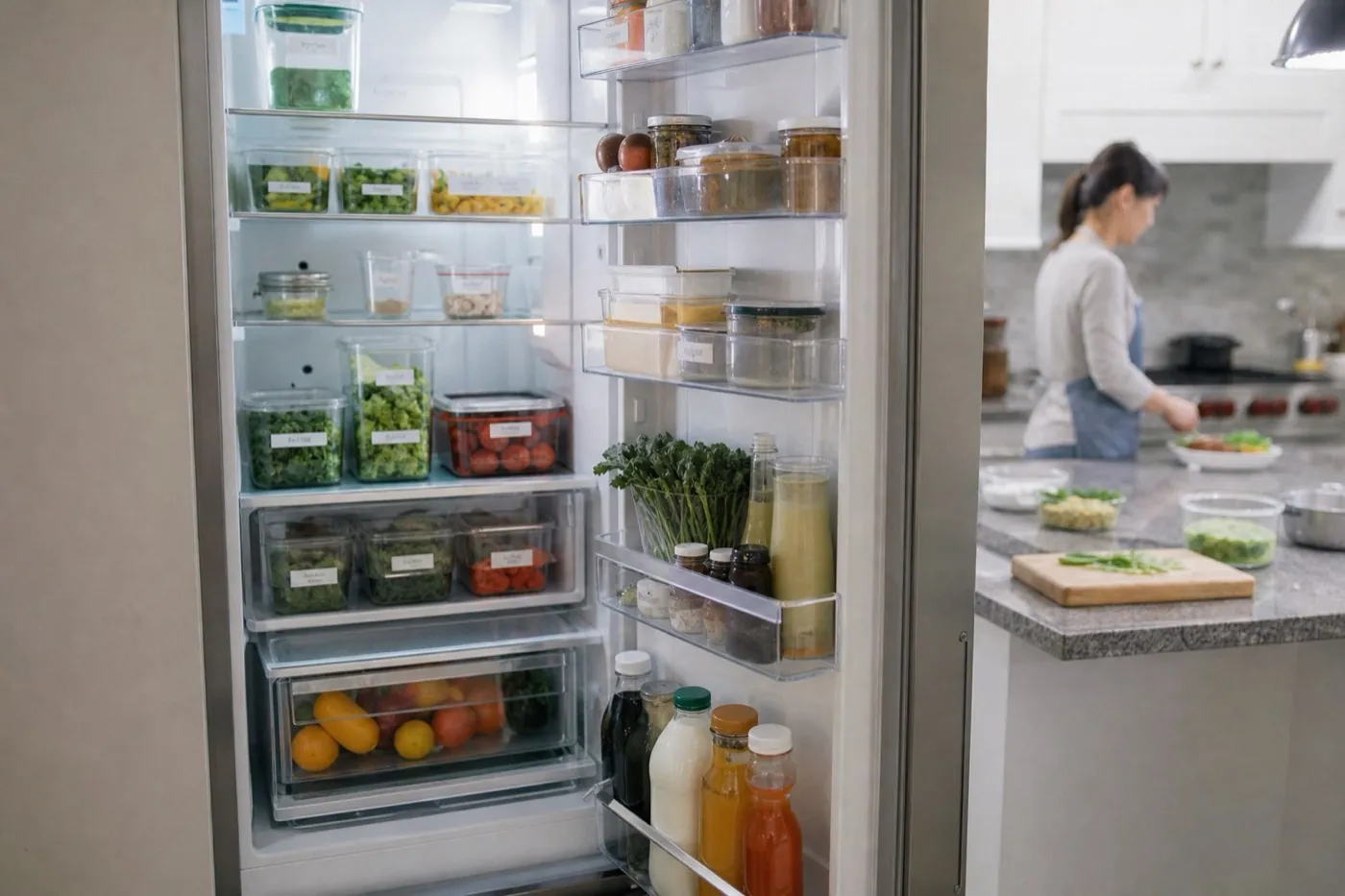
How should you organise a fridge so food stays safe?
To organise a fridge, put raw meat, poultry and fish in a sealed box on the bottom shelf, ready-to-eat food above it, dairy in the middle and only drinks and sauces in the door. The whole fridge should stay at 5°C or colder, because shelf order cannot fix a fridge that is too warm.
Below you will find a shelf plan, where to keep eggs and vegetables, how long things last and a weekly check. At the end is a list of boxes, thermometers and labels you can buy in one trip.
What temperature should a fridge be?
The UK Food Standards Agency (FSA) says a fridge should run between 0 and 5°C and a freezer at about −18°C. The US FDA gives 4°C or below. The numbers differ between national guidance, but the point is the same: keep it consistently cold.
The dial with numbers does not tell you the temperature inside. Both agencies advise buying a fridge thermometer, putting it where you can read it and checking it once a week.
If the thermometer reads above 5°C, move the dial one step colder and check again the next day at the same time. The fridge needs several hours to settle, so a reading right after the door has been open for ages will always be too high.
The second condition is airflow. The FDA advises against packing the fridge so tightly that cold air cannot move. After a big shop, move drinks and tins to the cupboard and keep in the fridge only what truly needs the cold.
Food Standards Agency / GOV.UK: How to chill, freeze and defrost food safelyFDA: Are You Storing Food Safely?What goes on which shelf?
Shelf order has one rule: things you cook sit lower than things you eat as they are. That way nothing from raw meat drips onto cheese or salad. The Polish public health centre NCEZ adds that raw foods such as meat and eggs should not stand right beside ready-to-eat foods like cold cuts, cheese and deli dishes.
The plan assumes a standard fridge with three or four shelves and a drawer. If yours is laid out differently, check the manufacturer's manual, because temperature zones vary by model.
| Place | What to put there | Why |
|---|---|---|
| Top shelf | leftovers in boxes, cold cuts, cheese, hummus, opened jars | ready to eat, nothing can drip on it |
| Middle shelf | milk, yoghurt, butter, curd cheese | dairy likes a steady temperature |
| Bottom shelf | raw meat, poultry and fish in a sealed box | coldest spot with no dripping risk |
| Salad drawer | vegetables and fruit | higher humidity |
| Door | drinks, sauces, mustard, ketchup | temperature swings most here |
Where should raw meat go in the fridge?
Keep raw meat, poultry and fish on the bottom shelf in their packaging or a clean sealed container. The FSA advises this so they cannot touch or drip onto other food. NCEZ says meat and fish need about 2°C, which means the coldest zone.
Set the meat tray inside a flat box with a lid. It is easy to wash afterwards, and any leak will not reach the other shelves. Once the meat is out, wash the box with soapy water and dry it.
How long can meat stay in the fridge?
Follow the "use by" date on the pack. The FSA is clear that you should not eat meat after its use-by date. If you know you will not manage it in time, freeze it in portions before the date runs out: the FSA says you can freeze up to midnight on the use-by date.
Cool cooked meat and put it in the fridge within one to two hours of cooking. Eat it within 48 hours or freeze it.
Food Standards Agency / GOV.UK: How to chill, freeze and defrost food safelyNCEZ (NIZP-PZH): Zakupy i przechowywanie produktów żywnościowychWhere do eggs, dairy and vegetables belong?
On eggs, the sources differ in detail. NCEZ puts eggs in the door compartment because they only need slight cooling. The FSA suggests keeping them apart from other foods, for example in the built-in egg tray. They agree on one thing: eggs stand away from ready-to-eat food.
NCEZ says dairy and cold cuts do best at 4–8°C, so the middle shelves suit them. Keep vegetables and fruit in the drawer, the warmer part of the fridge: NCEZ gives 9 to 10°C for them. Bread does not belong in the fridge: NCEZ says it keeps best in a cool, dry, dark place.
Do not store food in an open tin. The FSA advises moving the contents to a container, covering it and chilling it.
NCEZ (NIZP-PZH): Zakupy i przechowywanie produktów żywnościowychFood Standards Agency / GOV.UK: How to chill, freeze and defrost food safelyWhat should you do when you get home from the shop?
Put away meat, fish, dairy and frozen food first, and dry goods after. The FDA gives a two-hour rule: food that needs chilling should not sit at room temperature longer than that, and for less in hot weather. If the shop is far, take an insulated bag. NCEZ also advises carrying frozen food this way.
Put new items behind older ones so what needs eating first stays at the front. With one shelf for leftovers you can see at once how many boxes are waiting and whether tomorrow needs cooking.
FDA: Are You Storing Food Safely?NCEZ (NIZP-PZH): Zakupy i przechowywanie produktów żywnościowychHow do you do a weekly fridge check?
Once a week, ideally the day before a big shop, take everything off one shelf at a time and look it over. Throw out anything past its "use by" date and leftovers older than 48 hours, and wipe spills at once. The FDA recommends cleaning the fridge regularly because it limits bacterial growth.
Do not trust your nose. The FDA reminds us that food can make you ill while looking and smelling normal. Write the date on the box of leftovers rather than waiting for a smell. The manufacturer's label comes before any general table: if it says "use within two days of opening", that is the number.
FDA: Are You Storing Food Safely?Food Standards Agency / GOV.UK: How to chill, freeze and defrost food safelyHow do you organise a small fridge?
A small fridge follows the same order with fewer boxes. If you have one shelf for ready food and one for raw, keep the rule: raw below, ready above. Buy meat for a day or two and keep it in a flat box, and leave frozen food in the freezer.
With a small fridge it helps to shop more often and buy less. Decant big dairy packs into smaller boxes and move tins, drinks and jars to the cupboard. Free space between shelves is not waste: it is the airflow your fridge needs.
- Three glass boxes of the same size stack and take less room than mixed jars.
- Put door sauces in one caddy so they do not spill over the shelves.
- Keep loose vegetables in the drawer, not on a shelf, so they do not block the rest.
- Leave one shelf for dinner leftovers, with a date on each box.
How do you label boxes so nothing is wasted?
On a box of leftovers write the dish and the date it was cooked. Masking tape and a marker are cheap and peel off cleanly. The FSA advises eating leftovers within 48 hours or freezing them, so the date on the lid tells you at once how long you have.
Labels also help the rest of the household. Anyone taking a box out of the fridge reads the date instead of opening and sniffing it. In the app you can add "eat by Wednesday" to the shared task list and tick it off after dinner.
Food Standards Agency / GOV.UK: How to chill, freeze and defrost food safelyHow do you prepare the fridge for a big shop or the holidays?
Before a big shop, do the weekly check and empty one shelf. Throw out anything past its date and wipe the shelves. New shopping then goes into a clean fridge and nothing old gets hidden behind it.
With festive shopping, do not fill the fridge to the last centimetre, because air needs to circulate. Move drinks and root vegetables to a cool place outside the fridge, such as a pantry or a cold balcony. Check the thermometer afterwards, because an overfilled fridge can run warmer than an empty one.
What should you buy to keep a fridge organised?
The basic kit is a thermometer, a few lidded glass boxes in two sizes, a flat box for meat, zip-lock bags and labels with a marker. The ready fridge organising list has 12 items in four groups and fits one trip to a homeware shop.
If you do a weekly check, set a reminder in the app for the day before the shop. Add whatever is missing straight to the shared list and everyone at home sees it on their phone.
Fridge organising kit
- Equipment
- Fridge thermometer fridge and freezer2 pcs
- Flat box for raw meat lidded, about 2 l1 pcs
- Containers
- Glass lidded container 0.5 l for leftovers4 pcs
- Glass lidded container 1 l3 pcs
- Cheese box1 pcs
- Zip-lock bags 1 l1 pack
- Door caddy for sauces1 pcs
- Labelling
- Masking tape for labels1 pcs
- Permanent marker1 pcs
- Cleaning
- Microfibre cloths1 pack
- Washing-up liquid for washing shelves500 ml
- Kitchen roll for spills2 pcs
Frequently asked questions
What temperature should a fridge be?
The FSA gives 0 to 5°C and the FDA says 4°C or below. Whichever you follow, check with a thermometer, not the dial. Repeat the check once a week.
Should milk and eggs live in the fridge door?
Milk is happier on a middle shelf, because you open the door most often (our advice, not an official rule). NCEZ says eggs can sit in the door, while the FSA suggests keeping them apart from other foods. Check your fridge's manual.
How often should you clean the fridge?
The FDA recommends cleaning it regularly. A weekly check with a wipe of spills works, plus an occasional full wash of the shelves with warm soapy water.
Can you put hot food straight in the fridge?
No. The FSA advises cooling it at room temperature and putting it in the fridge within one to two hours. Split it into smaller portions so it cools faster.
Does bread belong in the fridge?
No. NCEZ recommends a cool, dry, dark place for bread. For longer storage, freeze it in portions.
Remember the simple pattern: ready food high, raw meat low and a thermometer on the shelf. If you want to organise a fridge without guesswork, open the ready list in BuyNest and buy the boxes you need. A weekly check takes five minutes.
Open the ready list in BuyNestSources
Take the shopping into BuyNest
BuyNest is on iPhone and Android. The app has no ads, including on the free plan.

